

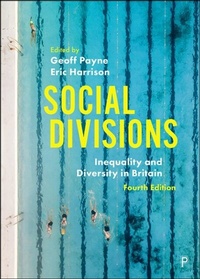
Social Divisions
Inequality and Diversity in Britain
4th Edition
Published on 22. April 2020
512 pages
978-1-4473-5513-7 (ISBN)
Description

Revised, restructured and updated to reflect the latest data and debates, this new edition of the widely used, classic textbook offers students an accessible account of the major social divisions that structure social life. Written by internationally known sociologists and experts, the book:
addresses a wide range of social divisions and inequalities in novel ways, with added chapters on education and age;
provides a framework for understanding contemporary social inequalities and diversities, and how they interrelate;
lends itself to teaching in a range of contexts with the potential to dip into particular chapters for different modules, or to use the book in a more extensive way for one particular module;
features signposting through the material, as well as key points, discussion questions and selected further readings for each chapter.
This clearly written volume presents a structured and critical guide to a core field that cuts across disciplines. It is an invaluable introduction and source book for students taking social inequalities and diversity modules in sociology, social policy, social work, education and health studies.
addresses a wide range of social divisions and inequalities in novel ways, with added chapters on education and age;
provides a framework for understanding contemporary social inequalities and diversities, and how they interrelate;
lends itself to teaching in a range of contexts with the potential to dip into particular chapters for different modules, or to use the book in a more extensive way for one particular module;
features signposting through the material, as well as key points, discussion questions and selected further readings for each chapter.
This clearly written volume presents a structured and critical guide to a core field that cuts across disciplines. It is an invaluable introduction and source book for students taking social inequalities and diversity modules in sociology, social policy, social work, education and health studies.
More details
Other editions
Additional editions
Book
04/2020
4th Edition
Policy Press
€50.00
Shipment within 15-20 days
E-Book
04/2020
4th Edition
Policy Press
€208.99
Available for download
Persons
Editor
Newcastle University
Geoff Payne is Research Associate in the School of Geography, Politics and Sociology at Newcastle University. A former President of the British Sociological Association, he has written and worked on social mobility, social inequalities, and social research methodology.
Geoff Payne is Research Associate in the School of Geography, Politics and Sociology at Newcastle University. A former President of the British Sociological Association, he has written and worked on social mobility, social inequalities, and social research methodology.
City, University of London
Eric Harrison is Senior Lecturer in Sociology in the School of Arts and Social Sciences at City, University of London, and Deputy Director of the European Social Survey. He has research interests in social stratification, social Inequality, wellbeing and survey methodology.
Eric Harrison is Senior Lecturer in Sociology in the School of Arts and Social Sciences at City, University of London, and Deputy Director of the European Social Survey. He has research interests in social stratification, social Inequality, wellbeing and survey methodology.
Contributions
Newcastle University
Clare Bambra is a Professor of Public Health at Newcastle University.
Clare Bambra is a Professor of Public Health at Newcastle University.
Faculty of Health & Social Care, University of the West of England
Elizabeth Frost is an Associate Professor at the University of the West of England, UK.
Elizabeth Frost is an Associate Professor at the University of the West of England, UK.
University of York
London School of Economics and Political Science
University of Cambridge and LSE
Diane Reay grew up in a working class, coal mining community before becoming an inner city, primary school teacher for 20 years. She is now emeritus Professor of Education at the University of Cambridge and visiting Professor of Sociology at the LSE with particular interests in social justice issues in education, and cultural analyses of social class, race and gender. She has researched extensively in the areas of social class, gender and ethnicity across primary, secondary and post-compulsory stages of education. with particular interests in social justice issues in education, and cultural analyses of social class, race and gender. She has researched extensively in the areas of social class, gender and ethnicity across primary, secondary and post-compulsory stages of education.
Diane Reay grew up in a working class, coal mining community before becoming an inner city, primary school teacher for 20 years. She is now emeritus Professor of Education at the University of Cambridge and visiting Professor of Sociology at the LSE with particular interests in social justice issues in education, and cultural analyses of social class, race and gender. She has researched extensively in the areas of social class, gender and ethnicity across primary, secondary and post-compulsory stages of education. with particular interests in social justice issues in education, and cultural analyses of social class, race and gender. She has researched extensively in the areas of social class, gender and ethnicity across primary, secondary and post-compulsory stages of education.
University of Warwick
School of Social Sciences, University of Teesside
Queensland University of Technology
Content
Acknowledgements
Introduction
Part 1 ~ The Persistence of Social Divisions
Defining and Explaining 'Social Divisions' ~ Geoff Payne
Class and Stratification ~ Eric Harrison and John Scott
Gender ~ Pamela Abbott
Race ~ John Solomos
Part 2 ~ Social Structures and Inequalities
Education ~ Diane Reay
Work ~ Tim Strangleman
Poverty ~ Lucinda Platt
Elites ~ Daniel Smith
Global Social Divisions ~ Robert Holton
Part 3 ~ Social Divisions and the Body
Sexuality ~ Sue Scott and Stevi Jackson
Age ~ Stephen Hunt and Liz Frost
Disability ~ Ruth Garbutt and David Saltiel
Health ~ Clare Bambra and Geoff Payne
Part 4 ~ Inclusion, Exclusion and Inequality
Social Identites ~ Steph Lawler
National Identity ~ David McCrone
Religion ~ Michael Rosie
Community ~ Graham Crow and Catherine Maclean
Social Divisions as a Sociological Perspective ~ Geoff Payne
Introduction
Part 1 ~ The Persistence of Social Divisions
Defining and Explaining 'Social Divisions' ~ Geoff Payne
Class and Stratification ~ Eric Harrison and John Scott
Gender ~ Pamela Abbott
Race ~ John Solomos
Part 2 ~ Social Structures and Inequalities
Education ~ Diane Reay
Work ~ Tim Strangleman
Poverty ~ Lucinda Platt
Elites ~ Daniel Smith
Global Social Divisions ~ Robert Holton
Part 3 ~ Social Divisions and the Body
Sexuality ~ Sue Scott and Stevi Jackson
Age ~ Stephen Hunt and Liz Frost
Disability ~ Ruth Garbutt and David Saltiel
Health ~ Clare Bambra and Geoff Payne
Part 4 ~ Inclusion, Exclusion and Inequality
Social Identites ~ Steph Lawler
National Identity ~ David McCrone
Religion ~ Michael Rosie
Community ~ Graham Crow and Catherine Maclean
Social Divisions as a Sociological Perspective ~ Geoff Payne
