

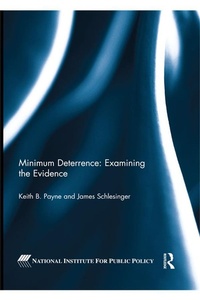
Minimum Deterrence: Examining the Evidence
1st Edition
Published on 14. April 2016
122 pages
978-1-317-67153-4 (ISBN)
Description

The National Institute for Public Policy's new book, Minimum Deterrence: Examining the Evidence, is the first of its kind. Dr. Keith Payne, former Secretary of Defense James Schlesinger and an unparalleled bipartisan group of senior civilian and military experts critically examine eight basic assumptions of Minimum Deterrence against available evidence. In general, Minimum Deterrence does not fare well under the careful scrutiny.
Proponents of a "Minimum Deterrent" US nuclear force posture believe that anywhere from a handful to a few hundred nuclear weapons are adequate to deter reliably and predictably any enemy from attacking the United States now and in the future. Because nuclear weapons are so destructive, their thinking goes, no foreign leader would dare challenge US capabilities. The benefits, advocates claim, of reducing US nuclear weapons to the "minimum" level needed are: better relations with Russia and China, reinforcement of the arms control and Nonproliferation Treaty, billions of defense dollars in savings, and greater international stability on the way to "nuclear zero."
As political pressure builds to pursue this vision of minimum US deterrence, Minimum Deterrence: Examining the Evidence stands as the seminal study to address the many claims of great benefit using available evidence.
This book was published as a special issue of Comparative Strategy.
Proponents of a "Minimum Deterrent" US nuclear force posture believe that anywhere from a handful to a few hundred nuclear weapons are adequate to deter reliably and predictably any enemy from attacking the United States now and in the future. Because nuclear weapons are so destructive, their thinking goes, no foreign leader would dare challenge US capabilities. The benefits, advocates claim, of reducing US nuclear weapons to the "minimum" level needed are: better relations with Russia and China, reinforcement of the arms control and Nonproliferation Treaty, billions of defense dollars in savings, and greater international stability on the way to "nuclear zero."
As political pressure builds to pursue this vision of minimum US deterrence, Minimum Deterrence: Examining the Evidence stands as the seminal study to address the many claims of great benefit using available evidence.
This book was published as a special issue of Comparative Strategy.
Reviews / Votes
"Schlesinger and Payne critically evaluate eight key assumptions underlying the strategy of minimum nuclear deterrence. They conclude that the diplomatic benefits of reducing the United States' weapons store to the lowest level 'required' are outweighed by the risk of attack if the perceived threat of US nuclear retaliation is reduced." - Lanxin Xiang, (2014)More details
Edition
1. Auflage
Language
English
Place of publication
London
United Kingdom
Publishing group
Taylor & Francis Ltd
Target group
College/higher education
Product notice
Reflowable
ISBN-13
978-1-317-67153-4 (9781317671534)
Copyright in bibliographic data and cover images is held by Nielsen Book Services Limited or by the publishers or by their respective licensors: all rights reserved.
Schweitzer Classification
Other editions
Additional editions
Keith B. Payne | James Schlesinger
Minimum Deterrence: Examining the Evidence
Book
12/2020
1st Edition
Routledge
€51.98
Shipment within 15-20 days
Keith B. Payne | James Schlesinger
Minimum Deterrence: Examining the Evidence
Book
11/2014
1st Edition
Routledge
€215.41
Shipment within 10-20 days
Persons
Keith B. Payne, Study Director; President, National Institute for Public Policy; Department Head, graduate school of Defense and Strategic Studies, Missouri State University (Washington, DC campus)
The Honorable James Schlesinger, Chairman, Senior Review Group, former Secretary of Defense; Secretary of Energy; Director of Central Intelligence; Chairman of the United States Atomic Energy Commission
The Honorable James Schlesinger, Chairman, Senior Review Group, former Secretary of Defense; Secretary of Energy; Director of Central Intelligence; Chairman of the United States Atomic Energy Commission
Content
Preface
Executive Summary
1. Introduction: Minimum Deterrence
2. Minimum Deterrence and U.S. Policy
3. Minimum Deterrence: Assumptions, Logic and Conclusions
4. Examining and Testing the Fundamental Assumptions and Logic of Minimum Deterrence
5. Summary and Conclusion: How Does Minimum Deterrence Fare Against Available Evidence and What Alternative Guidelines May Be Better?
Notes
Appendix
Executive Summary
1. Introduction: Minimum Deterrence
2. Minimum Deterrence and U.S. Policy
3. Minimum Deterrence: Assumptions, Logic and Conclusions
4. Examining and Testing the Fundamental Assumptions and Logic of Minimum Deterrence
5. Summary and Conclusion: How Does Minimum Deterrence Fare Against Available Evidence and What Alternative Guidelines May Be Better?
Notes
Appendix
