

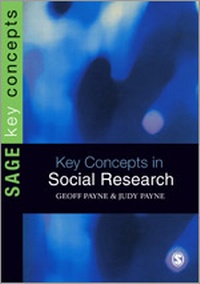
Key Concepts in Social Research
1st Edition
Published on 18. March 2004
248 pages
978-1-84860-062-1 (ISBN)
Description

`This clearly written and user-friendly book is ideal for students or researchers who wish to get a basic, but solid grasp of a topic and see how it fits with other topics. By following the links a student can easily and efficiently build up a clear conceptual map of social research' - Malcolm Williams, Reader in Sociology, Cardiff University
`This is a really useful book, written in an accessible manner for students beginning their study of social research methods. It is helpful both as an introductory text and as a reference guide for more advanced students. Most of the key topics in methods and methodology are covered and it will be suitable as a recommended text on a wide variety of courses' - Clive Seale, Brunel University
At last, an authoritative, crystal-clear introduction to research methods which really takes account of the needs of students for accessible, focused information to help with undergraduate essays and exams. The key concepts discussed here are based on a review of teaching syllabi and the authors' experience of many years of teaching. Topics range over qualitative and quantitative approaches and combine practical considerations with philosophical issues. They include several new topics, like internet and phone polling, internet searches, and visual methods. Each section is free-standing, can be tackled in order, but with links to other sections to enable students to cross-reference and build up a wider understanding of central research methods.
To facilitate comprehension and aid study, each section begins with a definition. It is followed by a summary of key points with key words and guides to further reading and up-to-date examples.
The book is a major addition to undergraduate reading lists. It is reliable, allows for easy transference to essays and exams and easy to use, and exceptionally clearly written for student consumption. The book answers the needs of all those who find research methods daunting, and for those who have dreamt of an ideal introduction to the subject.
`This is a really useful book, written in an accessible manner for students beginning their study of social research methods. It is helpful both as an introductory text and as a reference guide for more advanced students. Most of the key topics in methods and methodology are covered and it will be suitable as a recommended text on a wide variety of courses' - Clive Seale, Brunel University
At last, an authoritative, crystal-clear introduction to research methods which really takes account of the needs of students for accessible, focused information to help with undergraduate essays and exams. The key concepts discussed here are based on a review of teaching syllabi and the authors' experience of many years of teaching. Topics range over qualitative and quantitative approaches and combine practical considerations with philosophical issues. They include several new topics, like internet and phone polling, internet searches, and visual methods. Each section is free-standing, can be tackled in order, but with links to other sections to enable students to cross-reference and build up a wider understanding of central research methods.
To facilitate comprehension and aid study, each section begins with a definition. It is followed by a summary of key points with key words and guides to further reading and up-to-date examples.
The book is a major addition to undergraduate reading lists. It is reliable, allows for easy transference to essays and exams and easy to use, and exceptionally clearly written for student consumption. The book answers the needs of all those who find research methods daunting, and for those who have dreamt of an ideal introduction to the subject.
All prices
More details
Series
Edition
First Edition
Language
English
Place of publication
London
United Kingdom
Target group
College/higher education
ISBN-13
978-1-84860-062-1 (9781848600621)
Copyright in bibliographic data and cover images is held by Nielsen Book Services Limited or by the publishers or by their respective licensors: all rights reserved.
Schweitzer Classification
Other editions
Additional editions
Geoff Payne | Judy Payne
Key Concepts in Social Research
Book
03/2004
1st Edition
SAGE Publications Inc
€231.10
Shipment within 15-20 days
Geoff Payne | Judy Payne
Key Concepts in Social Research
Book
03/2004
1st Edition
SAGE Publications Inc
€83.20
Shipment within 15-20 days
Persons
Teaching Interests: Social Research Methods; Social
Inequalities, Divisions and Mobilities
Research Interests - current: Social Research Methods; Social
Mobility; Social Processes in (small
rural) Communities; 'Family History'
Research Interests - recent: Class Identities; Literacy; Gender;
Ethnicity; Poverty. Mrs. Judy Payne is Family and Consumer Sciences Teacher Educator in the department of Adolescent, Career, and Special Education. She is also the Career and Technical Education program coordinator.
Mrs. Payne earned her B.S. in Home Economics Education (1962) and M.S. in Home Economics Education (1967) from Southern Illinois University - Carbondale. She has taken additional graduate courses at Southern Illinois University - Carbondale and through Oregon State University. Before coming to the College of Education (2000), Mrs. Payne was a faculty member in the department of Home Economics, later renamed the department of Family & Consumer Studies. Her other teaching experiences include 3 years of middle school in Maryland, 2 years of secondary school in Illinois, and 3 years of middle/secondary school teaching in Oregon.
Inequalities, Divisions and Mobilities
Research Interests - current: Social Research Methods; Social
Mobility; Social Processes in (small
rural) Communities; 'Family History'
Research Interests - recent: Class Identities; Literacy; Gender;
Ethnicity; Poverty. Mrs. Judy Payne is Family and Consumer Sciences Teacher Educator in the department of Adolescent, Career, and Special Education. She is also the Career and Technical Education program coordinator.
Mrs. Payne earned her B.S. in Home Economics Education (1962) and M.S. in Home Economics Education (1967) from Southern Illinois University - Carbondale. She has taken additional graduate courses at Southern Illinois University - Carbondale and through Oregon State University. Before coming to the College of Education (2000), Mrs. Payne was a faculty member in the department of Home Economics, later renamed the department of Family & Consumer Studies. Her other teaching experiences include 3 years of middle school in Maryland, 2 years of secondary school in Illinois, and 3 years of middle/secondary school teaching in Oregon.
Content
Action Research
Association and Causation
Attitude Scales
Auto/Biography and Life Histories
Bias
Case Study
Coding Qualitative Data
Community Profiles
Community Studies
Content Analysis
Contingency Tables
Documentary Methods
Ethical Practice
Ethnography
Ethnomethodology and Conversational Analysis
Evaluation Studies
Experiments
Feminist Research
Fieldwork
Grounded Theory
Group Discussions/Focus Groups
Hawthorne Effect
Hypothesis
Indicators and Operationalisations
Internet and Other Searches
Internet Polling
Interviewing
Key Informants
Levels of Measurement
Longitudinal and Cross-Sectional Studies
Methods and Methodologies
Objectivity
Observation
Official Statistics
Participant Observation
Positivism and Realism
Qualitative Methods
Quantitative Methods
Questionnaires
Reflexivity
Reliability
Sampling
Estimates and Size
Sampling
Questions of Size
Sampling
Types
Secondary Analysis
Social Surveys
Telephone and Computer-Assisted Polling
Unobstrusive Methods and Triangulation
Validity
Visual Methods
Association and Causation
Attitude Scales
Auto/Biography and Life Histories
Bias
Case Study
Coding Qualitative Data
Community Profiles
Community Studies
Content Analysis
Contingency Tables
Documentary Methods
Ethical Practice
Ethnography
Ethnomethodology and Conversational Analysis
Evaluation Studies
Experiments
Feminist Research
Fieldwork
Grounded Theory
Group Discussions/Focus Groups
Hawthorne Effect
Hypothesis
Indicators and Operationalisations
Internet and Other Searches
Internet Polling
Interviewing
Key Informants
Levels of Measurement
Longitudinal and Cross-Sectional Studies
Methods and Methodologies
Objectivity
Observation
Official Statistics
Participant Observation
Positivism and Realism
Qualitative Methods
Quantitative Methods
Questionnaires
Reflexivity
Reliability
Sampling
Estimates and Size
Sampling
Questions of Size
Sampling
Types
Secondary Analysis
Social Surveys
Telephone and Computer-Assisted Polling
Unobstrusive Methods and Triangulation
Validity
Visual Methods
