

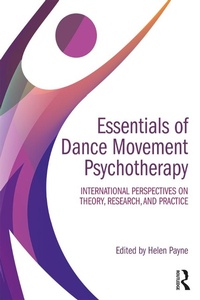
Essentials of Dance Movement Psychotherapy
International Perspectives on Theory, Research, and Practice
Published on 31. March 2017
284 pages
978-1-315-45284-5 (ISBN)
Description

Essentials of Dance Movement Psychotherapy contributes to the global interest in embodiment approaches to psychotherapy and to the field of dance movement psychotherapy specifically. It includes recent research, innovative theories and case studies of practice providing an inclusive overview of this ever growing field. As well as original UK contributions, offerings from other nations are incorporated, making it more accessible to the dance movement psychotherapy community of practice worldwide.
Helen Payne brings together well-known, experienced global experts along with rising stars from the field to offer the reader a valuable insight into the theory, research and practice of dance movement psychotherapy. The contributions reflect the breadth of developing approaches, covering subjects including:
* combining dance movement psychotherapy with music therapy;
* trauma and dance movement psychotherapy;
* the neuroscience of dance movement psychotherapy;
* the use of touch in dance movement psychotherapy;
* dance movement psychotherapy and autism;
* relational dance movement psychotherapy.
Essentials of Dance Movement Psychotherapy will be a treasured source for anyone wishing to learn more about the psychotherapeutic use of creative movement and dance. It will be of great value to students and practitioners in the arts therapies, psychotherapy, counselling and other health and social care professions.
Helen Payne brings together well-known, experienced global experts along with rising stars from the field to offer the reader a valuable insight into the theory, research and practice of dance movement psychotherapy. The contributions reflect the breadth of developing approaches, covering subjects including:
* combining dance movement psychotherapy with music therapy;
* trauma and dance movement psychotherapy;
* the neuroscience of dance movement psychotherapy;
* the use of touch in dance movement psychotherapy;
* dance movement psychotherapy and autism;
* relational dance movement psychotherapy.
Essentials of Dance Movement Psychotherapy will be a treasured source for anyone wishing to learn more about the psychotherapeutic use of creative movement and dance. It will be of great value to students and practitioners in the arts therapies, psychotherapy, counselling and other health and social care professions.
Reviews / Votes
"What a moving adventure to read Prof. Helen Payne's new book! It guides us into dance movement (psycho) therapy as an established, yet evolving, embodied practice. The 14 chapters by both old and new generation dance therapists break new ground in their depth and scope, guided by Marianne Eberhard-Kaechele's recognition that "a discipline is held together by a shared epistemology, but it must remain flexible, to adapt to changing requirements of patients, health care, society and the individual development of therapists over time".-Marja Cantell, Ph.D., Research Coach, Master of Arts Therapies, Codarts University of the Arts, Rotterdam, the Netherlands."This book covers DMP theory, research and practice with global perspective and is an essential reading for the students, researchers, educators and practitioners in the field of creative arts education and/or therapy/psychotherapy/mental health as well as special and somatic education. Professor Helen Payne with other contributors demonstrates with rich materials in the volume the wisdom and values of our expressive and amazing body/movement which we tend to neglect and separate from our mind. Whatever your background, you will be enlightened by the insightful and cutting edge thinking in each of the chapters."-Tony Y. Zhou, Ph.D., CMA, Founder, Inspirees Institute of Creative Arts Therapy, China.
More details
Language
English
Place of publication
London
United Kingdom
Publishing group
Taylor & Francis Ltd
Target group
College/higher education
Professional and scholarly
Illustrations
28 s/w Abbildungen, 7 s/w Tabellen, 22 s/w Photographien bzw. Rasterbilder, 6 s/w Zeichnungen
7 Tables, black and white; 6 Line drawings, black and white; 22 Halftones, black and white; 28 Illustrations, black and white
File size
24,32 MB
ISBN-13
978-1-315-45284-5 (9781315452845)
Copyright in bibliographic data and cover images is held by Nielsen Book Services Limited or by the publishers or by their respective licensors: all rights reserved.
Schweitzer Classification
Other editions
Additional editions
Helen Payne
Essentials of Dance Movement Psychotherapy
International Perspectives on Theory, Research, and Practice
Book
04/2017
1st Edition
Routledge
€193.45
Shipment within 10-20 days
Helen Payne
Essentials of Dance Movement Psychotherapy
International Perspectives on Theory, Research, and Practice
Book
04/2017
1st Edition
Routledge
€76.80
Shipment within 10-20 days
Person
Helen Payne
is an accredited psychotherapist and senior registered dance movement therapist. She is a Professor of psychotherapy at the University of Hertfordshire, facilitates authentic movement groups; has a small private practice; and is clinical manager for Pathways2Wellbeing, a university spin-out delivering healthcare services.
is an accredited psychotherapist and senior registered dance movement therapist. She is a Professor of psychotherapy at the University of Hertfordshire, facilitates authentic movement groups; has a small private practice; and is clinical manager for Pathways2Wellbeing, a university spin-out delivering healthcare services.
Content
Preface
Acknowledgements
Foreword by Marianne Eberhard-Kaechele
1 Introduction: Experiencing inter-corporality and professional learning HELEN PAYNE, UK
Part I: Theory
2 Relational dance movement psychotherapy: A new old idea SISSY LYKOU, UK
3 Dynamic equilibrium: Engaging neurophysiological intelligences through dance/movement therapy KALILA HOMANN, USA
4 Conscious movement sequencing: The core of the dance/movement therapy experience CHRISTINE CALDWELL, USA
5 A phase model of growth in dance therapy SUSANNE BENDER, GERMANY
Part II Research
6 Gestalt and dance movement psychotherapy: Moving towards integration through practice and research in adults with eating disorders YEVA FELDMAN, UK
7 The use of touch in dance/movement therapy: A phenomenological study ELINA CAUNA AND KRISTINE VENDE-KOTOVA, LATVIA
8 A dance informed contribution to nonverbal interpersonal relating in autism spectrum disorders ROSEMARIE SAMARITTER, THE NETHERLANDS
9 Movement-based supervision for Korean arts therapies students KYUNG SOON KO, SOUTH KOREA
Part III Practice
10 Reliable change in outcomes from The BodyMind Approach (TM) with people who have medically unexplained symptoms/somatic symptom disorder in primary health care HELEN PAYNE, UK
11 Overcoming trauma: When verbal language is not enough DITA FEDERMAN AND GALIT ZANA, ISRAEL
12 I am here with you: Dance movement therapy and music therapy as a marriage of empathy in the special school setting SARA OWEN, UK
13 Holding and adolescent angst: Significant moments within a dance movement
psychotherapy group in a mainstream secondary school JULIE JOSEPH AND VICKY KARKOU, UK
14 The recovery journey: The place and value of dance movement psychotherapy with clients with alcohol or substance misuse PAM FISHER, UK
Appendix
Associations
Training courses
Journals
Acknowledgements
Foreword by Marianne Eberhard-Kaechele
1 Introduction: Experiencing inter-corporality and professional learning HELEN PAYNE, UK
Part I: Theory
2 Relational dance movement psychotherapy: A new old idea SISSY LYKOU, UK
3 Dynamic equilibrium: Engaging neurophysiological intelligences through dance/movement therapy KALILA HOMANN, USA
4 Conscious movement sequencing: The core of the dance/movement therapy experience CHRISTINE CALDWELL, USA
5 A phase model of growth in dance therapy SUSANNE BENDER, GERMANY
Part II Research
6 Gestalt and dance movement psychotherapy: Moving towards integration through practice and research in adults with eating disorders YEVA FELDMAN, UK
7 The use of touch in dance/movement therapy: A phenomenological study ELINA CAUNA AND KRISTINE VENDE-KOTOVA, LATVIA
8 A dance informed contribution to nonverbal interpersonal relating in autism spectrum disorders ROSEMARIE SAMARITTER, THE NETHERLANDS
9 Movement-based supervision for Korean arts therapies students KYUNG SOON KO, SOUTH KOREA
Part III Practice
10 Reliable change in outcomes from The BodyMind Approach (TM) with people who have medically unexplained symptoms/somatic symptom disorder in primary health care HELEN PAYNE, UK
11 Overcoming trauma: When verbal language is not enough DITA FEDERMAN AND GALIT ZANA, ISRAEL
12 I am here with you: Dance movement therapy and music therapy as a marriage of empathy in the special school setting SARA OWEN, UK
13 Holding and adolescent angst: Significant moments within a dance movement
psychotherapy group in a mainstream secondary school JULIE JOSEPH AND VICKY KARKOU, UK
14 The recovery journey: The place and value of dance movement psychotherapy with clients with alcohol or substance misuse PAM FISHER, UK
Appendix
Associations
Training courses
Journals
