

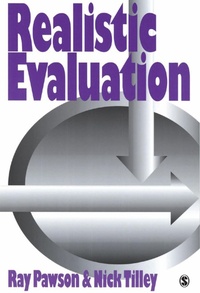
Realistic Evaluation
1st Edition
Published on 23. April 1997
256 pages
978-1-4462-3388-7 (ISBN)
Description

Realistic Evaluation shows how program evaluation needs to be, and can be bettered. It presents a profound yet highly readable critique of current evaluation practice, and goes on to introduce a `manifesto' and `handbook' for a fresh approach.
The main body of this book is devoted to the articulation of a new evaluation paradigm, which promises greater validity and utility from the findings of evaluation studies. The authors call this new approach `realistic evaluation'. The name reflects the paradigm's foundation in scientific realist philosophy, its commitment to the idea that programmes deal with real problems rather than mere social constructions, and its primary intention, which is to inform realistic developments in policy making that benefit programme participants and the public. Ray Pawson and Nicholas Tilley argue with passion that scientific evaluation requires a careful blend of theory and method, quality and quantity, ambition and realism.
The book offers a complete blueprint for evaluation activities, running from design to data collection and analysis to the cumulation of findings across programmes and onto the realization of research into policy. The argument is developed using practical examples throughout and is grounded in the major fields of programme evaluation.
This book will be essential reading for all those involved in the evaluation process especially those researchers, students and practitioners in the core disciplines of sociology, social policy, criminology, health and education.
`This book is a must for those engaged in the field, providing a fully illustrated text on evaluation with numerous examples from the criminal justice system. Unusually, it offers something for the academic, practitioner and student alike. I found Pawson and Tilley's latest work on evaluation an enjoyable and informative read. For myself their "realistic evaluation" clarified and formalised a jumbled set of ideas I had already been developing. Although not everyone will agree with the methodology proposed by the authors, this book is a valuable read as it will cause most of us at least to review our methodological stance' - International Journal of Police Science and Management
`This is an engaging book with a strong sense of voice and communicative task. The voice is sometimes strident, but always clear. Its communicative qualities are evident equally in its structure: lots of signposting for the reader within and across chapters' - Language Teaching Research
`This provocative, elegant and highly insightful book focuses on the effective incorporation of actual practice into the formulation of evaluation methodology. What a pleasure to read sentences like: "The research act involves "learning" a stakeholder's theories, formalizing them, and "teaching" them back to that informant who is then in a position to comment upon, clarify and further refine the key ideas". Pawson and Tilley have given us a wise, witty and persuasive account of how real practitioner experience might be encouraged to intrude on (and modify) researchers' concepts about program processes and outcomes. This holds important promise for achieving something that is devoutly to be wished: closer interaction among at least some researchers and some policy makers' - Eleanor Chelimsky, Past-President of the American Evaluation Association
`This is a sustained methodological argument by two wordly-wise social scientists. Unashamedly intellectual, theoretically ambitious yet with a clear but bounded conception of evaluation. It is articulate, occasionally eloquent and always iconoclastic, whilst eschewing "paradigm wars". The Pawson and Tilley "realist" call to arms threatens to take no prisoners among experimentalists, constructivists or pluralists. It is the kind of book that clarifies your thoughts, even when you disagree with everything they say' - Elliot Stern, The Tavistock Institute
The main body of this book is devoted to the articulation of a new evaluation paradigm, which promises greater validity and utility from the findings of evaluation studies. The authors call this new approach `realistic evaluation'. The name reflects the paradigm's foundation in scientific realist philosophy, its commitment to the idea that programmes deal with real problems rather than mere social constructions, and its primary intention, which is to inform realistic developments in policy making that benefit programme participants and the public. Ray Pawson and Nicholas Tilley argue with passion that scientific evaluation requires a careful blend of theory and method, quality and quantity, ambition and realism.
The book offers a complete blueprint for evaluation activities, running from design to data collection and analysis to the cumulation of findings across programmes and onto the realization of research into policy. The argument is developed using practical examples throughout and is grounded in the major fields of programme evaluation.
This book will be essential reading for all those involved in the evaluation process especially those researchers, students and practitioners in the core disciplines of sociology, social policy, criminology, health and education.
`This book is a must for those engaged in the field, providing a fully illustrated text on evaluation with numerous examples from the criminal justice system. Unusually, it offers something for the academic, practitioner and student alike. I found Pawson and Tilley's latest work on evaluation an enjoyable and informative read. For myself their "realistic evaluation" clarified and formalised a jumbled set of ideas I had already been developing. Although not everyone will agree with the methodology proposed by the authors, this book is a valuable read as it will cause most of us at least to review our methodological stance' - International Journal of Police Science and Management
`This is an engaging book with a strong sense of voice and communicative task. The voice is sometimes strident, but always clear. Its communicative qualities are evident equally in its structure: lots of signposting for the reader within and across chapters' - Language Teaching Research
`This provocative, elegant and highly insightful book focuses on the effective incorporation of actual practice into the formulation of evaluation methodology. What a pleasure to read sentences like: "The research act involves "learning" a stakeholder's theories, formalizing them, and "teaching" them back to that informant who is then in a position to comment upon, clarify and further refine the key ideas". Pawson and Tilley have given us a wise, witty and persuasive account of how real practitioner experience might be encouraged to intrude on (and modify) researchers' concepts about program processes and outcomes. This holds important promise for achieving something that is devoutly to be wished: closer interaction among at least some researchers and some policy makers' - Eleanor Chelimsky, Past-President of the American Evaluation Association
`This is a sustained methodological argument by two wordly-wise social scientists. Unashamedly intellectual, theoretically ambitious yet with a clear but bounded conception of evaluation. It is articulate, occasionally eloquent and always iconoclastic, whilst eschewing "paradigm wars". The Pawson and Tilley "realist" call to arms threatens to take no prisoners among experimentalists, constructivists or pluralists. It is the kind of book that clarifies your thoughts, even when you disagree with everything they say' - Elliot Stern, The Tavistock Institute
Reviews / Votes
`This book is a must for those engaged in the field, providing a fully illustrated text on evaluation with numerous examples from the criminal justice system. Unusually, it offers something for the academic, practitioner and student alike. I found Pawson and Tilley's latest work on evaluation an enjoyable and informative read. For myself their `realistic evaluation' clarified and formalised a jumbled set of ideas I had already been developing. Although not everyone will agree with the methodology proposed by the authors, this book is a valuable read as it will cause most of us at least to review our methodological stance' - International Journal of Police Science and Management`This is an engaging book with a strong sense of voice and communicative task. The voice is sometimes strident, but always clear. Its communicative qualities are evident equally in its structure: lots of signposting for the reader within and across chapters' - Language Teaching Research
`This provocative, elegant and highly insightful book focuses on the effective incorporation of actual practice into the formulation of evaluation methodology. What a pleasure to read sentences like: "The research act involves "learning" a stakeholder's theories, formalizing them, and "teaching" them back to that informant who is then in a position to comment upon, clarify and further refine the key ideas". Pawson and Tilley have given us a wise, witty and persuasive account of how real practitioner experience might be encouraged to intrude on (and modify) researchers' concepts about program processes and outcomes. This holds important promise for achieving something that is devoutly to be wished: closer interaction among at least some researchers and some policy makers' - Eleanor Chelimsky, Past-President of the American Evaluation Association
`This is a sustained methodological argument by two wordly-wise social scientists. Unashamedly intellectual, theoretically ambitious yet with a clear but bounded conception of evaluation. It is articulate, occasionally eloquent and always iconoclastic, whilst eschewing "paradigm wars". The Pawson and Tilley "realist" call to arms threatens to take no prisoners among experimentalists, constructivists or pluralists. It is the kind of book that clarifies your thoughts, even when you disagree with everything they say' - Elliot Stern, The Tavistock Institute
More details
Edition
1. Auflage
Language
English
Place of publication
London
United Kingdom
Target group
College/higher education
Professional and scholarly
Product notice
Reflowable
ISBN-13
978-1-4462-3388-7 (9781446233887)
Copyright in bibliographic data and cover images is held by Nielsen Book Services Limited or by the publishers or by their respective licensors: all rights reserved.
Schweitzer Classification
Other editions
Additional editions
Ray Pawson | Nick Tilley
Realistic Evaluation
Book
04/1997
1st Edition
SAGE Publications Inc
€233.00
Shipment within 15-20 days
Ray Pawson | Nick Tilley
Realistic Evaluation
Book
04/1997
1st Edition
SAGE Publications Inc
€113.30
Shipment within 15-20 days
Persons
Given my job title, it will come as no surprise that my main interest lies in research methodology. This does not quite bracket me with the technical nerds, however, for I have written widely on the philosophy and practice of research, covering methods qualitative and quantitative, pure and applied, contemporaneous and historical. There is a common 'realist' thread underlying every word, albeit a modest, middle-range, empirically-rich kind of realism. Nick Tilley is a professor in the UCL Department of Security and Crime Science, Emeritus Professor of Sociology at Nottingham Trent University, and an adjunct professor at the Griffith Criminology Institute in Brisbane. His academic work has been devoted to developing and delivering theoretically informed applied social science. Specific interests lie in evaluation methodology, the international crime drop, problem-oriented policing, and situational crime prevention, about all of which he has published extensively. Books include Realistic Evaluation (1997, with Ray Pawson); Crime Prevention (2009); Economic Analysis and Efficiency in Policing. Criminal Justice and Crime Prevention: What Works? (2016, with Matthew Manning, Shane Johnson, Gabriel Wong, and Margarita Vorsina); and Reducing Burglary (2018, with Andromachi Tseloni and Rebecca Thompson). Nick was awarded an OBE for Services to Policing and Crime Reduction in 2005 and elected a Fellow of the Academy of Social Sciences (FAcSS) in 2009.
Content
A History of Evaluation
Out with the Old
Weaknesses in Experimental Evaluation
In with the New
Introducing Scientific Realism
How To Design a Realistic Evaluation
How To Make Evaluations Cumulate
How To Construct Realistic Data
Utilizing Stakeholders' Knowledge
No Smoking without Firing Mechanisms
A `Realistic' Consultation
Evaluation, Policy and Practice
Realizing the Potential
The New Rules of Realistic Evaluation
Out with the Old
Weaknesses in Experimental Evaluation
In with the New
Introducing Scientific Realism
How To Design a Realistic Evaluation
How To Make Evaluations Cumulate
How To Construct Realistic Data
Utilizing Stakeholders' Knowledge
No Smoking without Firing Mechanisms
A `Realistic' Consultation
Evaluation, Policy and Practice
Realizing the Potential
The New Rules of Realistic Evaluation
