

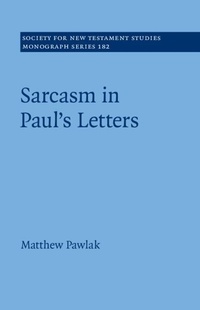
Sarcasm in Paul's Letters
Published on 21. December 2022
294 pages
978-1-009-27193-6 (ISBN)
Description

In this book, Matthew Pawlak offers the first treatment of sarcasm in New Testament studies. He provides an extensive analysis of sarcastic passages across the undisputed letters of Paul, showing where Paul is sarcastic, and how his sarcasm affects our understanding of his rhetoric and relationships with the Early Christian congregations in Galatia, Rome, and Corinth. Pawlak's identification of sarcasm is supported by a dataset of 400 examples drawn from a broad range of ancient texts, including major case studies on Septuagint Job, the prophets, and Lucian of Samosata. These data enable the determination of the typical linguistic signals of sarcasm in ancient Greek, as well as its rhetorical functions. Pawlak also addresses several ongoing discussions in Pauline scholarship. His volume advances our understanding of the abrupt opening of Galatians, diatribe and Paul's hypothetical interlocutor in Romans, the 'Corinthian slogans' of First Corinthians, and the 'fool's speech' found within Second Corinthians 10-13.
Reviews / Votes
'Matthew Pawlak's monograph is an important contribution to scholarship, and has implications not just for the study of Paul, but for literary analysis of any ancient text. In keeping with its subject matter, it is elegantly and engagingly written, and is brimming with exegetical insight and deft analysis of current scholarship. I can say without a trace of irony that this is a rare example of a scholarly book both fascinating and enjoyable to read!' Simon Gathercole, Professor of New Testament and Early Christianity, University of Cambridge 'Based on clearly defined terms and concepts, and employing a wide range of ancient examples, Pawlak clarifies the role of sarcastic language within Paul's rhetoric, showing how and why the apostle uses sarcasm. This book sheds new light on Paul's communicative strategies and language use.' Joerg Frey, Professor of New Testament Studies, University of Zurich 'In this groundbreaking work, Pawlak begins with a survey of ancient and modern discussions of irony in its various forms, and an examination of sarcasm in a wide range of Greek materials. Thus equipped, he identifies and treats sarcasm in Paul's letters with a level of sophistication, precision, and nuance unmatched in earlier studies. Furthermore, his study of Paul's use of sarcasm sheds light on other issues much debated within Pauline scholarship, including the use of diatribe in Romans and the historical background to 2 Corinthians 10-13. Altogether, a most impressive achievement.' Stephen Westerholm, Professor Emeritus of Christianity, McMaster University 'Matthew Pawlak offers a methodologically innovative and exceptionally precise examination of the use of irony and sarcasm across the Corpus Paulinum and its cultural and literary contexts. His impressive monograph represents a significant contribution to Pauline studies, in particular for shedding light on the apostle's complex argumentative strategies.' Michael Tilly, Professor of Ancient Judaism and History of Hellenistic Religions, York St. John University 'The rhetoric of sarcasm - one wonders why this has not yet been treated systematically in scholarship on Paul's letters. Matthew Pawlak does so here with all due thoroughness, bringing a new research topic into focus. His treatise on sarcasm in Greek literature - taking into account its structures and social contexts - not only offers new insights into Paul's communication, but is a sophisticated tool for further studies on the Septuagint and early Christian texts.' Markus OEhler, Institute of New Testament Studies, University of Vienna 'Matthew Pawlak's work, Sarcasm in Paul's Letters, fills a lacuna in Pauline scholarship. Recognizing sarcasm is vital for our interpretation of a text and Pawlak provides a working model for understanding this challenging, but essential, topic, and how it was signalled by ancient Greek authors. With detailed investigations of controversial passages, Pawlak provides new and fresh readings that challenge established arguments. This is an important contribution and warrants consideration by both biblical scholars and classicists.' Sean Adams, Professor of New Testament and Ancient Culture, University of Glasgow 'Pawlak's monograph has many strengths, combining ancient evidence and modern theorizing about sarcasm, establishing a solid foundation on which to study the use of sarcasm in the letters of Paul, and his discussions of purported occasions of sarcasm in Paul are circumspect and insightful. Those interested either in Paul or ancient conventions around sarcasm will learn much from this book.' Matthew Thiessen, Review of Biblical Literature 'This book is a wonderful contribution to the study of Paul's rhetoric, and it helpfully advances our understanding of Paul's letters, as well as his cultural and social location.' Laura Dingeldein, Reading ReligionMore details
Series
Language
English
Place of publication
Cambridge
United Kingdom
Illustrations
Worked examples or Exercises
File size
1,87 MB
ISBN-13
978-1-009-27193-6 (9781009271936)
Copyright in bibliographic data and cover images is held by Nielsen Book Services Limited or by the publishers or by their respective licensors: all rights reserved.
Schweitzer Classification
Other editions
Additional editions
Matthew Pawlak
Sarcasm in Paul's Letters
Book
08/2024
Cambridge University Press
€33.00
Shipment within 15-20 days
Matthew Pawlak
Sarcasm in Paul's Letters
Book
12/2022
Cambridge University Press
€102.50
Shipment within 15-20 days
Person
Content
Introduction; Part I. What is Sarcasm? How is Sarcasm Expressed? What Does Sarcasm Do?: 1. Method, defining sarcasm, and the scope of the project; 2. Sarcasm in the septuagint: with special reference to Job and the prophets; 3. Sarcasm in Ancient Greek texts: with special reference to Lucian; Part II. Sarcasm in Paul's Letters: 4. Sarcasm in Galatians; 5. Sarcasm in Romans: with special reference to diatribe and voice; 6. Sarcasm in First Corinthians; 7. Sarcasm (and asteismos) in Second Corinthians; 9. Conclusion.
