

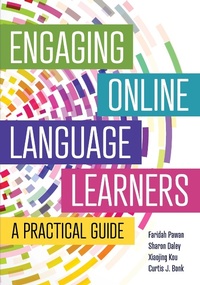
Engaging Online Language Learners: A Practical Guide
Description

More details
Other editions
Additional editions
Persons
Faridah Pawan is a professor of EFL/ESL teacher professional development in the Department of Instructional Systems Technology at Indiana University (IU). Since 2004, she has developed multiple online programs, including IU's EFL/ESL teaching and teacher training certificates and the EFL/ESL Online Peace Corps Masters International Program, as well as hybrid programs, such as the Tandem Certification of ESL/Content Area Teachers.
Sharon Daley is an associate clinical professor in the Indiana University School of Education. Her primary focus is teaching preservice teachers in literacy methods and field experience courses. She also teaches graduate courses focusing on literacy instruction, assessment, and literacy coaching. Her research interests focus on identity development of preservice teachers, as well as their development as reflective practitioners. She also works on projects to provide courses that develop academic readiness skills in undergraduate students in underserved international populations.
Xiaojing Kou has served as director for the Center for Language Technology at Indiana University since 2012. With her leadership, the center provides technology and instructional support to language teaching instructors through audio and video services, specialized language instructional space, web hosting of language materials, professional development opportunities, and promotion of world languages programs. She also provides consultation on technology integration in language instructional design and development.
Curtis J. Bonk is a professor in the School of Education at Indiana University (IU), teaching psychology and technology courses. In 2020, he was awarded the IU President's Award for Excellence in Teaching and Learning Technology, and in 2021, he received the David H. Jonassen Excellence in Research Award. Bonk has written more than 380 publications and given nearly 1,800 talks around the world.
Content
- Intro
- Title Page
- Copyright
- Contents
- Preface
- Part I: The Whys of Engaging Students in Online Teaching
- Chapter 1: Online Language Learning: Changes and Trends
- Chapter 2: Actionable Principles for Engaging and Motivating Students in the Online Environment
- Chapter 3: Online Language Teaching Competencies: A Combination of Pedagogical Knowledge and Skills
- Part II: The Ways to Engage Online Language Learners
- Chapter 4: Teaching Presence and Engaging Students Through Teacher Self-Presentation, Course Design, and Facilitation
- Chapter 5: Cognitive Presence and Engaging Students Through Challenge and Higher-Order Thinking
- Chapter 6: Social Presence and Engaging Students Through Community
- Chapter 7: Learning Presence and Engaging Students Through Self-Directed Learning
- Part III: The Next Steps to Sustain Online Teaching Expertise
- Chapter 8: Exemplary and Inspirational Online Teaching Practices
- Chapter 9: Ways Administrators Can Use Online Pathways to Reconceptualize and Support Teachers' Professional Development
- Chapter 10: Culturally and Linguistically Inclusive Online Instruction
- About the Authors
