

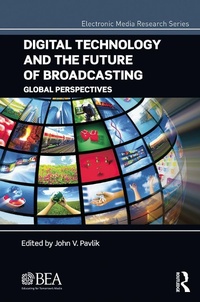
Digital Technology and the Future of Broadcasting
Global Perspectives
Published on 16. July 2015
252 pages
978-1-317-48694-7 (ISBN)
Description

This volume presents timely discussions on how digital technology is reshaping broadcasting and the media in the United States and around the world. It features contributions from distinguished scholars and young researchers, representing work that spans domestic and international issues of technological change and the implications for broadcasting and related media in a global context.
Among the many issues covered are:
The impact of digital technology on the structure of broadcasting organizations and regulation;
The nature of broadcast content or media programming and how it is delivered at home and abroad;
Engagement and interaction of the public with broadcasting and social and mobile media; and
The reshaping of revenue models for broadcasters and media organizations globally.
The first two parts of the volume, addressing research challenges, issues, and advances in global broadcasting, are competitively reviewed research papers which were presented at the BEA2014 Research Symposium. The third part focuses on international perspectives, with chapters from broadcasting scholars and paper discussants at the Research Symposium. This section provides reflection on the problems and prospects for research, education, and public policy that arise in this era of rapid and continuing change.
As a benchmark of the remarkable changes taking place in today's media environment, the volume sets an agenda for future research on the implications of digital technology for broadcasting and broadcasting education.
Among the many issues covered are:
The impact of digital technology on the structure of broadcasting organizations and regulation;
The nature of broadcast content or media programming and how it is delivered at home and abroad;
Engagement and interaction of the public with broadcasting and social and mobile media; and
The reshaping of revenue models for broadcasters and media organizations globally.
The first two parts of the volume, addressing research challenges, issues, and advances in global broadcasting, are competitively reviewed research papers which were presented at the BEA2014 Research Symposium. The third part focuses on international perspectives, with chapters from broadcasting scholars and paper discussants at the Research Symposium. This section provides reflection on the problems and prospects for research, education, and public policy that arise in this era of rapid and continuing change.
As a benchmark of the remarkable changes taking place in today's media environment, the volume sets an agenda for future research on the implications of digital technology for broadcasting and broadcasting education.
More details
Series
Language
English
Place of publication
London
United Kingdom
Publishing group
Taylor & Francis Ltd
Target group
College/higher education
Product notice
Reflowable
Illustrations
17 s/w Tabellen
17 Tables, black and white
File size
5,18 MB
ISBN-13
978-1-317-48694-7 (9781317486947)
Copyright in bibliographic data and cover images is held by Nielsen Book Services Limited or by the publishers or by their respective licensors: all rights reserved.
Schweitzer Classification
Other editions
Additional editions
Book
12/2019
1st Edition
Routledge
€67.40
Shipment within 15-20 days
Book
07/2015
1st Edition
Routledge
€241.90
Shipment within 10-20 days
Person
John V. Pavlik is professor in the Department of Journalism and Media Studies at the School of Communication and Information, Rutgers, the State University of New Jersey.
Content
Series Editor's Foreword
Introduction
Part I: Research Challenges in a Changing Broadcast Environment
Chapter 1
Backchannel Communication Motives in Predicting Social Presence and Sports Channel Commitment during the First Social Media Olympics
YoungChan Hwang, SBS (Seoul Broadcasting System) and Joon Soo Lim, Syracuse University
Chapter 2
Double Vision: An Eye Tracking Analysis of Visual Attention between Television and Second Screens
Miao Guo, Ball State University and Michael Holmes, Ball State University
Chapter 3
Twitter and Television: Broadcast Ratings in the Web 2.0 Era
Michael Brouder, Ball State University and Robert Brookey, Ball State University
Part II: Research Issues and Advances in Global Broadcasting
Chapter 4
Broadcast and New Media Use in China: Findings from a National Survey
Fei Shen, City University of Hong Kong; Zhian Zhang, Sun Yat-sen University; and Mike Zhengyu Yao, City University of Hong Kong
Chapter 5
Sensational Pictures: An Analysis of Visual Structure on Five Transnational Arab News Channels
Michael D. Bruce, University of Alabama
Chapter 6
Telepresence and Immersion with High-Definition Digital Displays: Background and Future Directions for Research
Peter Seel, Colorado State University
Part III: International Perspectives on Broadcasting in the Digital Age
Chapter 7
The Future of Television: An Arab Perspective
Joe Khalil, Northwestern University in Qatar
Chapter 8
Tourism as a mediated practice in a global media context: The gaze of female Korean tourists to New York City and the meaning of their practices
Eunkyung E.K. Lee, Social Innovation Center, The Hope Institute
Chapter 9
Assessing the role audience plays in digital broadcasting today and tomorrow
Dwight DeWerth-Pallmeyer, Widener University
Chapter 10
Digital broadcasting and the Media Monitoring System
Randolph Kluver, Texas A&M University
Chapter 11
Diversity in digital media at home and abroad
Naeemah Clark, Elon University
Chapter 12
The Legacy of Dr. Horrible: Potential Research into Second-Screen Intrusion, Coordination, and Influence
Tim Hudson, Point Park University
Chapter 13
Changing Paradigm
Mitchell Shapiro, University of Miami
Chapter 14: Concluding Reflections
Ok Glass:' Implications of Wearable Technologies for the Future of Broadcasting
John V. Pavlik, Rutgers University
Introduction
Part I: Research Challenges in a Changing Broadcast Environment
Chapter 1
Backchannel Communication Motives in Predicting Social Presence and Sports Channel Commitment during the First Social Media Olympics
YoungChan Hwang, SBS (Seoul Broadcasting System) and Joon Soo Lim, Syracuse University
Chapter 2
Double Vision: An Eye Tracking Analysis of Visual Attention between Television and Second Screens
Miao Guo, Ball State University and Michael Holmes, Ball State University
Chapter 3
Twitter and Television: Broadcast Ratings in the Web 2.0 Era
Michael Brouder, Ball State University and Robert Brookey, Ball State University
Part II: Research Issues and Advances in Global Broadcasting
Chapter 4
Broadcast and New Media Use in China: Findings from a National Survey
Fei Shen, City University of Hong Kong; Zhian Zhang, Sun Yat-sen University; and Mike Zhengyu Yao, City University of Hong Kong
Chapter 5
Sensational Pictures: An Analysis of Visual Structure on Five Transnational Arab News Channels
Michael D. Bruce, University of Alabama
Chapter 6
Telepresence and Immersion with High-Definition Digital Displays: Background and Future Directions for Research
Peter Seel, Colorado State University
Part III: International Perspectives on Broadcasting in the Digital Age
Chapter 7
The Future of Television: An Arab Perspective
Joe Khalil, Northwestern University in Qatar
Chapter 8
Tourism as a mediated practice in a global media context: The gaze of female Korean tourists to New York City and the meaning of their practices
Eunkyung E.K. Lee, Social Innovation Center, The Hope Institute
Chapter 9
Assessing the role audience plays in digital broadcasting today and tomorrow
Dwight DeWerth-Pallmeyer, Widener University
Chapter 10
Digital broadcasting and the Media Monitoring System
Randolph Kluver, Texas A&M University
Chapter 11
Diversity in digital media at home and abroad
Naeemah Clark, Elon University
Chapter 12
The Legacy of Dr. Horrible: Potential Research into Second-Screen Intrusion, Coordination, and Influence
Tim Hudson, Point Park University
Chapter 13
Changing Paradigm
Mitchell Shapiro, University of Miami
Chapter 14: Concluding Reflections
Ok Glass:' Implications of Wearable Technologies for the Future of Broadcasting
John V. Pavlik, Rutgers University
