

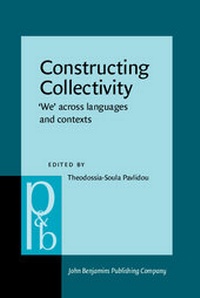
Constructing Collectivity
'We' across languages and contexts
1st Edition
Published on 27. February 2014
X, 355 pages
978-90-272-7084-9 (ISBN)
Description

This is the first edited volume dedicated specifically to first person non-singular reference ('we'). Its aim is to explore the interplay between the grammatical means that a language offers for accomplishing collective self-reference and the socio-pragmatic - broadly speaking - functions of 'we'. Besides an introduction, which offers an overview of the problems and issues associated with first person non-singular reference, the volume comprises fifteen chapters that cover languages as diverse as, e.g., Dutch, Greek, Hebrew, Cha'palaa and Norf'k, and various interactional and genre-specific contexts of spoken and written discourse. It, thus, effectively demonstrates the complexity of collective self-reference and the diversity of phenomena that become relevant when 'we' is not examined in isolation but within the context of situated language use. The book will be of particular interest to researchers working on person deixis and reference, personal pronouns, collective identities, etc., but will also appeal to linguists whose work lies at the interface between grammar and pragmatics, sociolinguistics, discourse and conversation analysis.
More details
Other editions
Additional editions
Book
02/2014
John Benjamins Publishing Co
€100.70
Shipment within 10-15 days
Person
Content
- Constructing Collectivity
- Editorial page
- Title page
- LCC data
- Table of contents
- Acknowledgements
- Preface
- References
- Constructing collectivity with 'we'
- 1. Introducing 'we'
- 2. Referential range and flexibility of 'we'
- 3. Further complexities of 'we'
- 4. Collective self-reference and person reference
- 5. Forms and functions of 'we' across languages and contexts
- 6. The present volume
- References
- Part I. Semantic and pragmatic perspectives on 'we'
- Referentiality, predicate patterns, and functions of we-utterances in American English interactions
- 1. Referentiality and 'we'
- 2. Introduction to the study
- 2.1 Usage-based studies in linguistics
- 2.2 Data and methods
- 3. Distributions and functions of inclusive and exclusive we-utterances
- 3.1 Inclusives
- 3.2 Exclusives
- 4. Modals in inclusive and exclusive we-utterances
- 4.1 Modals of possibility
- 4.2 Modals of obligation
- 4.3 Modals expressing habitual meaning
- 5. Collectivities commonly referred to with we
- 5.1 Classifying collectivities
- 5.2 Functions and properties of collectivity types
- 6. Conclusion
- References
- Corpora
- Singular perception, multiple perspectives through 'we'
- 1. Introduction
- 2. The (evidential) verbs of perception
- 3. Subjectivity and intersubjectivity
- 4. The data
- 5. We/Wir and evidential verbs of visual and auditory perception
- 5.1 See and sehen
- 5.2 Hear and hören
- 6. Conclusion
- References
- Referential and functional aspects of the Norwegian first person plural vi
- 1. Introduction
- 2. Background
- 2.1 Relevance theory
- 2.2 Accessibility/activation
- 2.2 A plural set including the speaker
- 3. A sense enumeration approach
- 4. Analyzing authentic Norwegian data
- 5. Discussion and conclusion
- References
- Grammar, interaction, and context
- 1. Introduction
- 2. The grammar of the first person plural in Italian
- 2.1 General features
- 2.2 Standard and non-prototypical references
- 3. Referential flexibility and the complex role of context
- 4. (Un)marked use of the first person plural in the construction of identities and expression of emotions/ideology
- 5. Noi in If This is a Man by Primo Levi
- 5.1 Preface
- 5.2 Noi as different aggregations
- 5.3 Unmarked and marked uses
- 5.4 Divergences in the English translation
- 6. Conclusion: A simple word with complex pragmatic configuration
- References
- The pragmatics of first person non-singular pronouns in Norf'k
- 1. Introduction: The language on Norfolk Island
- 2. A social history of Norf'k
- 3. Pronouns, social functions and social identity
- 4. Norfolk identity
- 5. Pronoun choices
- 6. Examination of some statements in Buffett and Laycock's grammar
- 7. Social deixis pronouns of first person non-singular pronouns
- 7.1 Hemmy dual inclusive
- 7.2 Aklan, ucklan paucal and plural insiders
- 7.3 Deictic wi/we
- 7.4 Ouwa, auwa
- 8. Etymology of Norf'k pronouns
- 9. First person non-singular pronouns on the Norfolk Forum chat room
- 10. Conclusions
- References
- Appendix I: Some additional remarks on the grammar and pragmatics of the Norf'k first person non-singular pronouns
- Appendix 2: A poem about Ucklun by George Nobbs:
- Appendix 3: A newspaper editorial on Aklan
- Part II. Interactional perspectives on 'we'
- 'We' as social categorization in Cha'palaa, a language of Ecuador
- 1. Collective pronominal reference and social categorization
- 2. Background on the Chachi people and the Cha'palaa language
- 3. Associational semantics in Cha'palaa grammar
- 4. Social categories and Cha'palaa ethnonyms
- 5. Co-referential relations between pronouns and ethnonyms
- 6. 'We' as social categorization in interaction
- 7. Discussion
- References
- Key to abbreviations
- Replying with the freestanding 'we' in Greek conversations
- 1. Introduction
- 2. Background
- 2.1 Subject pronouns in zero-subject languages
- 2.2 Previous work on eµe??
- 2.3 Theoretical frame and data for the present study
- 3. ?µe?? in second pair parts to questions
- 3.1 Replies to who-questions
- 3.2 Replies to other questions: eµe?? in turn-initial position
- 3.3 Replies to other questions: eµe?? in non-first TCU-initial position
- 3.4 Interim summary
- 3.5 Seemingly deviant cases
- 4. Discussion and concluding remarks
- References
- Appendix: Transcription symbols
- Establishing social groups in Hebrew
- 1. Introduction
- 2. Data and methods
- 3. The different uses of 'we' in Israeli radio phone-in programs
- 3.1 The conversation 'we'
- 3.2 The program 'we'
- 3.3 The delimited social 'we'
- 3.4 The general 'we'
- 3.5 The vocal 'we'
- 4. The categories and their impetus
- 5. The fluidity of the first person plural
- 6. Conclusion
- References
- Why 'we'?
- 1. Introduction
- 2. Ethnogrammar of 'we': Polish my
- 2. Ethnopragmatics of 'we': Polish my
- 3. The keys example
- 4. My: Between solidarity and deference
- 5. Cultural symbolism of my
- 6. Conclusion
- References
- Children's use of English we in a primary school in Wales
- 1. Introduction
- 2. Everyday word use and positioning of we
- 3. Social order through category reference
- 4. Presentation and analysis of children's use of we
- 4.1 Exclusion through the use of we
- 4.2 Invitations to play and the use of we
- 4.2.1 "we're playin silly fings"
- 4.3 Legitimate ownership and the use of we
- 5. Conclusion
- References
- Appendix
- Part III. Genre-specific perspectives on 'we'
- "Nail polish - We've chosen the nicest shades for you!"
- 1. Introduction
- 2. The first person plural in Dutch
- 2.1 Forms
- 2.2 Meanings
- 3. Description and characterization of the corpus texts
- 4. Voices in women's magazines
- 5. Voices and power
- 5.1 The expert position
- 5.2 The synthetic sister position
- 6. Presentation and discussion of extracts from the corpus
- 6.1 Exclusive 'we'
- 6.2 Inclusive 'we'
- 7. Summary and conclusions
- References
- Author positioning and audience addressivity by means of 'we' in Greek academic discourse
- 1. Introduction
- 2. Previous studies on Greek academic discourse
- 3. Materials and methodology
- 3.1 Procedure
- 3.2 Levels of context
- 4. Results
- 4.1 The semantic mappings of plural person reference in academic discourse: An overview
- 5. Frequencies of plural person reference
- 6. Discussion
- 6.1 Pragmatic functions of exclusive 'we'
- 6.2 Explicit audience addressivity by means of inclusive 'we'
- 6.3 Rhetorical possibilities of ambiguous plural person reference
- 7. Concluding remarks
- Acknowledgments
- References
- Bulgarian 'we' and audience involvement in academic writing
- 1. Introduction
- 2. Theoretical framework
- 2.1 Speech act theory
- 2.2 Linguistic means of authorial presence realization
- 2.3 Classification of the functions of micro-speech acts containing the 'we' perspective
- 2.4 Grammatical and semantic properties of the Bulgarian 'we'
- 3. Analysis
- 3.1 Data
- 3.2 General observations
- 3.3 Linguistic realization of the 'we' perspective in Bulgarian academic book reviews
- 3.4 The 'we' perspective functions in micro-speech acts
- 4. Conclusions
- References
- On the use of 'we' in Flemish World War II interviews
- 1. Introduction
- 2. Data description
- 3. Quantitative analysis
- 3.1 Exploring the pronouns in the corpus
- 3.2 Zooming in on 'we'
- 4. Qualitative analysis
- 4.1 Prevalent pattern of interviewer-interviewee interaction
- 4.2 Defining the referent by means of exclusion: us versus them
- 4.3 Referential fluidity?
- 4.4 Shifts to impersonal constructions
- 5. Discussion and conclusions
- References
- "Judge us on what we do"
- 1. Introduction
- 2. Political discourse in context
- 3. Pronouns in context
- 3.1 Self-reference
- 3.2 Footing
- 4. The communicative functions of we in British political discourse
- 4.1 We in monologic political discourse
- 4.2 We in dialogic political discourse
- 5. Conclusion
- Acknowledgement
- References
- Author index
- Subject index
