

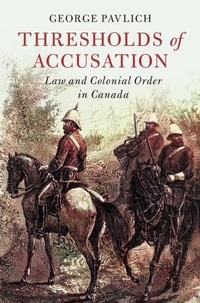
Thresholds of Accusation
Law and Colonial Order in Canada
Published on 14. September 2023
268 pages
978-1-009-33407-5 (ISBN)
Description

This critical socio-legal history probes pretrial accusations through which colonial criminal law forged social orders for settler-colonialism across western Canada, focusing on Alberta, 1874-1884. Following military intelligence, a Northwest Mounted Police force was established to compel Dominion law. That force began by deploying accusatory theatres to receive information about crimes, arrest suspects, and decide via preliminary examination who to send to trial. George Pavlich draws on exemplary performances of colonial accusation to show how police officers and justices of the peace translated local social lore into criminal law. These performances reflected intersecting powers of sovereignty, disciplinarily, and biopolitics; they held accused individuals legally culpable for crimes and obscured social upheavals that settlers brought. Reflecting on colonial legacies within today's vast and unequal criminalizing institutions, this book proposes that we seek new forms of accusation and legality, learning from Indigenous laws that tackle individual and collective responsibilities for societal disquiet.
Reviews / Votes
'George Pavlich has captured the power of law as a meaning-making enterprise, which in this case, was employed to create and sustain a national narrative to systematically dispossess Indigenous peoples from their lands. This complex disruption of Indigenous peoples' social, political, legal, and economic ordering was/is the dynamic of colonialism. What Pavlich has meticulously researched and articulates here is the 'how' of - a critical and practical insight into the depoliticizing of law as a colonial process. One of the beautiful things about this text is that its lessons apply today to the power relations that continue to ensnare and entangle Indigenous peoples. And, Pavlich is not a pessimist - because both history and the world are way too complex. Instead, he considers alternative ways to begin thinking about the operation of state law by drawing on Indigenous legal orders and legal practices. Truly a gift, and beautifully written to boot.' Val Napoleon, Law Foundation Chair of Indigenous Justice and Governance, University of Victoria 'With his stunning research on the colonial policing of western Canada in the nineteenth century, George Pavlich reveals the buried but still active structure of accusation that underlies the contemporary power of criminal law and punishment across settler colonial societies like the US and Canada. Today we tend to blame criminal justice bias on the bureaucratic agencies that dominate the visible system, but Thresholds of Accusation suggests a much deeper attachment and a much broader complicity. Key reading for those questioning the limits of criminal justice reform and abolition.' Jonathan S. Simon, Lance Robbins Professor of Criminal Justice Law, Berkeley Law 'What is the relationship between criminal law and settler colonialism? In Thresholds of Accusation, George Pavlich presents an erudite and compelling genealogy of criminal accusation as a long process of criminalization that continues to conceal the coercive and violent effects of settler colonialism on Indigenous communities today. Pavlich asks us to consider how the vast inequities in the Canadian criminal justice system, especially the overrepresentation of Indigenous peoples, are the effects of what he calls 'a dispossessing colonial rule by law.' The book is brimming with theoretical and methodological insights. Pavlich distills his arguments of accusation as a performative foundation of colonial law through close readings of archival documents. His analysis repudiates archival research as historical discovery and offers innovative methods for writing legal history. This is a must read.' Renisa Mawani, Canada Research Chair, Colonial Legal Histories and Professor, The University of British Columbia 'The book's methodological and theoretical approaches provide fresh perspectives on the role of accusation in shaping colonial social orders and its enduring impact on contemporary legal systems. Pavlich's work is not just a historical account; it is a critical examination of the socio-political underpinnings of colonial legal frameworks. The book stands out for its depth, its critical lens on a pivotal historical period, and its implications for understanding and reimagining modern legal systems.' Amy Swiffen, International Journal of Semiotics and LawMore details
Series
Language
English
Place of publication
Cambridge
United Kingdom
Target group
College/higher education
Illustrations
Worked examples or Exercises
File size
4,12 MB
ISBN-13
978-1-009-33407-5 (9781009334075)
Copyright in bibliographic data and cover images is held by Nielsen Book Services Limited or by the publishers or by their respective licensors: all rights reserved.
Schweitzer Classification
Other editions
Additional editions
Book
09/2023
Cambridge University Press
€122.50
Shipment within 15-20 days
Person
Content
1. Grammars of critique and colonial accusation; 2. Reconnaissance discourses for colonial law; 3. Sovereign spectacles and criminal accusation; 4. Justices of the peace at accusatory theatres; 5. Training police accusers; 6. Moulding accused individuals; 7. Biopolitics and colonial accusation; 8. Denouements and turned spades.
