

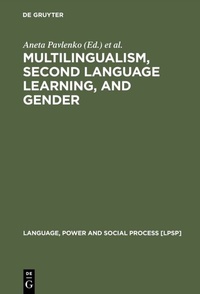
Multilingualism, Second Language Learning, and Gender
1st Edition
Published on 20. April 2011
XI, 356 pages
978-3-11-088940-6 (ISBN)
Description

This volume presents a comprehensive introduction to the study of second language learning, multilingualism and gender. An impressive array of papers situated within a feminist poststructuralist framework demonstrates how this framework allows for a deeper understanding of second language learning, a number of language contact phenomena, intercultural communication, and critical language pedagogy. The volume has wide appeal to students and scholars in the fields of language and gender, sociolinguistics, SLA, anthropology, and language education.
Reviews / Votes
"To scholars of language and gender, it offers second language learners as a rich source for inquiry. In its attention to these issues, this volume makes a valuable contribution to linguistics anthropology, education, and linguistics."Begona Echeverria in: Language in Society 1/2004 "This book ist a highly readable and informative collection of articles exploring the interaction of multilingualism, second language learning, and gender in a variety of contexts."Lauren Ross-Feldmann in: Language and Education 5/2003 "The editors of Multilingualism, Second Language Learning and Gender have made substantial contribution to the still-underaddressed area of gender and L2 learning. [...] These 11 chapters are of a consistently high quality. Each chapter focuses on an instringuing and original topic, grounds the topic theoretically, displays a thourough knowledge of the relevant literature, and describes the research project cogently and in satisfying detail. Furthermore, the chapters are well written and accessible, though there is an occasional somewhat jarring transition between chapters, as is often the case in edited collections. Overall, however, the editors of this volume are to be commended for producing a well-planned, well-mapped, well-executed book that takes the study of gender and L2 learning a huge step forward."Stephanie Vandrick in: Tesol Quarterly 2004More details
Other editions
Additional editions
Aneta Pavlenko | Adrian Blackledge | Ingrid Piller
Multilingualism, Second Language Learning, and Gender
Book
11/2001
1st Edition
De Gruyter
€34.95
Article exhausted; check for reprint
Aneta Pavlenko | Adrian Blackledge | Ingrid Piller
Multilingualism, Second Language Learning, and Gender
Book
11/2001
1st Edition
De Gruyter Mouton
€54.95
Shipment within 7-9 days
Aneta Pavlenko | Adrian Blackledge | Ingrid Piller
Multilingualism, Second Language Learning, and Gender
Book
01/2001
De Gruyter Mouton
€79.95
Article exhausted; check different version
Persons
Aneta Pavlenko is Assistant Professor at Temple University Philadelphia, USA.
Adrian Blackledge is Senior Lecturer at the University of Birmingham, United Kingdom.
Ingrid Piller is Assistant Professor at the University of Sydney, Australia.
Marya Teutsch-Dwyer is Associate Professor at St. Cloud State University, USA.
Content
- Intro
- Preface
- Contributors
- Introduction: Multilingualism, second language learning, and gender
- 1. Gender, society, and ideology in multilingual settings
- New directions in the study of multilingualism, second language learning, and gender
- Complex positionings: Women negotiating identity and power in a minority urban setting
- Researching women's language practices in multilingual workplaces
- Gendering the 'learner': Sexual harassment and second language acquisition
- 2. Negotiation and performance of gender in multilingual contexts
- "How am I to become a woman in an American vein?": Transformations of gender performance in second language learning
- (Re)constructing masculinity in a new linguistic reality
- Linguistic intermarriage: Language choice and negotiation of identity
- Finding one's voice in Japanese: A study of the pitch levels of L2 users
- 3. Gender in multilingual educational settings
- Gender and public space in a bilingual school
- Cross-cultural excursions: Foreign language study and feminist discourses of travel
- Self-expression, gender, and community: A Japanese feminist English class
- Name index
- Subject index
