

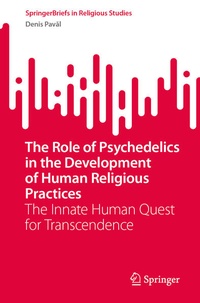
The Role of Psychedelics in the Development of Human Religious Practices
Description

The Role of Psychedelics in the Development of Human Religious Practices explores how mind-altering substances have shaped humanity's search for the sacred. Drawing on neuroscience, archaeology, ethnopharmacology, and art history, Denis Paval offers an accessible, balanced synthesis of a rapidly evolving field. This Brief examines the phenomenology and neuropharmacology of psychedelic experiences, evaluates claims about their historical use in ritual and religion, and addresses the current psychedelic renaissance. Challenging both uncritical enthusiasm and outright skepticism, it provides a concise, evidence-based guide for researchers, clinicians, students, and readers interested in consciousness, spirituality, and the origins of religious practice across cultures worldwide.
More details
Other editions
Additional editions
Person
Denis Paval, MD, PhD, is a psychiatrist and faculty member at the "Iuliu Ha?ieganu" University of Medicine and Pharmacy, Cluj-Napoca, where he combines academic teaching with active clinical practice. His research is firmly grounded in neuroscience, with a particular emphasis on the biological mechanisms underlying major psychiatric disorders. Dr. Paval has an extensive publication record in internationally indexed journals and contributes regularly to leading neuropsychiatric conferences. His scholarly interests also extend to the neuroscience of religion, where he examines how brain processes inform spiritual experience and the development of belief systems.
Content
Chapter 1. Introduction.- Chapter 2. The phenomenology of psychedelic experiences.- Chapter 3. The phenomenology of psychedelic experiences.- Chapter 4. Evidence of historical psychedelic use in religious practices.- Chapter 5. Conclusion.
