

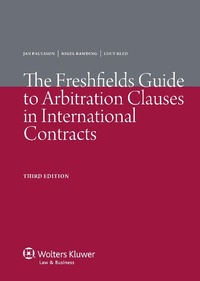
The Freshfields Guide to Arbitration Clauses in International Contracts
3rd Edition
Published on 12. August 2010
192 pages
978-90-411-4892-6 (ISBN)
Description

For many parties to international contracts, arbitration has proven to be the most effective means of dispute resolution. Too many of these agreements, however, still founder on the rock of a defective dispute resolution clause. This acclaimed book shows practitioners how to steer clear of that all-too- common obstacle by drafting fully-informed, comprehensive contract provisions at the outset.
With this newly updated edition of the very successful The Freshfields Guide to Arbitration and ADR - still in the concise, attractive format that made the original so popular - lawyers and business people will confidently negotiate contracts that ensure a speedy, clear-cut resolution of any dispute likely to arise. Taking into account the many significant developments in the law and practice of international arbitration that have occurred during the years since the First Edition, it offers: clear, uncomplicated contract-drafting advice, derived from the authors' wide practical experience model clauses that ensure the effectiveness of dispute resolution provisions - and avoid their pitfalls, and important reference materials.
With this new edition The Freshfields Guide to Arbitration and ADR reaffirms itself as the preferred short guide for busy contract negotiators. It will help them to draft provisions that will weather disputes, preserve transactions, and foster long-lasting mutual confidence and trust among the parties.
With this newly updated edition of the very successful The Freshfields Guide to Arbitration and ADR - still in the concise, attractive format that made the original so popular - lawyers and business people will confidently negotiate contracts that ensure a speedy, clear-cut resolution of any dispute likely to arise. Taking into account the many significant developments in the law and practice of international arbitration that have occurred during the years since the First Edition, it offers: clear, uncomplicated contract-drafting advice, derived from the authors' wide practical experience model clauses that ensure the effectiveness of dispute resolution provisions - and avoid their pitfalls, and important reference materials.
With this new edition The Freshfields Guide to Arbitration and ADR reaffirms itself as the preferred short guide for busy contract negotiators. It will help them to draft provisions that will weather disputes, preserve transactions, and foster long-lasting mutual confidence and trust among the parties.
More details
Other editions
Additional editions
Jan Paulsson | Nigel Rawding
The Freshfields Guide to Arbitration Clauses in International Contracts
Book
12/2010
3rd Edition
Kluwer Law International
€104.18
Shipment within 10-20 days
Content
- Cover
- Half Title Page
- Title Page
- Copyright Page
- Table of Contents
- About the authors
- Preface to the first edition
- Preface to the second edition
- Preface to the third edition
- Chapter 1 Choosing the method
- Direct negotiation
- ADR
- Litigation before national courts
- Arbitration
- Institutional or ad hoc arbitration?
- Institutional arbitration
- Ad hoc arbitration
- ICSID arbitration
- Treaty arbitration
- Growth in the use of arbitration
- Chapter 2 Choosing the applicable law
- The law(s) applicable to the substance of the dispute
- National laws
- What if no substantive law is chosen?
- General principles of law
- Common principles of national laws
- Concurrent laws
- The lex mercatoria
- The UNIDROIT Contract Principles
- Trade usage
- The Shari'ah
- Amiable composition and equity clauses
- Chapter 3 Choosing the place of arbitration
- Suitable legal environment
- Enforcing the arbitration agreement
- Enforceability of awards
- The UNCITRAL Model Law
- Practical considerations
- Meetings and hearings outside the place of arbitration
- Change of the place of arbitration?
- Some geographical observations
- Brazil
- Russia
- People's Republic of China
- Hong Kong and Singapore
- The Middle East
- India
- Chapter 4 Choosing the language of the arbitration
- Chapter 5 Choosing the rules
- Institutional or ad hoc?
- Ad hoc rules
- The UNCITRAL Rules
- Institutional arbitration
- The international acceptability of arbitral institutions
- ICC
- LCIA
- AAA/ICDR
- SCC
- Institutional Fees
- ICSID
- PCA
- Regional and national institutions
- Brazil
- Russia
- India
- People's Republic of China
- Hong Kong and Singapore
- The Middle East
- Industry-specific institutions
- Expedited procedures
- Responding to new methods of conducting arbitration
- E-commerce arbitration
- Chapter 6 Choosing the arbitrators
- Number of arbitrators
- Choosing an arbitrator
- Independence and impartiality of arbitrators
- Availability
- Appointment in default of agreement or on behalf of a defaulting party
- Selection of sole or presiding arbitrators
- Nationality requirements
- Qualifications of arbitrators
- Chapter 7 Choosing mechanisms to deal with specific situations
- Joinder, consolidation and multiparty arbitrations
- Joinder
- Consolidation
- Appointment of arbitrators in multi-party cases
- Class actions
- Adaptation of contracts and filling gaps
- Confidentiality
- Capacity of the parties to agree to arbitration
- Authority to agree to arbitration
- The law governing the arbitration clause
- Procedural law
- Arbitrability of disputes
- Exclusion of appeals
- Costs
- Contracts with state parties
- Waiver of state immunity
- Treaty arbitration
- Interim measures of protection
- "Split" clauses
- Detailed procedural rules
- Chapter 8 Choosing ADR/tiered dispute resolution methods
- Principal forms of ADR
- ADR rules and procedures
- Model clause
- Chapter 9 Drafting the arbitration clause
- Incorporation by reference
- Avoiding pitfalls and "pathological" clauses
- A general purpose institutional arbitration clause
- Appendix 1 Model clauses for institutional arbitration
- Standard arbitration procedures
- Appendix 2 Key features of selected arbitration rules
- Appendix 3 Sample clause for ad hoc arbitration
- Appendix 4 Sample tiered dispute resolution clause
- Appendix 5 Sample multi-party "umbrella" agreement
- 1. DEFINITIONS
- 2. DISPUTE RESOLUTION
- 3. ADDITIONAL PARTIES AND NEW AGREEMENTS
- 4. GOVERNING LAW
- Appendix 6 New York Convention and UNCITRAL Model Law countries and the top 20 places of ICC arbitration (2000-2009)
- Appendix 7 Contact details of selected arbitral institutions and other organisations
- Back Cover
