

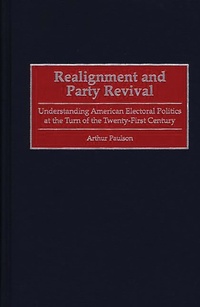
Realignment and Party Revival
Understanding American Electoral Politics at the Turn of the Twenty-First Century
1st Edition
Published on 30. June 2000
376 pages
978-0-313-00085-0 (ISBN)
Description

Are American political parties really in decay? Have American voters really given up on the major parties? Taking issue with widely accepted theories of dealignment and party decay, Paulson argues that the most profound realignment in American history occurred in the 1960s, and he presents an alternative theory of realignment and party revival.
In the 1964-1972 period, factional struggles within the major American political parties were resolved, with conservative Republicans and liberal Democrats emerging as the majority factions within their parties. The result was a critical realignment in Presidential elections, in which the decisive realignment involved the movement of white voters in the south toward the Republican coalition. The impression of dealignment came from the fact that electoral change in Congressional elections moved at a much slower rate. The south continued to vote Democratic for congress, usually for incumbent conservative Democrats. The result was an electoral environment which produced divided government. Secular realignment in congressional elections produced the Republican majorities of 1994. Now the conservative Democrats who were the swing voters since the 1960s, were voting Republican. The result is that the coalitions for yet another realignment are in place at the turn of the twenty-first century. After three decades in which the swing voters were relatively conservative, the new swing voter is a genuine centrist; an independent who is ideologically moderate. The coming realignment, Paulson asserts, will consummate the birth of a new, ideologically, polarized party system with a greater potential for party government, which would be a fundamental change for American democracy. A major resource for scholars, students, and other researchers interested in American parties and elections.
In the 1964-1972 period, factional struggles within the major American political parties were resolved, with conservative Republicans and liberal Democrats emerging as the majority factions within their parties. The result was a critical realignment in Presidential elections, in which the decisive realignment involved the movement of white voters in the south toward the Republican coalition. The impression of dealignment came from the fact that electoral change in Congressional elections moved at a much slower rate. The south continued to vote Democratic for congress, usually for incumbent conservative Democrats. The result was an electoral environment which produced divided government. Secular realignment in congressional elections produced the Republican majorities of 1994. Now the conservative Democrats who were the swing voters since the 1960s, were voting Republican. The result is that the coalitions for yet another realignment are in place at the turn of the twenty-first century. After three decades in which the swing voters were relatively conservative, the new swing voter is a genuine centrist; an independent who is ideologically moderate. The coming realignment, Paulson asserts, will consummate the birth of a new, ideologically, polarized party system with a greater potential for party government, which would be a fundamental change for American democracy. A major resource for scholars, students, and other researchers interested in American parties and elections.
More details
Edition
1. Auflage
Language
English
Place of publication
New York
United States
Publishing group
Bloomsbury Publishing Plc
Target group
Interest Age: From 7 to 17 years
ISBN-13
978-0-313-00085-0 (9780313000850)
Copyright in bibliographic data and cover images is held by Nielsen Book Services Limited or by the publishers or by their respective licensors: all rights reserved.
Schweitzer Classification
Other editions
Additional editions
Arthur Paulson
Realignment and Party Revival
Understanding American Electoral Politics at the Turn of the Twenty-First Century
Book
06/2000
Praeger Publishers Inc
€99.50
Shipment within 15-20 days
Person
ARTHUR PAULSON is Associate Professor of Political Science and the University Pre-Law Advisor at Southern Connecticut State University./e He is a life-long student of parties and elections.
Content
Preface
Introduction: Realignment and the Revival of Parties
A Century of Presidential Elections: From "System of `96" to System of `96
The Democratic Party as a Multifactional System, 1896-1964
The Republican Party as a Bifactional System, 1896-1964
Ideological Polarization and Party Change: Realignment of the Factional Systems, 1964-1972
Party Decay and the New Nominating Politics, 1972-1980
Ideological Polarization and the Two-Tier Party System: Split Ticket Voting, Divided Government, and Realignment in American Politics
Race and Class in the Post-New Deal Order
Realignment and the Study of American Elections
Conclusion: The Party System and American Democracy in the Twenty-First Century
Epilogue: The Y2K Election
Introduction: Realignment and the Revival of Parties
A Century of Presidential Elections: From "System of `96" to System of `96
The Democratic Party as a Multifactional System, 1896-1964
The Republican Party as a Bifactional System, 1896-1964
Ideological Polarization and Party Change: Realignment of the Factional Systems, 1964-1972
Party Decay and the New Nominating Politics, 1972-1980
Ideological Polarization and the Two-Tier Party System: Split Ticket Voting, Divided Government, and Realignment in American Politics
Race and Class in the Post-New Deal Order
Realignment and the Study of American Elections
Conclusion: The Party System and American Democracy in the Twenty-First Century
Epilogue: The Y2K Election
