

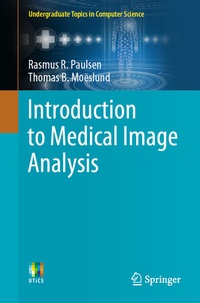
Introduction to Medical Image Analysis
Description

This easy-to-follow textbook presents an engaging introduction to the fascinating world of medical image analysis. Avoiding an overly mathematical treatment, the text focuses on intuitive explanations, illustrating the key algorithms and concepts in a way which will make sense to students from a broad range of different backgrounds.
Topics and features: explains what light is, and how it can be captured by a camera and converted into an image, as well as how images can be compressed and stored; describes basic image manipulation methods for understanding and improving image quality, and a useful segmentation algorithm; reviews the basic image processing methods for segmenting or enhancing certain features in an image, with a focus on morphology methods for binary images; examines how to detect, describe, and recognize objects in an image, and how the nature of color can be used for segmenting objects; introduces a statistical method to determine what class of object the pixelsin an image represent; describes how to change the geometry within an image, how to align two images so that they are as similar as possible, and how to detect lines and paths in images; provides further exercises and other supplementary material at an associated website.
This concise and accessible textbook will be invaluable to undergraduate students of computer science, engineering, medicine, and any multi-disciplinary courses that combine topics on health with data science. Medical practitioners working with medical imaging devices will also appreciate this easy-to-understand explanation of the technology.
More details
Other editions
Additional editions
Persons
Dr. Rasmus R. Paulsen is an Associate Professor at the Section for Image Analysis and Computer Graphics (IACG) in the Department for Applied Mathematics and Computer Science (DTU Compute) of the Technical University of Denmark (DTU).
Dr. Thomas B. Moeslund is a Professor at the Technical Faculty of IT and Design (TECH) of Aalborg University (AAU), Denmark, where he serves as Head of Media Technology and Head of the Visual Analysis of People Laboratory (VAP). His other publications include the Springer titles Introduction to Video and Image Processing , Computer Vision in Sports , and Visual Analysis of Humans .
Content
Introduction.- Image Acquisition.- Image Storage and Compression.- Point Processing.- Neighborhood Processing.- Morphology.- BLOB Analysis.- Color Images.- Pixel Classification.- Geometric Transformations.- Image Registration.- Line and Path Detection.- Appendix A: Bits, Bytes and Binary Numbers.- Appendix B: Mathematical Definitions.
