

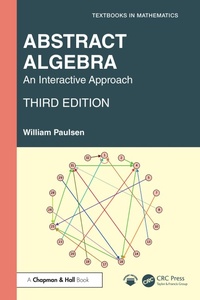
Abstract Algebra
An Interactive Approach
3rd Edition
Published on 30. May 2025
439 pages
978-1-040-35160-4 (ISBN)
Description

Abstract Algebra: An Interactive Approach, Third Edition is a new concept in learning modern algebra. Although all the expected topics are covered thoroughly and in the most popular order, the text offers much flexibility. Perhaps more significantly, the book gives professors and students the option of including technology in their courses. Each chapter in the textbook has a corresponding interactive Mathematica notebook and an interactive SageMath workbook that can be used in either the classroom or outside the classroom.
Students will be able to visualize the important abstract concepts, such as groups and rings (by displaying multiplication tables), homomorphisms (by showing a line graph between two groups), and permutations. This, in turn, allows the students to learn these difficult concepts much more quickly and obtain a firmer grasp than with a traditional textbook. Thus, the colorful diagrams produced by Mathematica give added value to the students.
Teachers can run the Mathematica or SageMath notebooks in the classroom in order to have their students visualize the dynamics of groups and rings. Students have the option of running the notebooks at home, and experiment with different groups or rings. Some of the exercises require technology, but most are of the standard type with various difficulty levels.
The third edition is meant to be used in an undergraduate, single-semester course, reducing the breadth of coverage, size, and cost of the previous editions. Additional changes include:
Binary operators are now in an independent section.
The extended Euclidean algorithm is included.
Many more homework problems are added to some sections.
Mathematical induction is moved to Section 1.2.
Despite the emphasis on additional software, the text is not short on rigor. All of the classical proofs are included, although some of the harder proofs can be shortened by using technology.
Students will be able to visualize the important abstract concepts, such as groups and rings (by displaying multiplication tables), homomorphisms (by showing a line graph between two groups), and permutations. This, in turn, allows the students to learn these difficult concepts much more quickly and obtain a firmer grasp than with a traditional textbook. Thus, the colorful diagrams produced by Mathematica give added value to the students.
Teachers can run the Mathematica or SageMath notebooks in the classroom in order to have their students visualize the dynamics of groups and rings. Students have the option of running the notebooks at home, and experiment with different groups or rings. Some of the exercises require technology, but most are of the standard type with various difficulty levels.
The third edition is meant to be used in an undergraduate, single-semester course, reducing the breadth of coverage, size, and cost of the previous editions. Additional changes include:
Binary operators are now in an independent section.
The extended Euclidean algorithm is included.
Many more homework problems are added to some sections.
Mathematical induction is moved to Section 1.2.
Despite the emphasis on additional software, the text is not short on rigor. All of the classical proofs are included, although some of the harder proofs can be shortened by using technology.
More details
Series
Edition
3rd edition
Language
English
Place of publication
London
United Kingdom
Publishing group
Taylor & Francis Ltd
Target group
College/higher education
Illustrations
34 Line drawings, black and white; 34 Illustrations, black and white
File size
10,18 MB
ISBN-13
978-1-040-35160-4 (9781040351604)
Copyright in bibliographic data and cover images is held by Nielsen Book Services Limited or by the publishers or by their respective licensors: all rights reserved.
Schweitzer Classification
Other editions
Additional editions
Book
05/2025
3rd Edition
Chapman & Hall/CRC
€134.60
Shipment within 10-20 days

Book
03/2025
CRC Press
Unfortunately, price unknown
Available (delivery time upon request)
Previous edition
E-Book
12/2023
2nd Edition
Taylor & Francis
€138.99
Available for download
Person
William Paulsen is a professor of mathematics at Arkansas State University. He is the author of Abstract Algebra: An Interactive Approach (CRC Press, 2009) and has published over 15 papers in applied mathematics, one of which proves that Penrose tiles can be three-colored, thus resolving a 30-year-old open problem posed by John H. Conway. Dr. Paulsen has also programmed several new games and puzzles in Javascript and C++, including Duelling Dimensions, which was syndicated through Knight Features. He earned a PhD in mathematics from Washington University in St. Louis.
Content
1 Preliminaries
1.1 Integer Factorization
1.2 Functions
1.3 Binary Operators
1.4 Modular Arithmetic
1.5 Rational and Real Numbers
2 Understanding the Group Concept
2.1 Introduction to Groups
2.2 Modular Congruence
2.3 The Definition of a Group
3 The Structure within a Group
3.1 Generators of Groups
3.2 Defining Finite Groups in SageMath
3.3 Subgroups
4 Patterns within the Cosets of Groups
4.1 Left and Right Cosets
4.2 Writing Secret Messages
4.3 Normal Subgroups
4.4 Quotient Groups
5 Mappings between Groups
5.1 Isomorphisms
5.2 Homomorphisms
5.3 The Three Isomorphism Theorems
6 Permutation Groups
6.1 Symmetric Groups
6.2 Cycles
6.3 Cayley's Theorem
6.4 Numbering the Permutations
7 Building Larger Groups from Smaller Groups
7.1 The Direct Product
7.2 The Fundamental Theorem of Finite Abelian Groups
7.3 Automorphisms
7.4 Semi-Direct Products
8 The Search for Normal Subgroups
8.1 The Center of a Group
8.2 The Normalizer and Normal Closure Subgroups
8.3 Conjugacy Classes and Simple Groups
8.4 Subnormal Series and the Jordan-Hoelder Theorem
8.5 Solving the Pyraminx (TM)
9 Introduction to Rings
9.1 The Definition of a Ring
9.2 Entering Finite Rings into SageMath
9.3 Some Properties of Rings
10 The Structure within Rings
10.1 Subrings
10.2 Quotient Rings and Ideals
10.3 Ring Isomorphisms
10.4 Homomorphisms and Kernels
11 Integral Domains and Fields
11.1 Polynomial Rings
11.2 The Field of Quotients
11.3 Complex Numbers
1.1 Integer Factorization
1.2 Functions
1.3 Binary Operators
1.4 Modular Arithmetic
1.5 Rational and Real Numbers
2 Understanding the Group Concept
2.1 Introduction to Groups
2.2 Modular Congruence
2.3 The Definition of a Group
3 The Structure within a Group
3.1 Generators of Groups
3.2 Defining Finite Groups in SageMath
3.3 Subgroups
4 Patterns within the Cosets of Groups
4.1 Left and Right Cosets
4.2 Writing Secret Messages
4.3 Normal Subgroups
4.4 Quotient Groups
5 Mappings between Groups
5.1 Isomorphisms
5.2 Homomorphisms
5.3 The Three Isomorphism Theorems
6 Permutation Groups
6.1 Symmetric Groups
6.2 Cycles
6.3 Cayley's Theorem
6.4 Numbering the Permutations
7 Building Larger Groups from Smaller Groups
7.1 The Direct Product
7.2 The Fundamental Theorem of Finite Abelian Groups
7.3 Automorphisms
7.4 Semi-Direct Products
8 The Search for Normal Subgroups
8.1 The Center of a Group
8.2 The Normalizer and Normal Closure Subgroups
8.3 Conjugacy Classes and Simple Groups
8.4 Subnormal Series and the Jordan-Hoelder Theorem
8.5 Solving the Pyraminx (TM)
9 Introduction to Rings
9.1 The Definition of a Ring
9.2 Entering Finite Rings into SageMath
9.3 Some Properties of Rings
10 The Structure within Rings
10.1 Subrings
10.2 Quotient Rings and Ideals
10.3 Ring Isomorphisms
10.4 Homomorphisms and Kernels
11 Integral Domains and Fields
11.1 Polynomial Rings
11.2 The Field of Quotients
11.3 Complex Numbers
