

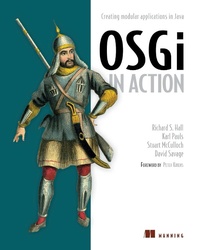
OSGi in Action
Creating Modular Applications in Java
1st Edition
Published on 5. April 2011
576 pages
978-1-63835-300-3 (ISBN)
Description

What is OSGi? Simply put, OSGi is a standardized technology that allowsdevelopers to create the highly modular Java applications that are required forenterprise development. OSGi lets you install, start, stop, update, or uninstallcomponents without taking down your entire system. The interest in OSGi basedapplications has exploded since major vendors like Sun, Spring, Oracle,BEA, and IBM have gotten behind the standard.
OSGi in Action is a comprehensive guide to OSGi with two primary goals.First, it provides a clear introduction to OSGi concepts with examples that arerelevant both for architects and developers. Then, it explores numerous practicalscenarios and techniques, answering questions like: How much of OSGi doyou actually need? How do you embed OSGi inside other containers? What arethe best practices for moving legacy systems to OSGi?
Purchase of the print book comes with an offer of a free PDF, ePub, and Kindle eBook from Manning. Also available is all code from the book.
OSGi in Action is a comprehensive guide to OSGi with two primary goals.First, it provides a clear introduction to OSGi concepts with examples that arerelevant both for architects and developers. Then, it explores numerous practicalscenarios and techniques, answering questions like: How much of OSGi doyou actually need? How do you embed OSGi inside other containers? What arethe best practices for moving legacy systems to OSGi?
Purchase of the print book comes with an offer of a free PDF, ePub, and Kindle eBook from Manning. Also available is all code from the book.
More details
Other editions
Additional editions
Book
04/2011
Manning Publications
€59.60
Article exhausted; check different version
Persons
Karl Pauls is a Felix committer.
David Savage is a Java software engineer. He is co-author of the Newton Distributed OSGi framework and Sigil tooling project, and recently joined Apache Felix as a committer.
Stuart McCulloch is a Java developer with CodeDragons, a leader in OSGi solutions, and a Felix committer.
Richard S. Hall, a long-time committer to the Apache Felix project, works with Sun Microsystems as part of the GlassFish team.
David Savage is a Java software engineer. He is co-author of the Newton Distributed OSGi framework and Sigil tooling project, and recently joined Apache Felix as a committer.
Stuart McCulloch is a Java developer with CodeDragons, a leader in OSGi solutions, and a Felix committer.
Richard S. Hall, a long-time committer to the Apache Felix project, works with Sun Microsystems as part of the GlassFish team.
Content
- Intro
- Copyright
- Brief Table of Contents
- Table of Contents
- Foreword
- Preface
- Acknowledgments
- About this Book
- About the Authors
- Part 1. Introducing OSGi: modularity, lifecycle, and services
- Chapter 1. OSGi revealed
- Chapter 2. Mastering modularity
- Chapter 3. Learning lifecycle
- Chapter 4. Studying services
- Chapter 5. Delving deeper into modularity
- Part 2. OSGi in practice
- Chapter 6. Moving toward bundles
- Chapter 7. Testing applications
- Chapter 8. Debugging applications
- Chapter 9. Managing bundles
- Chapter 10. Managing applications
- Part 3. Advanced topics
- Chapter 11. Component models and frameworks
- Chapter 12. Advanced component frameworks
- Chapter 13. Launching and embedding an OSGi framework
- Chapter 14. Securing your applications
- Chapter 15. Web applications and web services
- Appendix A. Building bundles
- Appendix B. OSGi standard services
- Index
- List of Figures
- List of Tables
- List of Listings
