

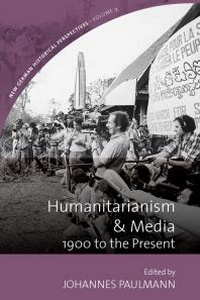
Humanitarianism and Media
1900 to the Present
1st Edition
Published on 17. December 2018
316 pages
978-1-78533-962-2 (ISBN)
Description

From Christian missionary publications to the media strategies employed by today's NGOs, this interdisciplinary collection explores the entangled histories of humanitarianism and media. It traces the emergence of humanitarian imagery in the West and investigates how the meanings of suffering and aid have been constructed in a period of evolving mass communication, demonstrating the extent to which many seemingly new phenomena in fact have long historical legacies. Ultimately, the critical histories collected here help to challenge existing asymmetries and help those who advocate a new cosmopolitan consciousness recognizing the dignity and rights of others.
Reviews / Votes
"Humanitarianism & Media proves to be a very insightful, well-written, and interesting book, which is recommendable to students and researchers involved in history and media and communication sciences in general, and the fields of humanitarianism, advocacy, journalism, and their intersections in particular. While the work does not really offer any completely new theories or concepts, it questions existing ones and lays an inspiring foundation for more in-depth, structural and critical historical research on the theme." * Communications"This very readable volume must be considered as an important contribution to a history of humanitarian activities. The contributors managed to use productively theories from media- and communication studies and, in addition, offer methodically fresh ideas for historical picture and film analysis." * H-Soz-Kult
"Nationalsocialst concentration camps and aerial warfare, famines during postcolonialism and the Spanish Civil War, all of which prevent comparable analysis for good reasons, remain separated because of borders, linguistic barriers or academic specialization, find here in pictures of "the pain of others" (Susan Sontag) their common point of reference. Not only specialists of human right (as well as Childhood Studies) and the history of photography would benefit from the thoughts and reflections offered here: in the age of visual communication this volume has set new standards." * Sehepunkte
"Based on substantial archival research and informed by relevant theoretical debates, this thought-provoking volume engages the reader in an interdisciplinary exploration of the central role the media have played for humanitarian initiatives, contributing significantly to recent scholarship on the subject". * Nina Berman, Arizona State University
"This volume consists of timely, useful, original contributions by historians, media scholars and anthropologists that will be essential reading for students". * Davide Rodogno, Graduate Institute of Geneva
More details
Series
Edition
1. Auflage
Language
English
Place of publication
Oxford
United Kingdom
Target group
Professional and scholarly
Illustrations
Bibliography; Index; 34 Illustrations
ISBN-13
978-1-78533-962-2 (9781785339622)
DOI
10.3167/9781785339615
Copyright in bibliographic data and cover images is held by Nielsen Book Services Limited or by the publishers or by their respective licensors: all rights reserved.
Schweitzer Classification
Other editions
Additional editions
Book
01/2020
1st Edition
Berghahn Books
€42.10
Shipment within 3-4 weeks
Book
12/2018
1st Edition
Berghahn Books
€147.50
Shipment within 3-4 weeks

Adele Garnier | Liliana Lyra Jubilut | Kristin Bergtora Sandvik
Refugee Resettlement
Power, Politics, and Humanitarian Governance
Book
08/2018
1st Edition
Berghahn Books
€42.10
Shipment within 3-4 weeks
Person
Johannes Paulmann is Director of the Leibniz Institute of European History at Mainz (Germany). He was Richard von Weizsaecker Fellow 2014-15 at St Antony's College, Oxford, and he edited Dilemmas of Humanitarian Aid in the Twentieth Century (2016).
Content
List of Illustrations
Acknowledgements
Humanitarianism and Media: Introduction to an Entangled History
Johannes Paulmann
PART I: HUMANITARIAN IMAGERY
Chapter 1. Promoting Distant Children in Need: Christian Imagery in the Late Nineteenth and Early Twentieth Centuries
Katharina Stornig
Chapter 2. "Make the Situation Real to Us without Stressing the Horrors": Children, Photography and Humanitarianism in the Spanish Civil War
Rose Holmes
Chapter 3. Humanitarianism on the Screen: The ICRC Films, 1921-1965
Appendix I: List of ICRC Films, 1921-1965 (Original Titles)
Appendix II: ICRC 'Humanitarion' Films, by Director/Cameraman
Daniel Palmieri
Chapter 4. "People Who Once were Human Beings Like You and Me": Why Allied Atrocity Films of Liberated Nazi Concentration Camps in 1944-46 Maximized the Horror and Universalized the Victims
Ulrike Weckel
Chapter 5. The Polemics of Pity: British Photographs of Berlin, 1945-1947
Paul Betts
Chapter 6. The Human Gaze: Photography after 1945
Tobias Weidner
PART II: HUMANITARIAN MEDIA REGIMES
Chapter 7. On Fishing in Other People's Ponds: The Freedom from Hunger Campaign, International Fundraising, and the Ethics of NGO Publicity
Heike Wieters
Chapter 8. Advocacy Strategies of Western Humanitarian NGOs from the 1960s to the 1990s
Valerie Gorin
Chapter 9. Humanitarianism and Revolution: Samed, the Palestine Red Crescent Society, and the Work of Liberation
Ilana Feldman
Chapter 10. Mediatization of Disasters and Humanitarian Aid in the Federal Republic of Germany
Patrick Merziger
Chapter 11. NGOs, Celebrity Humanitarianism, and the Media: Negotiating Conflicting Perceptions of Aid and Development during the "Ethiopian Famine"
Matthias Kuhnert
Chapter 12. The Audience of Distant Suffering and the Question of (In)Action
Maria Kyriakidou
Index
Acknowledgements
Humanitarianism and Media: Introduction to an Entangled History
Johannes Paulmann
PART I: HUMANITARIAN IMAGERY
Chapter 1. Promoting Distant Children in Need: Christian Imagery in the Late Nineteenth and Early Twentieth Centuries
Katharina Stornig
Chapter 2. "Make the Situation Real to Us without Stressing the Horrors": Children, Photography and Humanitarianism in the Spanish Civil War
Rose Holmes
Chapter 3. Humanitarianism on the Screen: The ICRC Films, 1921-1965
Appendix I: List of ICRC Films, 1921-1965 (Original Titles)
Appendix II: ICRC 'Humanitarion' Films, by Director/Cameraman
Daniel Palmieri
Chapter 4. "People Who Once were Human Beings Like You and Me": Why Allied Atrocity Films of Liberated Nazi Concentration Camps in 1944-46 Maximized the Horror and Universalized the Victims
Ulrike Weckel
Chapter 5. The Polemics of Pity: British Photographs of Berlin, 1945-1947
Paul Betts
Chapter 6. The Human Gaze: Photography after 1945
Tobias Weidner
PART II: HUMANITARIAN MEDIA REGIMES
Chapter 7. On Fishing in Other People's Ponds: The Freedom from Hunger Campaign, International Fundraising, and the Ethics of NGO Publicity
Heike Wieters
Chapter 8. Advocacy Strategies of Western Humanitarian NGOs from the 1960s to the 1990s
Valerie Gorin
Chapter 9. Humanitarianism and Revolution: Samed, the Palestine Red Crescent Society, and the Work of Liberation
Ilana Feldman
Chapter 10. Mediatization of Disasters and Humanitarian Aid in the Federal Republic of Germany
Patrick Merziger
Chapter 11. NGOs, Celebrity Humanitarianism, and the Media: Negotiating Conflicting Perceptions of Aid and Development during the "Ethiopian Famine"
Matthias Kuhnert
Chapter 12. The Audience of Distant Suffering and the Question of (In)Action
Maria Kyriakidou
Index
