

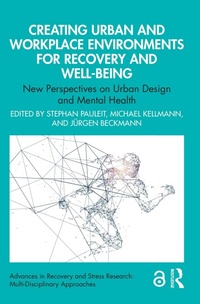
Creating Urban and Workplace Environments for Recovery and Well-being
New Perspectives on Urban Design and Mental Health
1st Edition
Published on 30. December 2024
256 pages
978-1-040-27301-2 (ISBN)
Description

This essential book offers suggestions for how cities and spaces can be planned and designed to reduce the impact of stress, provide opportunities for recovery, and promote the resilience of individuals in urban communities.
Connecting research from different scientific disciplines, the book provides a broader perspective of creating healthy lifestyle in society. It focuses on mental health and well-being by exploring how urban and workplace environments can be created to enhance and promote recovery. Divided into three parts, the book begins by investigating the multi-dimensional challenges of planning and design for stress reduction and recovery in urban areas. Part 2 concentrates on the design of residential and working environments, including commuting between the two, while Part 3 considers how neighbourhoods and entire cities contribute to or obstruct stress reduction, recovery, and well-being. The book concludes by demonstrating how the insights from the book can be implemented in practice to create restorative and inclusive environments. Bringing together leading experts, the book offers an interdisciplinary perspective for increasing well-being in urban developments.
The book will be of interest to researchers and practitioners in related fields, including environmental psychologists, urban planners, architects and landscape architects, healthcare staff, and policymakers.
Chapter 11 of this book is freely available as a downloadable Open Access PDF at http://www.taylorfrancis.com under a Creative Commons [Attribution-Non Commercial-No Derivatives (CC BY-NC-ND)] 4.0 license.
Connecting research from different scientific disciplines, the book provides a broader perspective of creating healthy lifestyle in society. It focuses on mental health and well-being by exploring how urban and workplace environments can be created to enhance and promote recovery. Divided into three parts, the book begins by investigating the multi-dimensional challenges of planning and design for stress reduction and recovery in urban areas. Part 2 concentrates on the design of residential and working environments, including commuting between the two, while Part 3 considers how neighbourhoods and entire cities contribute to or obstruct stress reduction, recovery, and well-being. The book concludes by demonstrating how the insights from the book can be implemented in practice to create restorative and inclusive environments. Bringing together leading experts, the book offers an interdisciplinary perspective for increasing well-being in urban developments.
The book will be of interest to researchers and practitioners in related fields, including environmental psychologists, urban planners, architects and landscape architects, healthcare staff, and policymakers.
Chapter 11 of this book is freely available as a downloadable Open Access PDF at http://www.taylorfrancis.com under a Creative Commons [Attribution-Non Commercial-No Derivatives (CC BY-NC-ND)] 4.0 license.
Reviews / Votes
"Based upon the intertwined concepts of human recovery and urban resilience, this important and insightful book shows how well-planned and well-designed urban environments can support our health and resilience. I appreciate the broadening of the focus to include not only living environments but also those environments where we work and commute. Nature and biodiversity are key to environments that promote recovery, resilience and wellbeing, as shown by many of the excellent contributions by leading experts. I can highly recommend this book to all of us who are helping to shape better urban environments."Dr Cecil Konijnendijk, Director, Nature Based Solutions Institute, Sweden
"Creating Urban and Workplace Environments for Recovery and Well-being is a collection of timely, relevant and comprehensive stories, reminding us that our daily surroundings, be it urban nature or a workplace, have tremendous impact on human health and well-being. In a time where the demands for multi-functionality of urban open spaces, and especially urban nature and green spaces, is dramatically increasing, this book documents and exemplifies how human health and well-being can be addressed in practice as well as in research, and in all phases from policy making to planning, design, implementation, and long-term management. This is an excellent 'must-read' for practitioners as well as researchers in the field."
Dr Thomas B. Randrup, Professor, Urban Open Space Management, Swedish University of Agricultural Sciences
More details
Series
Edition
1. Auflage
Language
English
Place of publication
London
United Kingdom
Publishing group
Taylor & Francis Ltd
Target group
College/higher education
Professional and scholarly
Illustrations
9 Tables, black and white; 19 Line drawings, black and white; 8 Halftones, black and white; 27 Illustrations, black and white
File size
12,35 MB
ISBN-13
978-1-040-27301-2 (9781040273012)
Copyright in bibliographic data and cover images is held by Nielsen Book Services Limited or by the publishers or by their respective licensors: all rights reserved.
Schweitzer Classification
Other editions
Additional editions
Stephan Pauleit | Michael Kellmann | Juergen Beckmann
Creating Urban and Workplace Environments for Recovery and Well-being
New Perspectives on Urban Design and Mental Health
Book
12/2024
1st Edition
Routledge
€197.60
Shipment within 10-20 days
Stephan Pauleit | Michael Kellmann | Juergen Beckmann
Creating Urban and Workplace Environments for Recovery and Well-being
New Perspectives on Urban Design and Mental Health
Book
12/2024
1st Edition
Routledge
€63.40
Shipment within 10-20 days
Persons
Stephan Pauleit is Chair for Strategic Landscape Planning and Management at Technical University of Munich, Germany.
Michael Kellmann is Professor of Sport Psychology at the Faculty of Sport Science at Ruhr University Bochum, Germany. He is also Honorary Professor in the School of Human Movement and Nutrition Sciences at The University of Queensland, Australia.
Juergen Beckmann is Professor of Sport Psychology, Emeritus of Excellence, at the School of Medicine and Health at Technical University of Munich, Germany. He is also Honorary Professor in the School of Human Movement and Nutrition Sciences at The University of Queensland, Australia.
Michael Kellmann is Professor of Sport Psychology at the Faculty of Sport Science at Ruhr University Bochum, Germany. He is also Honorary Professor in the School of Human Movement and Nutrition Sciences at The University of Queensland, Australia.
Juergen Beckmann is Professor of Sport Psychology, Emeritus of Excellence, at the School of Medicine and Health at Technical University of Munich, Germany. He is also Honorary Professor in the School of Human Movement and Nutrition Sciences at The University of Queensland, Australia.
Content
Part I: Conceptualizing the Problem 1. Urban flourishing: Human recovery and urban resilience as hubs for the city of the future Stephan Pauleit, Juergen Beckmann, and Michael Kellmann 2. Commuting to work by car: Is travel time leisure time? Achim Elfering and Fabrice Huber 3. Eight days a week: Long working hours, recovery, and breaks K. Wolfgang Kallus 4. Designing urban green spaces supporting health and recovery Anna Bengtsson, Anna Ashage, and Patrik Grahn Part II: Designing Home, Private and Working Environments for Recovery 5. Built recovery: New perspectives on designing office and hospital work environments Gemma Koppen, Mark N. Phillips, Claudia Iovi?a, and Tanja C. Vollmer 6. Natural spaces for stress recovery and mental well-being across the life course Matilda van den Bosch and Ingrid Jarvis 7. Urban densification, access to green space and well-being: Consequences of not owning private green space and crowded public green spaces Sjerp de Vries and Lauriane Suyin Chalmin-Pui 8. A tale of two restorations: Urban biodiversity underpins ecosystem restoration and promotes psychological restoration Monika Egerer and Melissa Marselle Part III: Urban Planning and Management for Recovery 9. Impacts of heat on human well-being: Creating restorative indoor and outdoor thermal environments in a changing climate Amelie Bauer, Hannah Lehmann, Teresa Zoelch, and Stephan Pauleit 10. Urban safety as a prerequisite for reduced stress and recovery opportunities in the city of tomorrow: Reflections beyond gender-neutral planning practices Vania Ceccato 11. Multi-scale urban design and recovery: Strategies, pathways, and implications Lanqing Gu and Martin Knoell 12. Creating urban and workplace environments for recovery and well-being: A concluding summary Juergen Beckmann, Michael Kellmann, and Stephan Pauleit
