

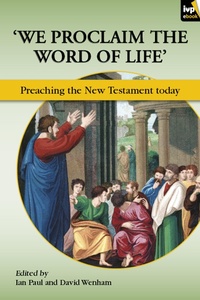
We Proclaim the Word of Life'
Preaching The New Testament Today
1st Edition
Published on 18. January 2013
288 pages
978-1-84474-884-6 (ISBN)
Description

Whatever we know about the New Testament, and however much we have studied it, it only has real value as its truths are proclaimed so that our lives are transformed, as God himself speaks and acts.
The New Testament writers were very interested in conveying their message persuasively, and this volume addresses the question of how we should preach from the New Testament in a way that is faithful to the text. The chapters cover the main texts and genres, along with the infancy narratives, parables, miracles, the Sermon on the Mount, ethics, future hope and judgment, archaeology and history, hermeneutics, and the 'New Homiletic'.
The aim is to offer insights into how to interpret, communicate and apply the New Testament, for today's preachers and Bible teachers who seek to 'proclaim the Word of life' (1 John 1:1).
The contributors are respected scholars who are also active in preaching: Charles Anderson, D. A. Carson, the late R. T. France, Justin Hardin, Mariam Kamell, I. Howard Marshall, Jason Maston, John Nolland, Peter Oakes, William Olhausen, Klyne Snodgrass, Helge Stadelmann, Christoph Stenschke, Stephen Travis, David Wenham, Paul Weston and Stephen Wright.
The New Testament writers were very interested in conveying their message persuasively, and this volume addresses the question of how we should preach from the New Testament in a way that is faithful to the text. The chapters cover the main texts and genres, along with the infancy narratives, parables, miracles, the Sermon on the Mount, ethics, future hope and judgment, archaeology and history, hermeneutics, and the 'New Homiletic'.
The aim is to offer insights into how to interpret, communicate and apply the New Testament, for today's preachers and Bible teachers who seek to 'proclaim the Word of life' (1 John 1:1).
The contributors are respected scholars who are also active in preaching: Charles Anderson, D. A. Carson, the late R. T. France, Justin Hardin, Mariam Kamell, I. Howard Marshall, Jason Maston, John Nolland, Peter Oakes, William Olhausen, Klyne Snodgrass, Helge Stadelmann, Christoph Stenschke, Stephen Travis, David Wenham, Paul Weston and Stephen Wright.
More details
Edition
1. Auflage
Language
English
Place of publication
Nottingham
United Kingdom
Edition type
Digital original
Product notice
Reflowable
ISBN-13
978-1-84474-884-6 (9781844748846)
Copyright in bibliographic data and cover images is held by Nielsen Book Services Limited or by the publishers or by their respective licensors: all rights reserved.
Schweitzer Classification
Other editions
Additional editions
Book
01/2013
Inter-Varsity Press
€26.50
Shipment within 3-4 weeks
Persons
Content
- Intro
- We Proclaim the Word of Life
- CONTENTS
- CONTRIBUTORS
- ABBREVIATIONS
- INTRODUCTION
- 1. PREACHING THE GOSPELS
- Knowing what the Gospels are about
- Recognizing the kind of writing
- Looking at the longer units
- Living inside a Gospel
- Planning the series
- Seeing biblical themes
- Connecting preaching and theology
- 2. PREACHING ON THE INFANCY NARRATIVES
- The Christmas story
- Myth and history
- The supernatural character of the events
- The relation to secular history
- The differences between Matthew and Luke
- The literary character of these chapters
- Scholarly scepticism and preaching
- Back to the text
- The fulfilment of Scripture
- Matthew
- Luke
- The annunciation to Mary (Luke 1:26-38)
- The Magnificat (Luke 1:39-56)
- The birth of Jesus (Luke 2:1-7)
- Simeon and the Nunc Dimittis (Luke 2:22-35)
- 3. PREACHING JESUS' PARABLES
- Use concrete and personal language
- Study the advantages of indirect communication
- Commit to seeing both the text and people
- Keep the parables as Jesus' parables
- Observe literary characteristics
- Shun both allegorizing and dogmas that parables have only one point
- Study parables that have the same form to see how various kinds of parables function
- Focus on the theology of the parables
- Focus on the identity displayed or called for in the parable
- Do not run from the difficulties
- Let the Bible be an ancient book
- Aim for response
- 4. PREACHING THE MIRACLES OF JESUS
- The significance of the miracles in the Gospels
- Theological interpretation of the miracles
- Homiletical strategies
- A canonical approach
- A narrative approach
- Proclaiming the mystery
- An example
- 5. PREACHING THE SERMON ON THE MOUNT
- Introduction: the primacy and difficulty of the Sermon
- Some general observations about understanding the Sermon
- Three observations about the context
- There is the context of Matthew's and Luke's Gospels as a whole
- A second contextual clue has to do with the particular context in which Matthew was written
- The third bit of context that is important is the context of the Sermon itself
- The Sermon not impossible legalism, but about kingdom living
- How to live this way
- Kingdom living
- Acknowledging that they are poor in spirit
- Going with Jesus
- Prayer to the heavenly Father
- But how literal?
- Practical conclusions for the preacher
- Grace and relationship, not legalism
- Grace, not works
- Positive beauty
- Practicality
- The serious challenge
- The preacher's integrity
- 6. THE CHALLENGES AND OPPORTUNITIES FOR PREACHING FROM THE ACTS OF THE APOSTLES
- Introduction
- The challenges of preaching the book of Acts
- The opportunities for preaching Acts
- How will we preach Acts?
- 7. PREACHING PAUL'S LETTERS
- Letters in the ancient world
- A brief guide to preaching Paul's letters
- Going forward
- What is the situation?
- What is Paul's pastoral response to this situation?
- What is the theological-scriptural ground for Paul's response?
- How might this response apply to situations in our contemporary context?
- Conclusion
- 8. PREACHING FROM THE PASTORAL EPISTLES
- The addressees - including us!
- The situation then
- Types of exposition
- What would we lose if the Pastoral Epistles had never been written?
- Christian belief
- Christian living
- Congregational life
- Problems and opportunities for the preacher
- Honesty on critical issues or silence?
- Time-bound teaching?
- Balances
- Context
- Variation
- By way of example
- Jumping the centuries: the problems in the congregations (Titus 1:10-16)
- Extracting doctrine (Titus 2:11 - 3:8)
- Further reading
- 9. THE CHALLENGE AND OPPORTUNITY OF PREACHING HEBREWS
- The challenges of preaching Hebrews
- The opportunity of Hebrews as preaching
- Hebrews as sermon: the genre question
- Exposition in individual passages in Hebrews
- Underlying hermeneutical principles of exposition in Hebrews
- Sermon structure of Hebrews: argument from exposition
- Sermon structure of Hebrews: argument for the sake of application
- Other lessons for our sermons from the sermon to the Hebrews
- The opportunity in preaching Hebrews
- Conclusion
- 10. PREACHING THE GENERAL EPISTLES
- James
- 1 Peter
- 2 Peter
- 1 John
- 2 John
- 3 John
- Jude
- Conclusion
- 11. PREACHING FROM THE BOOK OF REVELATION
- Introduction: the problems and promise of preaching Revelation
- Closing the gap between readers and Revelation
- The importance of genre
- The significance of historical context
- The influence of allusion to the Old Testament
- The role of cultural references
- The identification of literary features and structure
- The case of numerology
- Strategies for preaching
- Strategy 1: separate out the issues from the preaching
- Strategy 2: integrate issues and preaching but with clear explanation
- Strategy 3: fully integrate issues in preaching but in an overt way
- Conclusion
- 12. HOW ARCHAEOLOGY AND HISTORY CAN HELP WITH NEW TESTAMENT PREACHING
- Salvation on a coin
- Going via Corinth
- Meeting and eating in house churches
- Focus on general context
- The double archaeological and historical context of the Gospels
- When archaeological and literary worlds collide
- Text and people, then and now
- 13. PREACHING THE ETHICS OF THE NEW TESTAMENT
- Introduction
- Scholarly neglect
- Preachers' inhibitions
- Why it matters more than ever
- Kinds of ethical material
- Ethical terms in lists and clusters
- Preaching on ethics
- 14. PREACHING HOPE AND JUDGMENT
- Challenges from our culture
- Challenges from within ourselves
- Strategies for preaching
- Preaching hope
- The key themes
- Who will come?
- For what purpose will Christ come?
- When will he come?
- How then should we live in the light of this hope?
- Preaching the biblical hope
- Preaching judgment
- The key themes
- Two biblical images of judgment
- The criterion of judgment
- The outcome of judgment
- Will God bring all people into his presence?
- Judgment for Christians
- Preaching the judgment of God
- Conclusion
- Further reading
- 15. THE HERMENEUTICS OF RELATIONSHIP: THEOLOGICAL UNDERSTANDING FOR NEW TESTAMENT PREACHING
- Introduction
- What is hermeneutics and what does it tell us?
- The value of developing a relational hermeneutic
- A relational hermeneutic in action
- The need for a relational hermeneutic that is properly theological
- A theological hermeneutic must take account of Scripture's hermeneutic
- Paul and the art of Christian communication
- Grace, wisdom and love in Paul's theology of the cross: Christlike character as part of a theological hermeneutic
- Conclusion
- 16. THE ROLE OF EXEGESIS AND BIBLICAL TEXTS IN PREACHING THE NEW TESTAMENT: ENGAGING WITH THE 'NEW HOMILETIC'
- The uneven balance between text and listener in the homiletics of Fred Craddock
- The junior role of the biblical text in Eugene Lowry's homiletical theory
- Perspectives opened by the New Homiletic for biblically based preaching
- The example of Jana Childers
- The example of Thomas G. Long
- 17. PREACHING THE GOSPEL FROM THE GOSPELS
- Introduction
- Rediscovering the gospel narratives as narratives of the gospel
- They tell the story of Jesus
- They tell the story of Jesus in story forms
- They paint pictures of the kingdom
- Gospel narratives and preaching skills
- Learn to tell stories well
- Invite listeners on a 'journey'
- Create connections
- Gospel narratives and sermon strategies
- Ask the 'plot' questions
- Ask how Jesus is pictured, and what response is called for
- To appeal or not to appeal: should we invite people to respond to gospel preaching?
- Practically
- Conclusion
- Notes
