

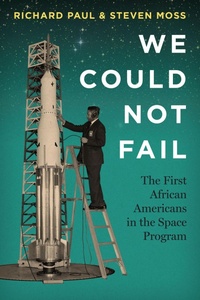
We Could Not Fail
The First African Americans in the Space Program
1st Edition
Published on 1. May 2015
312 pages
978-0-292-77251-9 (ISBN)
Description

.The Space Age began just as the struggle for civil rights forced Americans to confront the long and bitter legacy of slavery, discrimination, and violence against African Americans. Presidents John F. Kennedy and Lyndon Johnson utilized the space program as an agent for social change, using federal equal employment opportunity laws to open workplaces at NASA and NASA contractors to African Americans while creating thousands of research and technology jobs in the Deep South to ameliorate poverty. We Could Not Fail tells the inspiring, largely unknown story of how shooting for the stars helped to overcome segregation on earth.
Richard Paul and Steven Moss profile ten pioneer African American space workers whose stories illustrate the role NASA and the space program played in promoting civil rights. They recount how these technicians, mathematicians, engineers, and an astronaut candidate surmounted barriers to move, in some cases literally, from the cotton fields to the launching pad. The authors vividly describe what it was like to be the sole African American in a NASA work group and how these brave and determined men also helped to transform Southern society by integrating colleges, patenting new inventions, holding elective office, and reviving and governing defunct towns. Adding new names to the roster of civil rights heroes and a new chapter to the story of space exploration, We Could Not Fail demonstrates how African Americans broke the color barrier by competing successfully at the highest level of American intellectual and technological achievement.
Richard Paul and Steven Moss profile ten pioneer African American space workers whose stories illustrate the role NASA and the space program played in promoting civil rights. They recount how these technicians, mathematicians, engineers, and an astronaut candidate surmounted barriers to move, in some cases literally, from the cotton fields to the launching pad. The authors vividly describe what it was like to be the sole African American in a NASA work group and how these brave and determined men also helped to transform Southern society by integrating colleges, patenting new inventions, holding elective office, and reviving and governing defunct towns. Adding new names to the roster of civil rights heroes and a new chapter to the story of space exploration, We Could Not Fail demonstrates how African Americans broke the color barrier by competing successfully at the highest level of American intellectual and technological achievement.
Reviews / Votes
"Surprising and insightful." * New York Times Book Review * "The first African Americans to join the United States space program encountered pushback both inside and outside NASA's doors. When they moved to Cape Canaveral and other Deep South pillars to work on Apollo missions, the Ku Klux Klan was there to greet them. Even history and space program buffs should find insight in We Could Not Fail's fresh look at a well-treaded era." * Esquire * "This account of 10 pioneers, told against the backdrop of the civil rights era, highlights the intersection of technology and race in U.S. history, continuing innovations in technology, and the struggle of minorities to participate." * Booklist * "Paul (documentary producer) and Moss (English, Texas State Technical Coll.) offer a complementary narrative to our national story about the civil rights movement, providing a nuanced look at how integration and civil rights ideals shaped and were shaped by federal employers. . . . Vital and of interest to all Americans, from history and space buffs to students, researchers, and casual readers." * Library Journal * "President John F Kennedy's ambition to put a man on the moon was a key part of his legacy, but less well known is how his administration used NASA as an agent for social change during the civil rights movement. It's a nearly forgotten history that authors Richard Paul and Steven Moss investigate in their new book, We Could Not Fail. It profiles some of the first African Americans in the US space programme and the lasting impact of their work." * BBC World News * "We Could Not Fail is hard to put down. Reading about the personal experiences of African Americans with technical expertise before the civil rights era resonated strongly, as it likely will for any reader with African-American ancestors. The book's discussion of free African-American communities also sheds light on an important, but often overlooked, part of American history.We Could Not Fail is not only a terrific read but also an important historical book, collecting and documenting features of life in the South for African Americans that have not heretofore been recorded. " * Science Magazine * "This comprehensively researched book is replete with fascinating details about ways in which the civil rights movement influenced the space program. . . . It makes an important contribution to African American history." * The Washington Post *All prices
More details
Language
English
Place of publication
Austin, TX
United States
File size
9,80 MB
ISBN-13
978-0-292-77251-9 (9780292772519)
DOI
10.7560/772496
Copyright in bibliographic data and cover images is held by Nielsen Book Services Limited or by the publishers or by their respective licensors: all rights reserved.
Schweitzer Classification
Other editions
Additional editions
Book
09/2016
University of Texas Press
€37.32
Shipment within 15-20 days
Book
05/2015
University of Texas Press
€50.94
Article exhausted; check different version
Persons
A former producer of The Diane Rehm Show, Richard Paul is an award-winning independent public radio documentary producer whose work includes Race and the Space Race, about the first African Americans in the space program. Paul was the 2012-2013 Verville Fellow in Space History at the Smithsonian National Air and Space Museum. His feature stories have appeared on NPR's Morning Edition and PRI's Studio 360.Steven Moss is Associate Professor of English at Texas State Technical College and a Fellow of the Kellogg Institute. His master's thesis, "NASA and Racial Equality in the South, 1961-1968" (Texas Tech University, 1997), was one of the first academic works on the topic.
Content
Preface
Introduction
1. A Man of Firsts: Julius Montgomery
2. "There Was a Lot of History There": Theodis Ray
3. Stronger Than Steel: Frank Crossley
4. Dixie's Role in the Space Age
5. First of Race in Space: Ed Dwight
6. The View from Space: George Carruthers
7. "Huntsville, It Has Always Been Unique": Delano Hyder and Richard Hall
8. The Country Spartacus: Clyde Foster
9. Water Walkers: Morgan Watson and George Bourda
Conclusion
Appendix: Relevant Census Numbers on Employed Professional and Skilled Labor for NASA Host States
Notes
Acknowledgments
Index
Introduction
1. A Man of Firsts: Julius Montgomery
2. "There Was a Lot of History There": Theodis Ray
3. Stronger Than Steel: Frank Crossley
4. Dixie's Role in the Space Age
5. First of Race in Space: Ed Dwight
6. The View from Space: George Carruthers
7. "Huntsville, It Has Always Been Unique": Delano Hyder and Richard Hall
8. The Country Spartacus: Clyde Foster
9. Water Walkers: Morgan Watson and George Bourda
Conclusion
Appendix: Relevant Census Numbers on Employed Professional and Skilled Labor for NASA Host States
Notes
Acknowledgments
Index
