

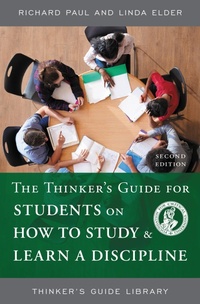
The Thinker's Guide for Students on How to Study & Learn a Discipline
2nd Edition
Published on 1. June 2019
64 pages
978-1-5381-3383-5 (ISBN)
Description

The Thinker's Guide for Students on How to Study and Learn a Discipline empowers students to take control of their own learning by asking questions, challenging assumptions, drawing upon reliable information, and exploring alternative opinions. Making intellectual work more accessible, practical, and engaging, this book fosters minds that question, probe, and can master a variety of forms of knowledge through intellectual perseverance and regular use of critical thinking skills.
As part of the Thinker's Guide Library, this book advances the mission of the Foundation for Critical Thinking to promote fair-minded critical societies through cultivating essential intellectual abilities and virtues across every field of study across world.
As part of the Thinker's Guide Library, this book advances the mission of the Foundation for Critical Thinking to promote fair-minded critical societies through cultivating essential intellectual abilities and virtues across every field of study across world.
More details
Series
Edition
2nd edition
Language
English
Place of publication
New York
United States
Illustrations
8 b/w illustrations; 24 textboxes
ISBN-13
978-1-5381-3383-5 (9781538133835)
Copyright in bibliographic data and cover images is held by Nielsen Book Services Limited or by the publishers or by their respective licensors: all rights reserved.
Schweitzer Classification
Other editions
Additional editions
Richard Paul | Linda Elder
The Thinker's Guide for Students on How to Study & Learn a Discipline
Book
01/2014
2nd Edition
Foundation for Critical Thinking
€32.70
Shipment within 3-4 weeks
Persons
Dr. Richard Paul was a leading proponent of critical thinking and, through his work and legacy, remains a distinguished thinker in the field. He founded the Center for Critical Thinking at Sonoma State University in 1980, followed by the Foundation for Critical Thinking. He developed concepts, principles, and theory essential to a robust and fairminded conception of critical thinking. Paul authored or coauthored more than two hundred articles and seven books on the critical thinking. He presented workshops to hundreds of thousands of educators over his 35-year career as a leader in the critical thinking movement.
Dr. Linda Elder is an educational psychologist and internationally recognized authority on critical thinking who has taught both psychology and critical thinking at the college level. She has been president of the Foundation for Critical Thinking and the executive director of the Center for Critical Thinking for 25 years. She has a special interest in the relation of thought and emotion, as well as the cognitive and affective and has developed an original theory of the stages of critical thinking development. Elder has coauthored four books on critical thinking, as well as all 23 titles found in the Thinker's Guide Library.
Dr. Linda Elder is an educational psychologist and internationally recognized authority on critical thinking who has taught both psychology and critical thinking at the college level. She has been president of the Foundation for Critical Thinking and the executive director of the Center for Critical Thinking for 25 years. She has a special interest in the relation of thought and emotion, as well as the cognitive and affective and has developed an original theory of the stages of critical thinking development. Elder has coauthored four books on critical thinking, as well as all 23 titles found in the Thinker's Guide Library.
Content
- Intro
- How to Use This Guide
- Contents
- Why a Thinker's Guide on How to Study and Learn?
- Forward: John Stuart Mill as an Exemplar of How to Study and Learn
- The Instructional Methods of James Mill
- Conclusion
- Part I: Laying the Foundation
- 18 Ideas for Becoming a Master Student
- The Relationship Between Critical Thinking and How to Study and Learn a Discipline
- How To Learn With Discipline
- How to Identify an Underlying Idea for the Subjects You Study
- Understanding Content Through The Thinking It Requires: A Key To Deep Learning
- How to Identify the Structure of a Subject: The Elements of Thought
- How to Figure Out the Form of Thinking Essential to Courses or Subjects
- How to Analyze the Logic of an Article, Essay, or Chapter
- How to Figure Out the Logic of a Textbook
- How to Understand Ideas
- How to Think Within the Ideas of a Subject
- How to Control (and Not Be Controlled By) Ideas
- How to Understand Reading, Writing, Speaking, Listening and Thinking
- How to Learn Ideas from Textbooks
- Part II: Following Through
- How Good a Student Are You?
- How to Think Through the Defining Traits of the Disciplined Mind
- To Evaluate Thinking We Must Understand and Apply Intellectual Standards
- How to Evaluate an Author's Reasoning
- How to Raise Important Questions Within a Subject
- How to Distinguish One-System from Competing-Systems Disciplines
- How to Ask Questions About Fields of Study
- How to Ask Questions About Textbooks
- How to Understand the Logic of Biochemistry (An Example)
- How to Think Biologically (An Example)
- How To Think Historically (An Example)
- The Logic of Philosophy
- The Logic of Sociology
- The Logic of Archaeology
- How to Understand the Role of Questions in Thinking and Learning
- How to Distinguish Inert Information and Activated Ignorance from Activated Knowledge
- A Test to Repeat In Every Class and Subject
