

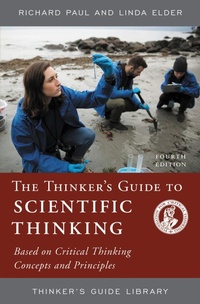
The Thinker's Guide to Scientific Thinking
Based on Critical Thinking Concepts and Principles
4th Edition
Published on 1. June 2019
66 pages
978-1-5381-3384-2 (ISBN)
Description

The Thinker's Guide to Scientific Thinking focuses on developing the intellectual skills inherent in the well-cultivated practice of every area of scientific research and study. It helps students and practicing scientists come to reason within the logic of science and to see the field as a cohesive whole.
From astronomers to zoologists and physicists to chemists, skilled scientists use careful analysis to question data, test theories, draw logical conclusions, and propose feasible solutions. Students in science courses, and scientists themselves will find their analytical abilities enhanced by the engaging framework of inquiry set forth by Richard Paul and Linda Elder in this guide.
As part of the Thinker's Guide Library, this book advances the mission of the Foundation for Critical Thinking to promote fairminded critical societies through cultivating essential intellectual abilities and virtues across every field of study across world.
From astronomers to zoologists and physicists to chemists, skilled scientists use careful analysis to question data, test theories, draw logical conclusions, and propose feasible solutions. Students in science courses, and scientists themselves will find their analytical abilities enhanced by the engaging framework of inquiry set forth by Richard Paul and Linda Elder in this guide.
As part of the Thinker's Guide Library, this book advances the mission of the Foundation for Critical Thinking to promote fairminded critical societies through cultivating essential intellectual abilities and virtues across every field of study across world.
More details
Series
Edition
4th edition
Language
English
Place of publication
New York
United States
Illustrations
10 color illustrations; 31 color photos; 8 tables; 3 textboxes
ISBN-13
978-1-5381-3384-2 (9781538133842)
Copyright in bibliographic data and cover images is held by Nielsen Book Services Limited or by the publishers or by their respective licensors: all rights reserved.
Schweitzer Classification
Other editions
Additional editions
Richard Paul | Linda Elder
The Thinker's Guide to Scientific Thinking
Based on Critical Thinking Concepts and Principles
Book
01/2015
4th Edition
Foundation for Critical Thinking
€38.20
Shipment within 3-4 weeks
Persons
Dr. Richard Paul was a leading proponent of critical thinking and, through his work and legacy, remains a distinguished thinker in the field. He founded the Center for Critical Thinking at Sonoma State University in 1980, followed by the Foundation for Critical Thinking. He developed concepts, principles, and theory essential to a robust and fairminded conception of critical thinking. Paul authored or coauthored more than two hundred articles and seven books on the critical thinking. He presented workshops to hundreds of thousands of educators over his 35-year career as a leader in the critical thinking movement.
Dr. Linda Elder is an educational psychologist and internationally recognized authority on critical thinking who has taught both psychology and critical thinking at the college level. She has been president of the Foundation for Critical Thinking and the executive director of the Center for Critical Thinking for 25 years. She has a special interest in the relation of thought and emotion, as well as the cognitive and affective and has developed an original theory of the stages of critical thinking development. Elder has coauthored four books on critical thinking, as well as all 23 titles found in the Thinker's Guide Library.
Dr. Linda Elder is an educational psychologist and internationally recognized authority on critical thinking who has taught both psychology and critical thinking at the college level. She has been president of the Foundation for Critical Thinking and the executive director of the Center for Critical Thinking for 25 years. She has a special interest in the relation of thought and emotion, as well as the cognitive and affective and has developed an original theory of the stages of critical thinking development. Elder has coauthored four books on critical thinking, as well as all 23 titles found in the Thinker's Guide Library.
Content
- The Thinker's Guide to SCIENTIFIC THINKING
- Contents
- Why Scientific Thinking?
- The Elements of Scientific Thought
- Questions Using the Elements of Scientific Thought
- A Checklist for Scientific Reasoning
- Scientific Thinking Seeks to Quantify, Explain, and Predict Relationships in Nature
- Universal Intellectual Standards Essential to Sound Scientific Thinking
- Intellectual Standards in Scientific Thinking
- The Figuring Mind Thinking Scientifically
- How to Analyze the Logic of a Scientific Article, Essay, or Chapter
- Analyzing the Logic of a Science Textbook
- Experimental Thinking Requires Experimental Controls
- The Logic of an Experiment
- Post Experiment Analysis
- How to Evaluate an Author's or Experimenter's Scientific Reasoning
- Two Kinds of Scientific Questions
- Asking One-System and Conflicting-System Questions
- Scientific Reasoning Abilities
- Analyzing & Assessing Scientific Research
- Purpose
- Questions at Issue or Central Problem
- Information
- Inference and Interpretation
- Assumptions
- Concepts and Ideas
- Point of View
- Implications and Consequences
- Intellectual Dispositions Essential to Scientific Thinking
- Scientific Thinkers Routinely Apply the Intellectual Standards
- Development of the Scientific Mind
- Analyzing the Logic of a Subject
- The Logic of Scientific Reasoning
- The Questioning Mind in Science
- The Logic of Science
- The Logic of Physics
- The Logic of Chemistry
- The Logic of Geology
- The Logic of Astronomy
- The Logic of Biology
- The Logic of Zoology
- The Logic of Botany
- The Logic of Biochemistry
- The Logic of Paleontology
- The Logic of Animal Physiology
- The Logic of Archaeology
- The Logic of Ecology
- The Problem of Pseudo-Scientific and Unscientific Thinking
- A Pseudo-Science: Why Astrology Is Not a Science
- A Critical Approach to Scientific Thinking
- Ethics and Science
