

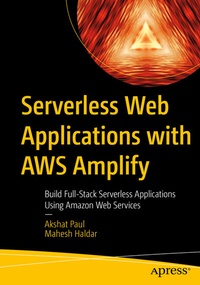
Serverless Web Applications with AWS Amplify
Description

You'll see how to manage authentication, standard UI components, database storage, filesystem, CI/CD pipeline and more. You'll also examine the architecture, strengths, scalability, and limitations of serverless, and how to use AWS Amplify effectively. You will use tools including React, Cognito, GraphQL, DynamoDB, Kinesis, and Sagemaker.
AWS Amplify is the fastest and easiest way to build serverless web and mobile apps at scale, comprising tools and services that work independently and can be wired together to build scalable apps.
What You'll Learn
-
Build GraphQL and REST APIs
-
Model data with Amplify Datastores
- Set up a CI/CD pipeline with Amplify
- Record and make sense of user data analytics with Kinesis
- Boost your application with AI/ML capability using Sagemaker
Developers who have worked on web technologies and want to learn how to build serverless applications and developers interested in making powerful applications using AWS that can then be wired using AWS Amplify.
More details
Other editions
Additional editions
Persons
Akshat Paul is a technology leader and author of four books on React Native, Ruby, and Rubymotion. He has extensive experience of mobile and web development and has delivered many enterprise and consumer applications over the years. In other avatars, Akshat frequently speaks at conferences and meetups on various technologies. He has given talks at React Native EU, Crossplatform mobile summit, Devops@scale Amsterdam, DevTheory Conference India, RubyConfIndia, #inspect-RubyMotion Conference brussels and was KeyNote speaker at technology leadership events at bkk and kl. Besides writing code Akshat spends time with his family, is an avid reader, and is obsessive about healthy eating.
Mahesh Haldar
is a developer, blogger and industry speaker who loves the JavaScript ecosystem, Flutter, cloud technologies and builds efficient software products to help businesses grow and improve their customers experience. As a principal software engineer, he currently architects and builds software solutions for the e-commerce platform Carrefour.
He speaks at tech community meetups and actively writes blogs on medium and has had research published in IJCA. Haldar has designed and developed complex large-scale systems for start-ups and large enterprises like Jago Bank and McKinsey & Company.
Content
1. Introduction to Serverless.- 2. UI Component and Authentication.- 3. Creating a Crude REST API.- 4. Integrating RETS APIs with a Frontend React App.- 5. Offline-first App.- 6. Data Storage.- 7. Analytics.- 8. Continuous Integration and Continuous Delivery/Continuous Deployment.- Chapter 9: Amplify Supplements.
