

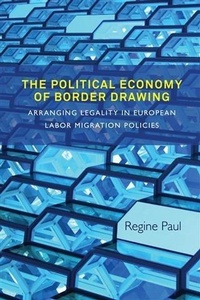
The Political Economy of Border Drawing
Arranging Legality in European Labor Migration Policies
Published on 1. January 2015
244 pages
978-1-78238-542-4 (ISBN)
Description

The conditions for non-EU migrant workers to gain legal entry to Britain, France, and Germany are at the same time similar and quite different. To explain this variation this book compares the fine-grained legal categories for migrant workers in each country, and examines the interaction of economic, social, and cultural rationales in determining migrant legality. Rather than investigating the failure of borders to keep unauthorized migrants out, the author highlights the different policies of each country as "border-drawing" actions. Policymakers draw lines between different migrant groups, and between migrants and citizens, through considerations of both their economic utility and skills, but also their places of origin and prospects for social integration. Overall, migrant worker legality is arranged against the backdrop of the specific vision each country has of itself in an economically competitive, globalized world with rapidly changing welfare and citizenship models.
Reviews / Votes
"This volume constitutes a valuable study on the topic of international migrations in the European context, while not exclusively focusing on the EU. Given that it concerns the broad research area of migrations and public policy, it is inherently multi-disciplinary... The structure of the book is clear and well thought out, while its contents is both concise and in-depth, featuring a thorough introduction, six chapters and conclusions... Overall, the volume serves two important functions. First, it chronicles the current data on labor migration policies in the chosen EU countries, and, second, it sheds new light on selected aspects of the field. Owing to this, it is a good choice for many readers, including scientists and specialists - but not limited to those, as it is also accessible to people, who are newly discovering the research area." ? Journal of Common Market Studies"The Political Economy of Border Drawing is an interesting and relevant read for anyone interested in migration management and policies in Europe. The book contains key statistics on legal migration in each country and clearly summarizes each chapter's main analytical points and findings, making it very reader-friendly. It can be recommended for both academic scholars and policy practitioners seeking better understanding of the methods and management of labor migration." ? International Migration Review
"The volume is a comprehensive text on the labor management of the three countries and in its comparative approach contributes to an understanding of the underlying logics of labor migrant selectivity in Germany, the UK and France. Paul sees the emergence of a common cultural political economy of labor migration, influenced by common norms, such as competition and economic utility in France, Germany and the UK. Her approach of taking a Bourdieusian perspective and including the idea of symbolic power into state theory and migration studies is especially worth mentioning." ? Journal of Economics Bibliography
"The author relates in an inspiring way [how]...capitalism, the welfare regime, and citizenship [relate] to migration policies, and analyzes the logics of labor migration regulations in three cases. The book makes a key contribution to the academic debate by pointing light on the normative basis of migration policies and the seeming contradictions between the logics of migrant admissions." ? Lisa-Marie Heimeshoff, University of Kassel
"This is one the most innovative books on labor migration I have read in a decade. Regine Paul's precise mastery of, among others, comparative political economy and rigorous constructivist sociology allows her to go beyond traditional accounts of labor migration policy... [This]book is a wake-up call for political economists, who too often take notions such as skills, shortage or legality for granted instead of studying them as objects of political struggles and stakes in contested boundary-making processes." ? Sebastien Chauvin, University of Amsterdam
More details
Language
English
Place of publication
Oxford
United Kingdom
Target group
Professional and scholarly
Illustrations
Bibliography; Index; 10 Tables, unspecified; 23 Illustrations
File size
5,45 MB
ISBN-13
978-1-78238-542-4 (9781782385424)
DOI
10.3167/9781782385417
Copyright in bibliographic data and cover images is held by Nielsen Book Services Limited or by the publishers or by their respective licensors: all rights reserved.
Schweitzer Classification
Other editions
Additional editions

Regine Paul
The Political Economy of Border Drawing
Arranging Legality in European Labor Migration Policies
Book
03/2019
1st Edition
Berghahn Books
€41.60
Shipment within 3-4 weeks
Regine Paul
The Political Economy of Border Drawing
Arranging Legality in European Labor Migration Policies
Book
01/2015
1st Edition
Berghahn Books
€147.00
Shipment within 3-4 weeks
Person
Regine Paul is a postdoc scholar with the HowSAFE project on comparative risk regulation at the University of Bielefeld. She has published a number of scholarly articles and contributed to edited volumes on migration and mobility policies in Europe. She is also board member of the research network "European Integration and the Global Political Economy" at the Council for European Studies.
Content
List of Figures, Tables and Boxes
Preface
Abbreviations
Introduction: Labor Migration Management: A Case for Interdisciplinary and Interpretive Policy Studies
PART I: BORDER-DRAWING AS A FRAMEWORK FOR MIGRATION POLICY
Chapter 1. Labor Migration Management as Meaningful Border-Drawing
Chapter 2. Border-Drawing across Capitalist Economies, Welfare States and Citizenship Regimes
Chapter 3. Contextualized Border-Drawing: Profiling Migration Histories and Policy Legacies for Comparative Analysis
PART II: BORDER-DRAWING IN GERMAN, FRENCH AND BRITISH LABOR MIGRATION POLICIES
Chapter 4. What Makes Migrant Workers 'Legal'? Mapping Entry Regulation
Chapter 5. A "Tool for Growth"? The Shared Cultural Political Economy of Labor Migration Policies
Chapter 6. "Poles Don't Even Play Cricket!" Embedding Labor Migration Policies in National Socio-Cultural Norms
Conclusion: Border-Drawing, Policy Analysis, and the Governance of Mobility in Europe
Documents and Interviews
References
Index
Preface
Abbreviations
Introduction: Labor Migration Management: A Case for Interdisciplinary and Interpretive Policy Studies
PART I: BORDER-DRAWING AS A FRAMEWORK FOR MIGRATION POLICY
Chapter 1. Labor Migration Management as Meaningful Border-Drawing
Chapter 2. Border-Drawing across Capitalist Economies, Welfare States and Citizenship Regimes
Chapter 3. Contextualized Border-Drawing: Profiling Migration Histories and Policy Legacies for Comparative Analysis
PART II: BORDER-DRAWING IN GERMAN, FRENCH AND BRITISH LABOR MIGRATION POLICIES
Chapter 4. What Makes Migrant Workers 'Legal'? Mapping Entry Regulation
Chapter 5. A "Tool for Growth"? The Shared Cultural Political Economy of Labor Migration Policies
Chapter 6. "Poles Don't Even Play Cricket!" Embedding Labor Migration Policies in National Socio-Cultural Norms
Conclusion: Border-Drawing, Policy Analysis, and the Governance of Mobility in Europe
Documents and Interviews
References
Index
