

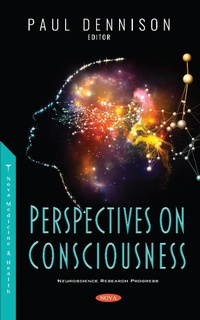
Perspectives on Consciousness
Published on 25. February 2021
410 pages
978-1-5361-9347-3 (ISBN)
Description

Perspectives on Consciousness bridges ancient views on consciousness with modern neuroscience, quantum physics and higher-dimensional mathematics, as well as real-world application to raising awareness of consciousness in teaching. Following a description of neurobiological approaches towards understanding the subjective nature of conscious experience in Chapter 1, including the enigma of qualia, the challenging dilemmas of understanding damaged consciousness following brain injury are reviewed in Chapter 2. The nature of qualia is taken up again in Chapter 3, which introduces a Qbit theory of consciousness based on inspirations and insights from quantum mechanics, biology, information theory and thermodynamics. Chapters 4, 5 and 6 bridge ancient and modern views on consciousness, ranging across ancient yet impressively sophisticated Buddhist understandings of perception, feeling and cognition (Chapter 4), the also ancient Jewish mystical tradition of the kabbalistic Zohar (Chapter 6), and insights into brain activity drawn from deep states of meditation (Chapter 5). Chapter 5 also includes a discussion of hierarchies of consciousness including likely interactions at the global-societal level with implications to understanding climate change and the Covid-19 pandemic. Chapter 7 takes readers to the outer reaches of discussions on consciousness to introduce ideas of higher-dimensional structures, and the problem of understanding consciousness within mainstream physics, before the final Chapter 8 sets a refreshing and timely change of pace to consider the need to help children, and their teachers, develop a broader awareness of consciousness as part of life in the global "family." The book will be of interest to a general scientific audience, as well as those with specialized interests in neuroscience and consciousness studies, education and philosophy, as well as Buddhist and Kabbalistic spiritual traditions.
More details
Other editions
Additional editions
Paul Dennison
Perspectives on Consciousness
Book
03/2021
Nova Science Publishers Inc
€303.55
Shipment within 15-20 days
Content
- Intro
- Contents
- Preface
- Chapter 1
- The Neurobiological Approach to Conscious Subjective Experience*
- Abstract
- Introduction
- Consciousness: The Traditional Philosophical Debate
- The Self-Consciousness Dimension
- Models of Consciousness and Self-Consciousness
- Edelman's Model of Consciousness
- Damasio's Biological Theory of Consciousness
- Metzinger's Self-Model Theory
- The Embodied Perspective of Self- Consciousness
- Exploring the Neurobiological Correlates of Self-Consciousness
- The Real Hard Problem: Exploring the Subjective Experience
- Conclusion
- References
- Chapter 2
- Assessment of Consciousness after Brain Injury: A Prolonged Disorder of Diagnosis
- Abstract
- Introduction
- Background
- Presentations in Prolonged Disorders of Consciousness
- Vegetative State
- Minimally Conscious State
- Similar Presentations
- Current Neurobehavioural Diagnostic Measures
- Key Current Diagnostic Measures
- Sensory Modality Assessment and Rehabilitation Technique (SMART)
- JFK Coma Recovery Scale - Revised (CRS-R)
- Wessex Head Injury Matrix (WHIM)
- Key Additional Neurobehavioural Measures
- Sensory Tool to Assess Responsiveness (STAR)
- Post-Coma Scale (PCS)
- Music Therapy Assessment Tool for Awareness in Disorders of Consciousness (MATADOC)
- Diagnostic Issues with Neurobehavioural Assessments
- Tailoring of Measures
- Stringency of Criteria
- Involvement of Caregivers
- Clinician Experience
- Lack of Objective Measures
- Future Research
- Neurophysiological and Neuroimaging Diagnostic Measures
- Conclusion
- References
- Chapter 3
- The QBIT Theory of Consciousness*
- Abstract
- Introduction
- Iterative Hierarchical Computation
- Predictive Coding
- Generative Model
- Bayesian Inference
- Free-Energy Principle
- Information and Entropy
- Complexity
- Symmetry Breaking
- Information Compression
- Entanglement and Coherence
- Entanglement Purification
- Monogamy of Entanglement
- Quantum Computation
- Neural Qubits
- Topological Qubits
- Qualia and Meaning
- Chunking
- QBIT, IIT, and Orch OR
- Conclusion
- Acknowledgments
- References
- Chapter 4
- The Nature and Roles of Consciousness in Theravada Buddhism*
- Abstract
- TheravAda Buddhism
- The Analysis of a Person into Five Aggregates: Bundles of Processes
- Comparisons to Modern Neuroscience
- Lack of an Enduring, Continuous Self, and the Need for Self-Control and Self-Discipline
- The "I Am" Conceit
- Consciousness and Name-and-Form
- The Abhidhamma Model of Citta, Cetasikas, and RUpa
- Non-Materialism, and Consciousness as a Fundamental Element of Reality
- Mind-Body Interaction
- The Physical Supports for Consciousness
- The Abhidhamma on the Sequence of Mental Processing
- The Arising of a Sense Consciousness
- The Situation During Sleep
- Further Comparisons to Modern Neuroscience
- The Khandhas Model
- The Abhidhamma Model
- The JhAnas, or Absorptions: Altered States of Consciousness
- The Formless (Arupa) States
- The Sphere of Infinite Space
- The Sphere of Infinite Consciousness
- The Sphere of No-Thingness
- The Sphere of Neither Perception Nor Non-Perception
- The State of Cessation, and Nirvana
- Conclusion
- Abbreviations
- References
- Chapter 5
- The Human Default Consciousness, Jhana Consciousness, Gaia "Consciousness" and Some Thoughts on the Covid-19 Pandemic*
- Abstract
- Introduction
- The Human Default Consciousness in Western Philosophy, Psychoanalysis, Buddhism and Neuroscience
- Western Philosophy
- Perception and Consciousness
- The Strength of Impressions, Differences between Them, and Their Meaning to the Recipient
- Attention
- Order, in Time and Space
- Language
- Psychoanalysis
- Outer-Inner, Early Infant Development and Subjectivity
- The Language of Relationship
- The Grammar of Defence
- Buddhist Meditation
- The First Rupa (Form) Jhana and Disengagement from Sensory Consciousness
- The Second Rupa Jhana
- The Third and Fourth Rupa Jhanas
- Breaking the Cycle of Dependence
- Neuroscience
- Free Energy and Active Inference
- Sentience, Subjectivity and Consciousness
- Disruption of the Default Sensory Consciousness Towards Jhana Consciousness
- Spindles, Attention and the 1st Rupa Jhana
- Infraslow Waves (ISWs) and the 2nd and Higher Rupa Jhanas
- Underlying Cortical Sources of ISWs
- The 2nd and Higher Rupa Jhanas
- Spike-Waves and Seizure-Like States
- Spike-Waves
- Instability
- Brain Networks, Harmonic and Fractal Structure
- Jhana Consciousness
- A New Axis of Consciousness
- Markov Blankets and Hierarchies of "Consciousness"
- Markov Blanket Hierarchies
- "Communication" and Forms of Consciousness
- Default Sensory Consciousness (DCs)
- Jhana Consciousness
- "Consciousness" More Broadly
- The Illusion of "I"
- A Global Markov Blanket, Gaia Consciousness and Climate Change
- The Covid-19 Pandemic and Breakdown of the Global Markov Blanket
- Instability of Markov Blanket Structures and Breakdown of Adaptive Inference
- Information Geometries and the Nature of Breakdown of the Global Markov Blanket
- Cross-Discipline Lessons and Options
- Conclusion
- References
- Chapter 6
- The Faces of God: A Kabbalistic "Myth" and Its Implications for Consciousness*
- Abstract
- The Value of Mysticism for Consciousness Research
- Kabbalah and Levels of Consciousness
- The Faces of God and the Constellations of Self
- The Ontology of Consciousness
- References
- Chapter 7
- Making Space and Time for Consciousness in Physics*
- Abstract
- Introduction
- Relating Physical and Perceptual Space
- 3D Reality Structure and Representative Theory
- 4D Reality Structure and Extended Mind
- The Flow of Time and 5D Reality Structure
- Psycho-Physical Space-Time
- The Specious Present and The Nature of Self
- Non-Physical Realms
- Conclusion
- Acknowledgments
- References
- Chapter 8
- Integration of Consciousness in Teaching and Learning
- Abstract
- Introduction
- Consciousness and "Cosmic" Consciousness: Theories and Definitions
- Historical Philosophy
- Contemporary Science
- Variations of Consciousness
- The Importance of Consciousness in Education
- Its Fundamental Role
- Hierarchies of Consciousness in Education
- Application of Consciousness in Education
- p4cHI (Philosophy for Children in Hawai'i) and p4t (Philosophy for Teachers)
- From the Ground Up
- Education of the Heart
- Insights for Education
- Conclusion
- References
- About the Editor
- About the Contributors
- Index
- Blank Page
- Blank Page
