

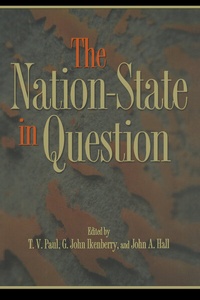
The Nation-State in Question
1st Edition
Published on 7. December 2020
400 pages
978-0-691-22149-6 (ISBN)
Description

Has globalization forever undermined the state as the mighty guarantor of public welfare and security? In the 1990s, the prevailing and even hopeful view was that it had. The euphoria did not last long. Today the "return of the state" is increasingly being discussed as a desirable reality. This book is the first to bring together a group of prominent scholars from comparative politics, international relations, and sociology to systematically reassess--through a historical lens that moves beyond the standard focus on the West--state-society relations and state power at the dawn of the twenty-first century.
The contributors examine the sources and forms of state power in light of a range of welfare and security needs in order to tell us what states can do today. They assess the extent to which international social forces affect states, and the capacity of states to adapt in specific issue areas. Their striking conclusion is that states have continued to be pivotal in diverse areas such as nationalism, national security, multiculturalism, taxation, and industrial relations. Offering rich insights on the changing contours of state power, The Nation-State in Question will be of interest to social scientists, students, and policymakers alike. John Hall's introduction is followed by chapters by Peter Baldwin, John Campbell, Francesco Duina, Grzegorz Ekiert, Jeffrey Herbst, Christopher Hood, Anatoly Khazanov, Brendan O'Leary, T. V. Paul, Bernard Yack, Rudra Sil, and Minxin Pei. The conclusion is by John Ikenberry.
The contributors examine the sources and forms of state power in light of a range of welfare and security needs in order to tell us what states can do today. They assess the extent to which international social forces affect states, and the capacity of states to adapt in specific issue areas. Their striking conclusion is that states have continued to be pivotal in diverse areas such as nationalism, national security, multiculturalism, taxation, and industrial relations. Offering rich insights on the changing contours of state power, The Nation-State in Question will be of interest to social scientists, students, and policymakers alike. John Hall's introduction is followed by chapters by Peter Baldwin, John Campbell, Francesco Duina, Grzegorz Ekiert, Jeffrey Herbst, Christopher Hood, Anatoly Khazanov, Brendan O'Leary, T. V. Paul, Bernard Yack, Rudra Sil, and Minxin Pei. The conclusion is by John Ikenberry.
More details
Other editions
Additional editions
T.V. Paul | G. John Ikenberry | John A. Hall
The Nation-State in Question
Book
10/2003
Princeton University Press
€71.80
Article exhausted; check different version
T.V. Paul | G. John Ikenberry | John A. Hall
The Nation-State in Question
The Nation-State in Question
Book
10/2003
Princeton University Press
€44.30
Article not available at the moment
Persons
T. V. Paul, Professor of Political Science at McGill University, has published six books including India in the World Order. G. John Ikenberry, Peter F. Krogh Professor of Geopolitics and Global Justice at Georgetown University, is the author of After Victory (Princeton), which received the Robert L. Jervis and Paul W. Schroeder Prize for 2002 from the American Political Science Association as the best book in the area of international history and politics. John Hall is James McGill Professor of Sociology at McGill University. His books include Is America Breaking Apart? (Princeton).
Content
- Cover Page
- Half-title Page
- Title Page
- Copyright Page
- Contents
- Illustrations
- Preface
- Introduction: Nation-States in History
- Part 1: National Identities
- Chapter 1: Nationalism, Popular Sovereignty, and the Liberal Democratic State
- Chapter 2: What States Can Do with Nations: An Iron Law of Nationalism and Federation?
- Chapter 3: A State without a Nation? Russia after Empire
- Chapter 4: The Return of the Coercive State: Behavioral Control in Multicultural Society
- Part 2: State Security
- Chapter 5: States, Security Function, and the New Global Forces
- Chapter 6: States and War in Africa
- Part 3: State Autonomy
- Chapter 7: National Legislatures in Common Markets: Autonomy in the European Union and Mercosur
- Chapter 8: The Tax State in the Information Age
- Chapter 9: States, Politics, and Globalization: Why Institutions Still Matter
- Chapter 10: Globalization, the State, and Industrial Relations: Common Challenges, Divergent Transitions
- Part 4: State Capacity
- Chapter 11: The State after State Socialism: Poland in Comparative Perspective
- Chapter 12: Rotten from Within: Decentralized Predation and Incapacitated State
- Conclusion: What States Can Do Now
- Contributors
- Index
