

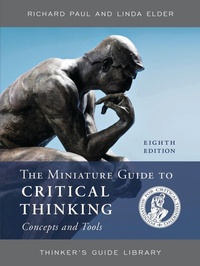
The Miniature Guide to Critical Thinking Concepts and Tools
8th Edition
Published on 20. September 2019
48 pages
978-1-5381-3495-5 (ISBN)
Description

This powerful book introduces core critical thinking concepts and principles as an empowering problem-solving framework for every profession, course of study, and indeed every area of life. The Miniature Guide to Critical Thinking Concepts and Tools distills the groundbreaking work of Richard Paul and Linda Elder, targeting how to deconstruct thinking through the elements of reasoning and how to assess the quality of our thinking.
The eighth edition of this guide further details the foundations of critical thinking and how they can be applied in instruction to improve teaching and learning at all levels; it also reveals how we can learn to identify and avoid egocentric and sociocentric thought, which lead to close-mindedness, self-deception, arrogance, hypocrisy, greed, selfishness, herd mentality, prejudice, and the like.
With more than half a million copies sold, Richard Paul and Linda Elder's bestselling book in the Thinker's Guide Library is used in secondary and higher education courses and professional development seminars across the globe. In a world of conflicting information and clashing ideologies, this guide clears a path for advancing fairminded critical societies.
The eighth edition of this guide further details the foundations of critical thinking and how they can be applied in instruction to improve teaching and learning at all levels; it also reveals how we can learn to identify and avoid egocentric and sociocentric thought, which lead to close-mindedness, self-deception, arrogance, hypocrisy, greed, selfishness, herd mentality, prejudice, and the like.
With more than half a million copies sold, Richard Paul and Linda Elder's bestselling book in the Thinker's Guide Library is used in secondary and higher education courses and professional development seminars across the globe. In a world of conflicting information and clashing ideologies, this guide clears a path for advancing fairminded critical societies.
More details
Series
Edition
8th edition
Language
English
Place of publication
New York
United States
Illustrations
17 color illustrations
File size
2,45 MB
ISBN-13
978-1-5381-3495-5 (9781538134955)
Copyright in bibliographic data and cover images is held by Nielsen Book Services Limited or by the publishers or by their respective licensors: all rights reserved.
Schweitzer Classification
Other editions
Additional editions
Richard Paul | Linda Elder
The Miniature Guide to Critical Thinking Concepts and Tools
Book
09/2019
8th Edition
Rowman & Littlefield Publishers
€14.00
Shipment within 3-4 weeks
Persons
Dr. Linda Elder is an educational psychologist who has taught both psychology and critical thinking at the college level. She has been President of the Foundation for Critical Thinking and the Executive Director of the Center for Critical Thinking for almost 25 years. She has a special interest in the relation of thought and emotion, as well as the cognitive and affective. She has developed an original theory of the stages of critical thinking development. Elder has coauthored four books on critical thinking, as well as all 23 titles found in the Thinker's Guide Library.
Dr. Richard Paul was a leading proponent of critical thinking and through his work and legacy remains an international authority in the field. He founded the Center for Critical Thinking at Sonoma State University in 1980, followed by the Foundation for Critical Thinking. He developed concepts, principles, and theory essentials to a robust and fairminded conception of critical thinking and authored more than 200 articles and seven books on the topic. He presented workshops to hundreds of thousands of educators over his 35-year career as a leader in the critical thinking movement.
Dr. Richard Paul was a leading proponent of critical thinking and through his work and legacy remains an international authority in the field. He founded the Center for Critical Thinking at Sonoma State University in 1980, followed by the Foundation for Critical Thinking. He developed concepts, principles, and theory essentials to a robust and fairminded conception of critical thinking and authored more than 200 articles and seven books on the topic. He presented workshops to hundreds of thousands of educators over his 35-year career as a leader in the critical thinking movement.
Content
- Intro
- About the Authors
- Contents
- Introduction
- Why Critical Thinking?
- Stages of Critical Thinking Development
- A Substantive Approach to Critical Thinking
- Critical Thinkers Routinely Apply Intellectual Standards to the Elements of Reasoning
- Three Types of Character
- The Elements of Thought
- Questions Using the Elements of Thought
- A Checklist for Reasoning
- The Figuring Mind
- Universal Intellectual Standards
- Some Essential Intellectual Standards for All Human Thought
- Where Do Intellectual Standards Come From?
- Intellectual Virtues of the Fairminded Critical Thinker
- Essential Intellectual Traits
- How Intellectual Virtues Are Interrelated
- The Spirit of Critical Thinking
- Template for Analyzing the Logic of an Article
- Criteria for Evaluating Reasoning
- A Template for Problem-Solving
- Analyzing and Assessing Research
- Three Kinds of Questions
- Three Levels of Thought
- The Human Mind Is Frequently Irrational While Having the Capacity for Rational Thought
- Humans Often Distort Reality Through Irrational Lenses
- The Problem of Egocentric Thinking
- Feelings That Accompany Egocentrism
- The Problem of Sociocentric Thinking
- Primary Forms of Sociocentric Thought
- Unethical Pursuit of Group Agendas
- Envisioning Critical Societies
- 20 Barriers to Critical Societies
