

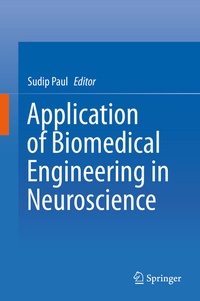
Application of Biomedical Engineering in Neuroscience
Description

This book focuses on interdisciplinary research in the field of biomedical engineering and neuroscience. Biomedical engineering is a vast field, ranging from bioengineering to brain-computer interfaces. The book explores the system-level function and dysfunction of the nervous system from scientific and engineering perspectives. The initial sections introduce readers to the physiology of the brain, and to the biomedical tools needed for diagnostics and effective therapies for various neurodegenerative and regenerative disorders.
In turn, the book summarizes the biomedical interventions that are used to understand the neural mechanisms underlying empathy disorders, and reviews recent advances in biomedical engineering for rehabilitation in connection with neurodevelopmental disorders and brain injuries. Lastly, the book discusses innovations in machine learning and artificial intelligence for computer-aided disease diagnosis and treatment, as well as applications of nanotechnology in therapeutic neurology.
More details
Other editions
Additional editions
Person
Dr. Sudip Paul is currently an Assistant Professor at the Department of Biomedical Engineering, School of Technology, North-Eastern Hill University (NEHU), Shillong, India. He received his Ph.D. from the Indian Institute of Technology (Banaras Hindu University), Varanasi with a specialization in Electrophysiology and Brain Signal Analysis, and subsequently completed postdoctoral research in Computational Neuroscience under the Biotechnology Overseas Associateship scheme for scientists working in the North Eastern States of India, supported by the Department of Biotechnology, Government of India. He has organized several workshops and conferences, most notably the 29th Annual Meeting of the Society for Neurochemistry, India, and the IRBO/APRC Associate School 2017. He has published more than 90 international journal and conference papers and has filed four patents.
A member of various societies and professional bodies, including the APSN, ISN, IBRO, SNCI, SfN, and IEEE, he received first prize in the Sushruta Innovation Award 2011, sponsored by the Department of Science and Technology, Government of India, and numerous other awards, including a World Federation of Neurology (WFN) travelling fellowship, Young Investigator Award, and IBRO and ISN Travel Awards. He also serves as an editorial board member for a number of international journals.
