

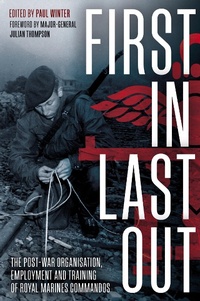
First In Last Out
The Post-war Organisation, Employment and Training of Royal Marines Commandos
Published on 12. May 2021
216 pages
978-1-61200-963-6 (ISBN)
Description

"...the level or research, the quality of graphics, and the readability are exceptional. [...] It is a subject area not covered often and it is a worthy addition to the bookshelves of readers with an interest in early Southwest Pacific air campaigns of World War Two." - Sir Henry Beverley Lieutenant General RM
The official document Amphibious Warfare Handbook No. 10a: The Organisation, Employment and Training of Commandos is a unique piece of postwar Royal Marines Commando doctrine, never before published, or quoted at length. Prepared in 1951 at the height of the Korean War by the Chief of Amphibious Warfare and the Commandant General Royal Marines, this seventy-page aide memoir is, in essence, the distillation of major lessons learned by the British wartime Combined Operations Headquarters regarding amphibious warfare, raiding, cliff assaults, sabotage, intelligence-gathering, specialized infantry work, guerrilla warfare and Commando tactics. In addition, it offers its readership a delineation of the characteristics, skills and qualities required of a Royal Marines Commando. Published to mark the seventieth anniversary of its official issue, this rare example of bespoke Commando doctrine is a timely and highly relevant addition to a growing body of work on The Corps of Royal Marines. Currently undergoing significant institutional changes by means of the Future Commando Force (FCF) program, the Royal Marines are having to challenge their existing operating concept, force structures, doctrine, and organizational design to meet the emerging defense challenges of the 21st century. It serves to remind those currently evolving the FCF concept of General Sir John Hackett's advice, namely, "To see where we are going, we must know where we are, and to know where we are, we need to discover how we got here."
The official document Amphibious Warfare Handbook No. 10a: The Organisation, Employment and Training of Commandos is a unique piece of postwar Royal Marines Commando doctrine, never before published, or quoted at length. Prepared in 1951 at the height of the Korean War by the Chief of Amphibious Warfare and the Commandant General Royal Marines, this seventy-page aide memoir is, in essence, the distillation of major lessons learned by the British wartime Combined Operations Headquarters regarding amphibious warfare, raiding, cliff assaults, sabotage, intelligence-gathering, specialized infantry work, guerrilla warfare and Commando tactics. In addition, it offers its readership a delineation of the characteristics, skills and qualities required of a Royal Marines Commando. Published to mark the seventieth anniversary of its official issue, this rare example of bespoke Commando doctrine is a timely and highly relevant addition to a growing body of work on The Corps of Royal Marines. Currently undergoing significant institutional changes by means of the Future Commando Force (FCF) program, the Royal Marines are having to challenge their existing operating concept, force structures, doctrine, and organizational design to meet the emerging defense challenges of the 21st century. It serves to remind those currently evolving the FCF concept of General Sir John Hackett's advice, namely, "To see where we are going, we must know where we are, and to know where we are, we need to discover how we got here."
More details
Other editions
Additional editions
paul winter
First in Last out
The Post-War Organisation, Employment and Training of Royal Marines Commandos
Book
05/2021
Casemate Publishers
€33.00
Shipment within 3-4 weeks
Person
Educated at the universities of Warwick, London and Cambridge, Dr Paul Winter received his doctorate in history in 2009. He specialized in wartime intelligence and military history, publishing academic articles in Intelligence and National Security and War in History. In 2013 he was a Changing Character of War Visiting Research Fellow at the University of Oxford. From 2017 to 2020, he was an affiliated academic at 40 Commando Royal Marines assisting with Professional Military Education and Officer Career Development. He is currently a member of the Land and Littoral Strike team at the Maritime Warfare Centre.Born in Calcutta, Julian Thompson was educated at Sherborne School. He joined the Royal Marines aged 18 and served on seven continents over 34 years.He commanded 40 Commando Royal Marines and then, during the Falklands War, 3 Commando Brigade which made the initial Landings and saw much of the action in the battles that followed.Since retiring as a Major General he has pursued literary and academic interests. He is a Visiting Professor at the Department of War Studies, King's College, London. Among his many published works are Ready For Anything; The Parachute Regiment at War 1940 - 1982, The Lifeblood of War: Logistics and Armed Conflict and The Royal Marines. He has published six books with the Imperial War Museum: Victory in Europe, The War at Sea: the Royal Navy in the Second World War, Behind Enemy Lines, Modern Warfare (ed), The War in Burma and The War at Sea 1914-1918.
Content
- Intro
- Title
- Copyright
- Dedication
- Contents
- Foreword
- Acknowledgements
- Introduction
- Notes
- Contents
- Amphibious Warfare Handbook No. 10a: The Organisation, Employment and Training of Commandos, 1951
- PART I-OPERATIONS
- Chapter 1-Introduction
- Outline Organisation
- Chapter 2-Commando Amphibious Operations
- General
- Naval and Air Situation
- Choice between Seaborne and Airborne Attack
- Surprise and Security
- Intelligence
- Navigation
- Radar
- Mines
- Difficult Coasts-Rocks, Cliffs and Heavy Seas
- Landing Ships and Assault Craft
- Strength of Landing Forces
- Vehicles
- Load on the Man
- Planning
- Chapter 3-Amphibious Raids
- General Considerations
- Methods
- Multiple Raids
- Co-ordination with other activities
- Control
- Chapter 4-Tasks Requiring Special Skill as a Part of Larger Operations
- General Considerations
- Capture of Coast Defence Batteries and Radar Stations
- Tasks on Difficult Parts of the Coast-line
- Tasks on Low Transport Scales
- Chapter 5-Seizure of Ports and other Strategic or Tactical Areas
- Chapter 6-Land Operations
- General Considerations
- Employment in Place of Infantry
- Internal Security Duties in Peace
- PART II-TRAINING AND SELECTION
- Chapter 7-General
- General Considerations
- Morale and Commando Spirit
- Skill
- Specialists
- Selection
- Volunteering
- Preliminary Training
- Commando Training
- National Service Men
- Chapter 8-Stage 1 Commando Training
- General
- Risk
- Commando Spirit and Skills
- Infantry Tactics
- Night Training
- Amphibious Training
- Parades, Inspections and Marches
- Singing
- Chapter 9-Stage 2 Commando Training
- General
- Heavy Weapons
- Assault Engineers
- Parachutists
- Cliff Loaders
- Snipers
- Landing Craft Helmsmen
- Night and Guerilla Specialists
- Swimmer Canoeists
- Special Courses for Backward Men
- Chapter 10-Training of Signallers, Clerks, Cooks and Tradesmen
- General Considerations
- Signallers
- Clerks
- Cooks
- Drivers
- Chapter 11-Advanced Training
- Sub-Unit, Unit and Formation Training
- Specialist Training
- Advanced Individual Training
- Advanced and Competitive Battle Skills
- Sport
- Mountaineering and Expeditions Generally
- Boating and Seamanship
- Attachments to Other Arms and Services
- Initiative Tests
- Chapter 12-Reserve Training
- PART III-THE TECHNIQUE OF DIFFICULT ASSAULT LANDINGS
- Chapter 13-General
- Chapter 14-Rock Landings
- Introduction
- Craft
- Crews
- Coxswain and/or Helmsman
- Kedgeman or Kedgemen
- Bowman or Bowmen
- Assaulting Troops
- Re-embarkation
- Choice of Landing Place
- The Beach-master-Beach Markings
- Limit Conditions
- Intelligence
- Special Precautions
- Training
- Chapter 15-Cliff Assault
- General Considerations
- Scramble Assaults
- Scaling Assaults
- Climbing Leaders
- Projection
- Scaling Ladders
- Parachutists or Agents
- Tactical Organisation of a Cliff Assault
- Withdrawal
- Selection of Routes of Ascent
- Limit Conditions
- Training
- Chapter 16-Miscellaneous Difficulties
- Beach Landings in Rough Weather and Surf
- Mud
- Long Voyages in Minor Landing Craft
- Improvised Landing Craft
- Landings alongside Moles or Quays
- Chapter 17-Follow-up and Administration
- Landing Place Organisation and Control
- Methods of Landing Stores
- Casualty Evacuation
- Administration in General
- APPENDICES
- A - Outline of Shipping Suitable for Raiding Operations
- B - Outline of Landing Craft Suitable for Raiding Operations
- C - Notes on Man Loads
- D - Notes on Hardening
- Living Out
- and Living in the Field
- E - Standardised Cliff Assault Procedure for Training
- F - Special Equipment for Commando Amphibious Assaults
- G - Notes on Boots and Other Footwear for Climbing and Difficult Landings
- H - Notes on the Assessment of Cliffs for Assault Purposes
- I - Cliff Haulage Methods
- Appendix: Definition of a Royal Marines Commando
