

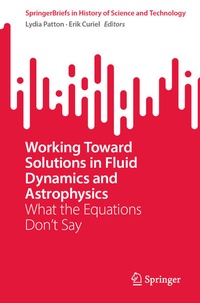
Working Toward Solutions in Fluid Dynamics and Astrophysics
Description

This book focuses on continuing the long-standing productive dialogue between physical science and the philosophy of science. Researchers and readers who want to keep up to date on front-line scientific research in fluid mechanics and gravitational wave astrophysics will find timely and well-informed analyses of this scientific research and its philosophical significance. These exciting frontiers of research pose deep scientific problems, and raise key questions in the philosophy of science related to scientific explanation and understanding, theory change and assessment, measurement, interpretation, realism, and modeling. The audience of the book includes philosophers of science, philosophers of mathematics, scientists with philosophical interests, and students in philosophy, history, mathematics, and science. Anyone who is interested in the methods and philosophical questions behind the recent exciting work in physics discussed here will profit from reading this book.
More details
Other editions
Additional editions
Persons
Erik Curiel is Assistant Professor at the Munich Center for Mathematical Philosophy (LMU Munich) and Senior Research Fellow at the Black Hole Initiative (Harvard). In physics, he works on general relativity, semi-classical gravity and black hole thermodynamics. In philosophy, he works in all areas of philosophy of physics and many areas in more general philosophy of science. He has held academic positions at the University of Western Ontario, the London School of Economics, the University of Pittsburgh and Stanford, and has held research fellowships at Trinity College (Cambridge), the Smithsonian Astrophysical Observatory and the Università degli Studi di Firenze. His work has appeared in The British Journal for the Philosophy of Science , Nature Astronomy , Philosophy of Science , and Physical Review D , and his unpublished work is widely cited.
Lydia Patton is Professor in the Department of Philosophy at Virginia Tech, with current research projects centering on theory testing and on differential equations and their use in physical theories, especially fluid dynamics and gravitational wave astronomy. Patton is a founder of the VT Gravity Lab, the Editor in Chief of the journal HOPOS , and Series Editor of the Palgrave-Springer series New Directions in the Philosophy of Science. Patton's work has been published in journals including Studies in History and Philosophy of Modern Physics , Synthese , The Monist , History and Philosophy of Logic , and Historia Mathematica , and in dozens of edited collections.
