

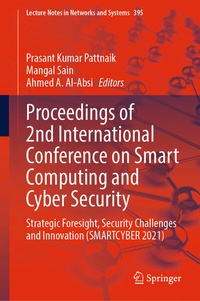
Proceedings of 2nd International Conference on Smart Computing and Cyber Security
Description

This book presents high-quality research papers presented at the Second International Conference on Smart Computing and Cyber Security: Strategic Foresight, Security Challenges and Innovation (SMARTCYBER 2021) held during June 16-17, 2021, in the Department of Smart Computing, Kyungdong University, Global Campus, South Korea. The book includes selected works from academics and industrial experts in the field of computer science, information technology, and electronics and telecommunication. The content addresses challenges of cyber security.
More details
Other editions
Additional editions
Persons
Prasant Kumar Pattnaik
, Ph.D (Computer Science), Fellow IETE, Senior Member IEEE is a Professor at the School of Computer Engineering, KIIT Deemed University, Bhubaneswar. He has more than a decade of teaching and research experience and awarded half dozen of Ph.D. Dr. Pattnaik has published numbers of Research Papers in peer-reviewed International Journals and Conferences and filed many patents. He also edited book volumes in Springer and IGI Global Publication. His areas of interest include Mobile Computing, Cloud Computing, Cyber Security, Intelligent Systems and Brain Computer Interface. He is one of the Associate Editor of Journal of Intelligent & Fuzzy Systems, IOS Press and Intelligent Systems Book Series Editor of CRC Press, Taylor Francis Group
Mangal Sain received the Master of Application degree from India in 2003 and the Ph.D. degree in computer science from Dongseo University, Busan, South Korea, in 2011. Since 2011, he has been an AssistantProfessor with the Department of Information and Communication Engineering, Dongseo University, Busan, South Korea. He has published over 40 international publications. His current research interests include wireless sensor network, middleware, cloud computing, embedded system, and Internet of Things. He is a member of TIIS and has participated as a TPC member in several international conferences.
Ahmed A. Al-Absi, Ph.D is an
Associate Professor
at the Smart Computing Department, Kyungdong University Global Campus, South Korea. He is currently Dean of Faculty of International Studies and Director of Global Academic Collaboration Centers at Kyungdong University Global. He has more than ten years of experience in teaching and university lecturing in the areas of database design and computer algorithms. Dr. Al-Absi has published numbers of research papers in peer-reviewed international journals and conferences. His research areas are Big Data, Large Scale Data Process Systems, Cloud Computing, IoT, VANET, Deep Learning, Parallel Computing, Security, and Bioinformatics. His professional experience includes being a speaker at a number of renowned research conferences and technical meetings such as IEEE, Korea ICT leaders forum, and reviewer for refereed journals and conferences on data-intensive computing as well as an examiner for postgraduate scholars in his research areas.
