

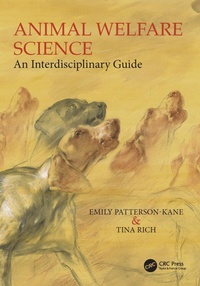
Animal Welfare Science
An Interdisciplinary Guide
1st Edition
Published on 10. September 2025
326 pages
978-1-040-35883-2 (ISBN)
Description

Animal welfare as a concept and practice is important to many disciplines and professions. From blue skies scientists to front line animal rescue, there is a need for this textbook, which distils and interprets the core concepts and language of animal welfare science.
Coverage includes the main theories and why we needed them; practical advice for how to assess animal welfare; illustrative examples of different species and the importance of their interactions; and the stresses and strains experienced across an increasingly diverse workforce. Foundational knowledge is combined with real-world examples and recent advances to communicate the content and spirit of this unique field.
This accessible text is designed to support tertiary animal welfare curricula but is also relevant to the study of human-animal interactions, anthropology, and related fields. It provides a jumping-off point for many areas of knowledge and application for anyone interested in how animal welfare and science intersect. Animal Welfare Science: An Interdisciplinary Guide was created to provide an informational grounding that fosters competency, credibility, and the confidence to engage with peers across the animal welfare space. It also provides an overview of the career landscape with practical advice about the challenges and pressure points that you may encounter. Along with copious color illustrations, bullet points, thought experiments, tables, and links to video and other online resources aid accessibility.
Coverage includes the main theories and why we needed them; practical advice for how to assess animal welfare; illustrative examples of different species and the importance of their interactions; and the stresses and strains experienced across an increasingly diverse workforce. Foundational knowledge is combined with real-world examples and recent advances to communicate the content and spirit of this unique field.
This accessible text is designed to support tertiary animal welfare curricula but is also relevant to the study of human-animal interactions, anthropology, and related fields. It provides a jumping-off point for many areas of knowledge and application for anyone interested in how animal welfare and science intersect. Animal Welfare Science: An Interdisciplinary Guide was created to provide an informational grounding that fosters competency, credibility, and the confidence to engage with peers across the animal welfare space. It also provides an overview of the career landscape with practical advice about the challenges and pressure points that you may encounter. Along with copious color illustrations, bullet points, thought experiments, tables, and links to video and other online resources aid accessibility.
More details
Edition
1. Auflage
Language
English
Place of publication
London
United Kingdom
Publishing group
Taylor & Francis Ltd
Target group
College/higher education
Illustrations
15 Tables, black and white; 10 Line drawings, color; 38 Halftones, color; 35 Illustrations, color; 13 Illustrations, black and white
File size
87,17 MB
ISBN-13
978-1-040-35883-2 (9781040358832)
Copyright in bibliographic data and cover images is held by Nielsen Book Services Limited or by the publishers or by their respective licensors: all rights reserved.
Schweitzer Classification
Other editions
Additional editions
Book
09/2025
1st Edition
CRC Press
€104.50
Shipment within 10-20 days
Book
09/2025
1st Edition
CRC Press
€142.50
Shipment within 10-20 days
Persons
Emily Patterson-Kane trained as a behavioral psychologist in New Zealand at Waikato University and Victoria University of Wellington. She held the Killam Postdoctoral Fellowship to research the environmental needs of laboratory rodents at the University of British Columbia. Her published research investigates many aspects of animal cruelty, animal welfare assessment, and animal welfare history and education. Emily first took the role of Animal Welfare Scientist at the American Veterinary Medical Association and is currently employed as a director of research at the American Society for the Protection of Animals. She co-authored The Sciences of Animal Welfare and Rethinking the American Animal Rights Movement (Routledge, 2022). (Shown with Vienna, her canine collaborator). Emily's website can be found at www.EmilyPattersonKane.com.
Tina Rich is a generalist scientist, which is a rare and adaptive thing in today's largely specialist world. After obtaining a PhD in Immunology from Birkbeck College (University of London), she took postdoctoral posts at the Brain Tumor Research Center (UCSF, San Francisco), the Laboratoire d'lmmunogenetique Moleculaire (Institut des Cordeliers, Paris), the Pathology Department of the University of Cambridge (UK), and won tenure at the University of Glasgow, where she was recruited to the Veterinary Medicine's Institute of Comparative Medicine (ICM), supported by an RCUK fellowship. At the latter university, Tina's involvement in the ICM began an ongoing interest in nonhuman animal health and welfare. Since then she has worked as a writer and editor, paralegal, and strategic contributor to nonprofit organizations who have a focus on the welfare of the environment and animals. At this stage of her globe-trotting, Tina lives in New Jersey with two dogs and two cats, all of whom clearly communicate their welfare wants and needs.
Tina Rich is a generalist scientist, which is a rare and adaptive thing in today's largely specialist world. After obtaining a PhD in Immunology from Birkbeck College (University of London), she took postdoctoral posts at the Brain Tumor Research Center (UCSF, San Francisco), the Laboratoire d'lmmunogenetique Moleculaire (Institut des Cordeliers, Paris), the Pathology Department of the University of Cambridge (UK), and won tenure at the University of Glasgow, where she was recruited to the Veterinary Medicine's Institute of Comparative Medicine (ICM), supported by an RCUK fellowship. At the latter university, Tina's involvement in the ICM began an ongoing interest in nonhuman animal health and welfare. Since then she has worked as a writer and editor, paralegal, and strategic contributor to nonprofit organizations who have a focus on the welfare of the environment and animals. At this stage of her globe-trotting, Tina lives in New Jersey with two dogs and two cats, all of whom clearly communicate their welfare wants and needs.
Content
Author Bios
Part I: Theory
1. Introduction
2. Theories - Foundational Texts
3. Theories - Strain
4. Theories - Domains
5. Definitions
Part II: Assessment - Body and Mind
6. Physical State
7. A Natural Life
8. Subjective Experiences
Part III: Evaluation
9. Animal Welfare Assessment
10. Assessment - Group
11. Implications for Conservation
Part IV: Interactions - Humans & Animals
12. Interactions: Conspecific
13. Interactions: Heterospecific
14. Interactions: Animal & Human
15. Interactions: Human & Animal
Part V: Human Factors
16. Individual Factors
17. Norms
18. Codified, Ethical and Economic Conduct
19. Professional Settings
20. Animal Welfare Science as a Cross-Cultural Space
21. Themes
Glossary
Notable People and Animals
Part I: Theory
1. Introduction
2. Theories - Foundational Texts
3. Theories - Strain
4. Theories - Domains
5. Definitions
Part II: Assessment - Body and Mind
6. Physical State
7. A Natural Life
8. Subjective Experiences
Part III: Evaluation
9. Animal Welfare Assessment
10. Assessment - Group
11. Implications for Conservation
Part IV: Interactions - Humans & Animals
12. Interactions: Conspecific
13. Interactions: Heterospecific
14. Interactions: Animal & Human
15. Interactions: Human & Animal
Part V: Human Factors
16. Individual Factors
17. Norms
18. Codified, Ethical and Economic Conduct
19. Professional Settings
20. Animal Welfare Science as a Cross-Cultural Space
21. Themes
Glossary
Notable People and Animals
