

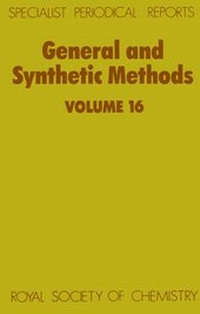
General and Synthetic Methods
Volume 16
1st Edition
Published on 31. October 2007
464 pages
978-1-84755-628-8 (ISBN)
Description

Specialist Periodical Reports provide systematic and detailed review coverage of progress in the major areas of chemical research. Written by experts in their specialist fields the series creates a unique service for the active research chemist, supplying regular critical in-depth accounts of progress in particular areas of chemistry. For over 80 years the Royal Society of Chemistry and its predecessor, the Chemical Society, have been publishing reports charting developments in chemistry, which originally took the form of Annual Reports. However, by 1967 the whole spectrum of chemistry could no longer be contained within one volume and the series Specialist Periodical Reports was born. The Annual Reports themselves still existed but were divided into two, and subsequently three, volumes covering Inorganic, Organic and Physical Chemistry. For more general coverage of the highlights in chemistry they remain a 'must'. Since that time the SPR series has altered according to the fluctuating degree of activity in various fields of chemistry. Some titles have remained unchanged, while others have altered their emphasis along with their titles; some have been combined under a new name whereas others have had to be discontinued. The current list of Specialist Periodical Reports can be seen on the inside flap of this volume.
More details
Series
Edition
1. Auflage
Language
English
Place of publication
Cambridge
United Kingdom
Target group
Professional and scholarly
ISBN-13
978-1-84755-628-8 (9781847556288)
DOI
10.1039/9781847556288
Copyright in bibliographic data and cover images is held by Nielsen Book Services Limited or by the publishers or by their respective licensors: all rights reserved.
Schweitzer Classification
Other editions
Additional editions
Book
01/1994
Royal Society of Chemistry
€337.50
Shipment within 3-4 weeks
Persons
Content
- General and Synthetic Methods
- Contents
- Chapter 1 Saturated and Unsaturated Hydrocarbons
- 1 Saturated Hydrocarbons
- 2 Olefinic Hydrocarbons
- 3 Stereoselective, Simultaneous Formation of sp3 and sp2 Centres
- Claisen Rearrangements
- [2,3] Wittig Rearrangements
- 4 Conjugated Dienes
- 5 Non-conjugated Dienes
- 6 Polyenes
- 7 Allenes
- 8 Alkynes
- 9 Enynes
- References
- Chapter 2 Aldehydes and Ketones
- 1 Synthesis of Aldehydes and Ketones
- Oxidative Methods
- Reductive Methods
- Methods Involving Umpolung
- Other Methods
- Cyclic Ketones
- 2 Synthesis of Functionalised Aldehydes and Ketones
- Unsaturated Aldehydes and Ketones
- a-Substituted Aldehydes and Ketones
- Dicarbonyl Compounds
- 3 Protection and Deprotection of Aldehydes and Ketones
- 4 Reactions of Aldehydes and Ketones
- Reactions of Enolates
- Aldol Reactions
- Conjugate Addition Reactions
- References
- Chapter 3 Carboxylic Acids and Derivatives
- 1 Carboxylic Acids
- General Synthesis
- Diacids
- Hydroxy-acids
- Keto-acids
- Unsaturated Acids
- Aromatic Acids
- Halo-acids
- Carboxylic Acid Protection
- 2 Carboxylic Acid Esters
- Esterification
- General Synthesis
- Diesters
- Hydroxy-esters
- Keto-esters
- Unsaturated Esters
- Halo-esters
- Thioesters
- 3 Carboxylic Acid Amides
- General Synthesis
- Hydroxy-amides
- Keto-amides
- Unsaturated Amides
- Thioamides
- 4 Lactones
- General Synthesis
- Butyrolactones
- a-Methylene- and a-Alkylidenebutyrolactones
- ?-Alkylidinebutyrolactones
- Butenolides
- Tetronic Acids
- Phthalides
- Valerolactones
- Macrolides
- 5 Amino Acids
- a-Amino acids
- Dehydroamino acids
- Hydroxy a-amino acids
- ß-Amino acids
- Amino-acid Coupling
- Amino-acid Protection
- References
- Chapter 4 Alcohols, Halogeno Compounds, and Ethers
- 1 Alcohols
- Preparation
- By Addition to Olefins
- By Reduction of Carbonyl Compounds
- By Nucleophilic Alkylation
- Non Stereoselective Addition
- Selective Addition
- By Opening of Epoxides
- Miscellaneous Methods
- Protection and Deprotection
- Oxidation and Deoxygenation
- 2 Halogeno Compounds
- 3 Ethers and Thioethers
- References
- Chapter 5 Amines, Nitriles, and Other Nitrogen-containing Functional Groups
- 1 Amines
- Acyclic Amines
- Aromatic Amines
- Allylic Amines
- Cyclic Amines
- Protecting Groups
- Enamines
- Alkyldiamines
- 2 Amino-alcohols
- 1,2-Amino-alcohols
- 1,3-Amino-alcohols
- 1,2-Amino-thiols, 1,2-Aminoketones, and a-Aminophosphonic Acids
- Azo Compounds
- Nitriles
- Nitro Compounds
- Nitroxyl and Nitroso Compounds
- Alkyl Nitrates and Nitramines
- Hydroxylamines
- Imines
- Amidines
- Oximes and Hydrazones
- Thiodiimides
- Azides
- Thiocyanates, Isothiocyanates, and Isocyanides
- References
- Chapter 6 Organometallics in Synthesis
- Part I: The Transition Elements
- 1 Introduction
- 2 Reduction
- 3 Oxidation
- 4 Isomerisations and Rearrangements
- 5 Carbon-Carbon Bond-Forming Reactions
- Via Organometallic Electrophiles
- Via Organometallic Nucleophiles
- Via Coupling and Cycloaddition Reactions
- Via Carbonylation Reactions
- 6 Miscellaneous Reactions
- References
- Part II: Main Group Elements
- 1 Group I
- Lithium Amides
- Lithium Enolates
- Non-stabilized Organolithium Reagents
- Lithiated Aromatic and Heteroaromatic Rings
- Benzylic and Allylic Lithium Anions
- Alkenyl and Alkynyl Lithium Anions
- Di- and Trilithiated Anions
- Sodium and Potassium
- Anions Stabilised by Sulphur, Silicon, and Selenium
- 2 Group II
- Magnesium
- Zinc and Mercury
- 3 Group III
- Boron
- Aluminium and Thallium
- 4 Group IV
- Silicon and Germanium
- Allyl, Benzyl, and Alkenyl Silanes and their Derivatives
- Tin and Lead
- 5 Group V
- Phosphorus
- Arsenic, Antimony, and Bismuth
- 6 Group VI
- Sulphur
- Selenium and Tellurium
- References
- Chapter 7 Saturated Carbocyclic Ring Synthesis
- 1 Three-membered Rings
- 2 Four-membered Rings
- 3 Five-membered Rings
- Transition Metal Mediated Cyclisations
- Radical Cyclisations
- Other Routes to Five-membered Rings
- 4 Six-membered Rings
- Diels-Alder Reactions
- Other Routes to Six-membered Rings
- 5 Seven-membered, Medium, and Large Rings
- Seven and Eight-membered Rings
- Large Rings
- Ring Expansions
- References
- Chapter 8 Saturated Heterocyclic Ring Synthesis
- 1 Oxygen-containing Heterocycles
- Three-membered Rings
- Four-membered Rings
- Five-membered Rings
- Tetrahydrofurans
- Dihydrofurans and Benzofurans
- Five-membered Rings with More than One Oxygen
- Six-membered Rings
- Tetrahydropyrans
- Dihydropyrans
- Six-membered Rings with More than One Oxygen
- Medium- and Large-ring Ethers
- 2 Sulphur-containing Heterocycles
- 3 Heterocycles Containing More than One Heteroatom
- Nitrogen- and Oxygen-containing Rings
- Five-membered Rings
- Six- and Seven-membered Rings
- Nitrogen- and Sulphur, and Sulphur- and Oxygen- containing Rings
- 4 Nitrogen-containing Heterocycles
- Three- and Four-membered Rings
- Five-membered Rings
- Six-membered Rings Containing One Nitrogen
- Five- and Six-membered Rings with Two Nitrogen Atoms
- Seven-membered and Larger Rings
- ß-Lactam
- References
- Chapter 9 Highlights in the Total Synthesis of Natural Products
- 1 Terpenes
- 2 Alkaloids
- 3 Spiroacetals
- 4 Macrolides
- 5 Polyether Antibiotics
- 6 Tetronolides
- 7 Enediynes
- 8 Other Natural Products
- References
- Chapter 10 Reviews on General and Synthetic Methods
- 1 Saturated and Unsaturated Hydrocarbons
- 2 Halogeno Compounds
- 3 Sulphur Compounds
- 4 Carbonyl Compounds
- 5 Carboxylic Acids and Derivatives
- 6 Carbocyclic Ring Synthesis
- 7 Heterocyclic Ring Synthesis and Alkaloids
- 8 Organometallics
- 9 Asymmetric Synthesis and Stereoselective Processes
- 10 Natural Products Synthesis
- 11 Nucleosides
- 12 Radicals in Synthesis
- 13 Carbohydrates
- 14 Cycloaddition Reactions
- 15 Pressure Reactions
- 16 Photochemistry and Electrochemistry
- 17 General
- Author Index
