

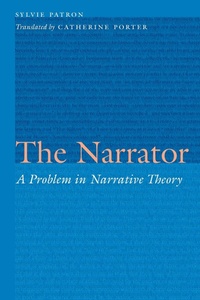
The Narrator
A Problem in Narrative Theory
1st Edition
Published on 1. September 2023
384 pages
978-1-4962-3696-8 (ISBN)
Description

The narrator (the answer to the question "who speaks in the text?") is a commonly used notion in teaching literature and in literary criticism, even though it is the object of an ongoing debate in narrative theory. Do all fictional narratives have a narrator, or only some of them? Can narratives thus be "narratorless"? This question divides communicational theories (based on the communication between real or fictional narrator and narratee) and noncommunicational or poetic theories (which aim to rehabilitate the function of the author as the creator of the fictional narrative).
Clarifying the notion of the narrator requires a historical and epistemological approach focused on the opposition between communicational theories of narrative in general and noncommunicational or poetic theories of the fictional narrative in particular. The Narrator offers an original and critical synthesis of the problem of the narrator in the work of narratologists and other theoreticians of narrative communication from the French, Czech, German, and American traditions and in representations of the noncommunicational theories of fictional narrative. Sylvie Patron provides linguistic and pragmatic tools for interrogating the concept of the narrator based on the idea that fictional narrative has the power to signal, by specific linguistic marks, that the reader must construct a narrator; when these marks are missing, the reader is able to perceive other forms and other narrative effects, specially sought after by certain authors.
Clarifying the notion of the narrator requires a historical and epistemological approach focused on the opposition between communicational theories of narrative in general and noncommunicational or poetic theories of the fictional narrative in particular. The Narrator offers an original and critical synthesis of the problem of the narrator in the work of narratologists and other theoreticians of narrative communication from the French, Czech, German, and American traditions and in representations of the noncommunicational theories of fictional narrative. Sylvie Patron provides linguistic and pragmatic tools for interrogating the concept of the narrator based on the idea that fictional narrative has the power to signal, by specific linguistic marks, that the reader must construct a narrator; when these marks are missing, the reader is able to perceive other forms and other narrative effects, specially sought after by certain authors.
Reviews / Votes
"This is a meticulously researched, thought-provoking study of the concept of the narrator."-K. Wein, Choice "This ground-breaking study situates works that presume that every narrative has a narrator within communicational theories and convincingly argues instead for poetic theories, which maintain that while authors of fiction may create narrators, they are in no way compelled to do so. A major contribution to narrative theory."-Jonathan Culler, author of Structuralist Poetics: Structuralism, Linguistics, and the Study of Literature "The Narrator is an expansive, meticulously researched, and brilliantly argued intervention in narrative theory. Powerful and compelling, its conclusions will have to be engaged with by all future students of narration."-Brian Richardson, author of Unnatural Voices: Extreme Narration in Modern and Contemporary FictionMore details
Series
Language
English
Place of publication
Lincoln
United States
Target group
Professional and scholarly
Illustrations
4 diagrams, 2 indexes
File size
2,49 MB
ISBN-13
978-1-4962-3696-8 (9781496236968)
Copyright in bibliographic data and cover images is held by Nielsen Book Services Limited or by the publishers or by their respective licensors: all rights reserved.
Schweitzer Classification
Other editions
Additional editions
Book
09/2023
University of Nebraska Press
€94.28
Shipment within 15-20 days
Persons
Sylvie Patron is a professor at UniversitE Paris CitE. She is the author or editor of several books on narrative theory, including Optional-Narrator Theory: Principles, Perspectives, Proposals (Nebraska, 2021). Catherine Porter is a visiting scholar in the Society for the Humanities at Cornell University. She has translated more than forty books and is the coeditor of A Companion to Translation Studies.
Content
- Cover Page
- Frontiers of Narrative
- Title Page
- Copyright Page
- Contents
- Illustrations
- Acknowledgments
- Introduction
- Part 1. Communicational Theories of Narrative: The Narrator in All Narratives
- 1. Genette: A Primitive Concept
- 2. Dolezel (I): The Theory of Narrative Modes
- 3. Chatman (I): A Continuum Approach to the Issue of the Narrator
- 4. Stanzel: The Narrator and the Tripartition of Fictional Narrative
- 5. Speech Act Theory and Narratology
- 6. Fludernik, Nünning: The Cognitive Turn of Narratology
- Part 2. Poetic Theories of Narrative: The Optional Narrator
- 7. Toward Another Reading of Hamburger
- 8. Kuroda: Communicational and Noncommunicational Theories of Language and of Narrative
- 9. Banfield: The Free Indirect Style at the Core of a Poetic Theory of Narrative
- 10. Deictic Shift Theory
- Conclusion
- Appendix 1: Enunciative Narratology: A French Speciality
- Appendix 2: Selected Texts on the Narrator
- Notes
- References
- Index of Names
- Index of Subjects
