

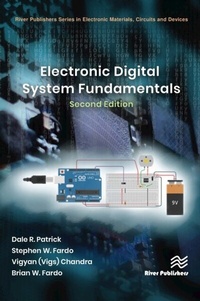
Electronic Digital System Fundamentals
2nd Edition
Published on 14. December 2023
456 pages
978-1-003-81294-4 (ISBN)
Description

Electronic Digital Systems Fundamentals, 2nd Edition is an introductory text that provides coverage of the various topics in the field of digital electronics. The key concepts presented in this book are discussed using a simplified approach that greatly enhances learning. The use of mathematics is kept to the very minimum and is discussed clearly through applications and illustrations.
Each chapter is organized in a step-by-step progression of concepts and theory. The chapters begin with an introduction, discuss important concepts with the help of numerous illustrations, as well as examples, and conclude with summaries.
The overall learning objectives of this book include:
Describe the characteristics of a digital electronic system.
Explain the operation of digital electronic gate circuits.
Demonstrate how gate functions are achieved.
Use binary, octal, and hexadecimal counting systems.
Use Boolean algebra to define different logic operations.
Change a logic diagram into a Boolean expression and a Boolean expression into a logic diagram.
Explain how discrete components are utilized in the construction of digital integrated circuits.
Discuss how counting, decoding, multiplexing, demultiplexing, and clocks function with logic devices.
Change a truth table into a logic expression and a logic expression into a truth table.
Identify some of the common functions of digital memory.
Explain how arithmetic operations are achieved with digital circuitry.
Describe the operation of microcontrollers.
Each chapter is organized in a step-by-step progression of concepts and theory. The chapters begin with an introduction, discuss important concepts with the help of numerous illustrations, as well as examples, and conclude with summaries.
The overall learning objectives of this book include:
Describe the characteristics of a digital electronic system.
Explain the operation of digital electronic gate circuits.
Demonstrate how gate functions are achieved.
Use binary, octal, and hexadecimal counting systems.
Use Boolean algebra to define different logic operations.
Change a logic diagram into a Boolean expression and a Boolean expression into a logic diagram.
Explain how discrete components are utilized in the construction of digital integrated circuits.
Discuss how counting, decoding, multiplexing, demultiplexing, and clocks function with logic devices.
Change a truth table into a logic expression and a logic expression into a truth table.
Identify some of the common functions of digital memory.
Explain how arithmetic operations are achieved with digital circuitry.
Describe the operation of microcontrollers.
More details
Series
Edition
2nd edition
Language
English
Place of publication
London
United Kingdom
Publishing group
Taylor & Francis Ebooks
Target group
College/higher education
Professional and scholarly
Product notice
Reflowable
Illustrations
74 Illustrations, color; 225 Illustrations, black and white
ISBN-13
978-1-003-81294-4 (9781003812944)
Copyright in bibliographic data and cover images is held by Nielsen Book Services Limited or by the publishers or by their respective licensors: all rights reserved.
Schweitzer Classification
Other editions
Additional editions
Dale R. Patrick | Stephen W. Fardo | Vigyan (Vigs) Chandra
Electronic Digital System Fundamentals
Book
12/2023
2nd Edition
River Publishers
€213.20
Article not available for order
Persons
Dale R. Patrick served as a Professor in the Department of Applied Engineering and Technology at Eastern Kentucky University. His experience includes teaching and organizing laboratory classes in electrical engineering/electronics technology for many years. He completed Bachelor of Science and Graduate Degrees at Indiana State University. His experience also includes research projects, technical teacher training, and energy consulting for business and industry. He and Dr. Fardo have co-authored over 30 textbooks and laboratory manuals.
Stephen W. Fardo is currently a Foundation Professor in the Department of Applied Engineering and Technology at Eastern Kentucky University. His experience includes teaching and organizing laboratory classes in electrical engineering/electronics technology for many years and coordinating/advising technical teacher programs for the State of Kentucky. He completed Bachelor of Science, Master of Science and Doctoral Degrees at Eastern Kentucky University and University of Kentucky. His experience also includes research projects, technical teacher education, and energy consulting for business and industry. He and Dale Patrick have co-authored over 30 textbooks and laboratory manuals.
Vigyan (Vigs) Chandra is a professor and coordinator of the Cyber Systems Technology-related undergraduate and graduate degree programs offered by the Departments of Computer Science and Information Technology (CSIT) and Applied Engineering and Technology (AET) at Eastern Kentucky University. He earned a doctoral degree from the University of Kentucky in Electrical and Computer Engineering and a Master's degree in Career and Technical Education from Eastern. He holds certifications in various computer networking areas and teaches computer systems and applications, network hardware, communication systems, and digital, analog, and machine-control electronics. He is the recipient of the 2020-2021 Critical Thinking and Reading Teacher Award and the 2013 Golden Apple Award for Teaching Excellence at Eastern. His professional interests include implementing active teaching and learning strategies, metacognition, integrating open-source software/hardware with online control and computer networking technologies.
Brian W. Fardo served as an Adjunct Professor in the Department of Applied Engineering and Technology and the Noel Studio for Academic Creativity at Eastern Kentucky University. His experience includes teaching classes in applied creative thinking, electrical systems, materials and processes, transportation, manufacturing, construction, engineering graphics, and quality control. He has a B.Sc. Degree in Industrial Distribution and Logistics, an M.Sc. in Technology Systems from East Carolina University, and an M.Sc. in Career and Technical Education Eastern Kentucky University. He has completed coursework for a Doctoral Degree in Engineering/Technology Education at North Carolina State University. He currently owns and operates a telecommunications business.
Stephen W. Fardo is currently a Foundation Professor in the Department of Applied Engineering and Technology at Eastern Kentucky University. His experience includes teaching and organizing laboratory classes in electrical engineering/electronics technology for many years and coordinating/advising technical teacher programs for the State of Kentucky. He completed Bachelor of Science, Master of Science and Doctoral Degrees at Eastern Kentucky University and University of Kentucky. His experience also includes research projects, technical teacher education, and energy consulting for business and industry. He and Dale Patrick have co-authored over 30 textbooks and laboratory manuals.
Vigyan (Vigs) Chandra is a professor and coordinator of the Cyber Systems Technology-related undergraduate and graduate degree programs offered by the Departments of Computer Science and Information Technology (CSIT) and Applied Engineering and Technology (AET) at Eastern Kentucky University. He earned a doctoral degree from the University of Kentucky in Electrical and Computer Engineering and a Master's degree in Career and Technical Education from Eastern. He holds certifications in various computer networking areas and teaches computer systems and applications, network hardware, communication systems, and digital, analog, and machine-control electronics. He is the recipient of the 2020-2021 Critical Thinking and Reading Teacher Award and the 2013 Golden Apple Award for Teaching Excellence at Eastern. His professional interests include implementing active teaching and learning strategies, metacognition, integrating open-source software/hardware with online control and computer networking technologies.
Brian W. Fardo served as an Adjunct Professor in the Department of Applied Engineering and Technology and the Noel Studio for Academic Creativity at Eastern Kentucky University. His experience includes teaching classes in applied creative thinking, electrical systems, materials and processes, transportation, manufacturing, construction, engineering graphics, and quality control. He has a B.Sc. Degree in Industrial Distribution and Logistics, an M.Sc. in Technology Systems from East Carolina University, and an M.Sc. in Career and Technical Education Eastern Kentucky University. He has completed coursework for a Doctoral Degree in Engineering/Technology Education at North Carolina State University. He currently owns and operates a telecommunications business.
Content
1. Introduction to Digital Systems 2. Digital Logic Gates 3. Boolean Algebra and Logic Gates 4. Combinational Logic Gates 5. Number Systems, Conversions and Codes 6. Binary Addition and Subtraction 7. Digital Timing and Signals 8. Sequential Logic Gates 9. Counters and Shift Registers 10. Data Conversion 11. Advanced Digital Concepts 12. Arduino Microcontroller Applications 13. Electrical and Electronic Safety 14. Datasheets 15. Constructing Digital Circuits
