

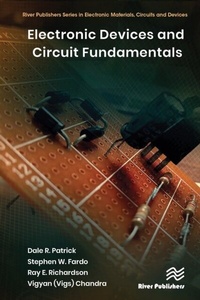
Electronic Devices and Circuit Fundamentals
1st Edition
Published on 8. May 2023
1078 pages
978-1-000-87977-3 (ISBN)
Description

This book explores many fundamental topics in a basic and easy-to-understand manner. It, and the accompanying DC-AC Electrical Fundamentals by the same co-authors, have been developed using a classic textbook - Electricity and Electronics: A Survey (5th Edition) by Patrick and Fardo - as a framework. Both new books have been structured using the same basic sequence and organization of the textbook as previous editions.
This book has been expanded to 23 chapters, further simplifying content and providing a more comprehensive coverage of fundamental content. The content has been continually updated and revised through new editions and by external reviewers throughout the years. Additional quality checks to ensure technical accuracy, clarity and coverage of content have always been an area of focus. Each edition of the text has been improved through the following features:
Improved and updated text content.
Improved usage of illustrations and photos.
Use of color to add emphasis and clarify content.
This book has been expanded to 23 chapters, further simplifying content and providing a more comprehensive coverage of fundamental content. The content has been continually updated and revised through new editions and by external reviewers throughout the years. Additional quality checks to ensure technical accuracy, clarity and coverage of content have always been an area of focus. Each edition of the text has been improved through the following features:
Improved and updated text content.
Improved usage of illustrations and photos.
Use of color to add emphasis and clarify content.
More details
Edition
1. Auflage
Language
English
Place of publication
London
United Kingdom
Publishing group
Taylor & Francis Ebooks
Target group
College/higher education
Professional and scholarly
Product notice
Reflowable
Illustrations
1 Tables, black and white; 128 Line drawings, color; 184 Line drawings, black and white; 27 Halftones, color; 130 Halftones, black and white; 155 Illustrations, color; 314 Illustrations, black and white
ISBN-13
978-1-000-87977-3 (9781000879773)
Copyright in bibliographic data and cover images is held by Nielsen Book Services Limited or by the publishers or by their respective licensors: all rights reserved.
Schweitzer Classification
Other editions
Additional editions

Dale R. Patrick | Stephen W. Fardo | Ray E. Richardson
Electronic Devices and Circuit Fundamentals
Book
05/2023
1st Edition
River Publishers
€171.12
Article not available for order
Persons
Dale R. Patrick was a Professor in the Department of Applied Engineering and Technology at Eastern Kentucky University. His experience includes teaching and organizing laboratory classes in Electrical Engineering/Electronics Technology for many years. He completed Bachelor of Science and Graduate Degrees at Indiana State University. His experience also includes research projects, technical teacher training, and energy consulting for business and industry. He and Dr. Fardo have co-authored over 30 textbooks and laboratory manuals.
Stephen W. Fardo is currently a Foundation Professor in the Department of Applied Engineering and Technology at Eastern Kentucky University. His experience includes teaching and organizing laboratory classes in Electrical Engineering/Electronics Technology for many years and coordinating/advising technical teacher programs for the State of Kentucky. He completed Bachelor of Science, Master of Science and Doctoral degrees at Eastern Kentucky University and University of Kentucky. His experience also includes research projects, technical teacher education, and energy consulting for business and industry. He and Dale Patrick have co-authored over 30 textbooks and laboratory manuals.
Ray E. Richardson is a Professor in the Department of Applied Engineering and Technology at Eastern Kentucky University. His experience includes teaching and organizing lecture and laboratory classes in Electrical Engineering/Electronics Technology since 1985 as well as teaching technical seminars, technical writing, and classes in the graduate program. He completed Bachelor of Science and Master of Science degrees at Eastern Illinois University, and a doctorate level degree at the University of Illinois. He is a certified Technology Manager at Senior level by ATMAE. Other experience includes research projects in technical education and consulting in the manufacturing, food, and electronics areas.
Vigyan (Vigs) Chandra is a professor and coordinator of the Cyber Systems Technology-related undergraduate and graduate degree programs offered by the Departments of Computer Science and Information Technology (CSIT) and Applied Engineering and Technology (AET) at Eastern Kentucky University. He earned a doctoral degree from the University of Kentucky in Electrical and Computer Engineering and a master's degree in Career and Technical Education from Eastern. He holds certifications in various computer networking areas and teaches computer systems and applications, network hardware, communication systems, and digital, analog, and machine-control electronics. He is the recipient of the 2020-21 Critical Thinking and Reading Teacher Awards and the 2013 Golden Apple Award for Teaching Excellence at Eastern. His professional interests include implementing active teaching and learning strategies, metacognition, and integrating open-source software/hardware with online control and computer networking technologies.
Stephen W. Fardo is currently a Foundation Professor in the Department of Applied Engineering and Technology at Eastern Kentucky University. His experience includes teaching and organizing laboratory classes in Electrical Engineering/Electronics Technology for many years and coordinating/advising technical teacher programs for the State of Kentucky. He completed Bachelor of Science, Master of Science and Doctoral degrees at Eastern Kentucky University and University of Kentucky. His experience also includes research projects, technical teacher education, and energy consulting for business and industry. He and Dale Patrick have co-authored over 30 textbooks and laboratory manuals.
Ray E. Richardson is a Professor in the Department of Applied Engineering and Technology at Eastern Kentucky University. His experience includes teaching and organizing lecture and laboratory classes in Electrical Engineering/Electronics Technology since 1985 as well as teaching technical seminars, technical writing, and classes in the graduate program. He completed Bachelor of Science and Master of Science degrees at Eastern Illinois University, and a doctorate level degree at the University of Illinois. He is a certified Technology Manager at Senior level by ATMAE. Other experience includes research projects in technical education and consulting in the manufacturing, food, and electronics areas.
Vigyan (Vigs) Chandra is a professor and coordinator of the Cyber Systems Technology-related undergraduate and graduate degree programs offered by the Departments of Computer Science and Information Technology (CSIT) and Applied Engineering and Technology (AET) at Eastern Kentucky University. He earned a doctoral degree from the University of Kentucky in Electrical and Computer Engineering and a master's degree in Career and Technical Education from Eastern. He holds certifications in various computer networking areas and teaches computer systems and applications, network hardware, communication systems, and digital, analog, and machine-control electronics. He is the recipient of the 2020-21 Critical Thinking and Reading Teacher Awards and the 2013 Golden Apple Award for Teaching Excellence at Eastern. His professional interests include implementing active teaching and learning strategies, metacognition, and integrating open-source software/hardware with online control and computer networking technologies.
Content
1. Semiconductor Fundamentals 2. P-N Junction Diodes 3. Zener Diodes 4. Power Supplies 5. Special Semiconductor Diodes 6. Bipolar Junction Transistors (BJTs) 7. BJT Amplifiers 8. Field Effect Transistors (FETs) 9. FET Amplifiers 10. Power Amplifiers 11. Amplification Systems 12. Thyristors 13. Optoelectronic Devices 14. Integrated Circuits (ICs) 15. Operational Amplifiers (Op-Amps) 16. Linear Op-Amp Circuits 17. Specialized Op-Amp Circuits 18. Filter Circuits 19. Oscillator Circuits 20. Radio Frequency (RF) Communication Circuits 21. Communication Systems 22. Digital Circuit Fundamentals
