

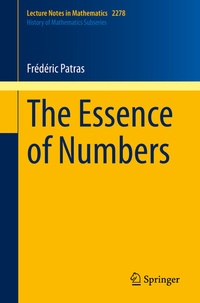
The Essence of Numbers
Description

This book considers the manifold possible approaches, past and present, to our understanding of the natural numbers. They are treated as epistemic objects: mathematical objects that have been subject to epistemological inquiry and attention throughout their history and whose conception has evolved accordingly. Although they are the simplest and most common mathematical objects, as this book reveals, they have a very complex nature whose study illuminates subtle features of the functioning of our thought.
Using jointly history, mathematics and philosophy to grasp the essence of numbers, the reader is led through their various interpretations, presenting the ways they have been involved in major theoretical projects from Thales onward. Some pertain primarily to philosophy (as in the works of Plato, Aristotle, Kant, Wittgenstein...), others to general mathematics (Euclid's Elements , Cartesian algebraic geometry, Cantorian infinities, set theory...).
Also serving as an introduction to the works and thought of major mathematicians and philosophers, from Plato and Aristotle to Cantor, Dedekind, Frege, Husserl and Weyl, this book will be of interest to a wide variety of readers, from scholars with a general interest in the philosophy or mathematics to philosophers and mathematicians themselves.
Reviews / Votes
"Patras' book is an enjoyable read, highlighting the complexities of the familiar numbers, engaging a phenomenological approach which remains fairly rare in the philosophy of mathematics." (Emmylou Haffner, Mathematical Reviews, May, 2022)More details
Other editions
Additional editions
Person
Frédéric Patras , alumnus of the École Normale Supérieure and research director at CNRS, is a mathematician who has long been committed to philosophical studies. Also the author of a book on contemporary mathematical thinking ( La pensée mathématique contemporaine ), he has published and edited over a hundred works on various subjects. He is interested in what the philosophical tradition can bring to our current understanding of science and mathematics.
