

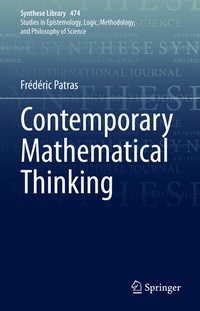
Contemporary Mathematical Thinking
Description

This book deals with the evolution of mathematical thought during the 20th century. Representing a unique point of view combining mathematics, philosophy and history on this issue, it presents an original analysis of key authors, for example Bourbaki, Grothendieck and Husserl.
As a product of 19th and early 20th century science, a canon of knowledge or a scientific ideology, mathematical structuralism had to give way. The succession is difficult, still in progress, and uncertain. To understand contemporary mathematics, its progressive liberation from the slogans of "modern mathematics" and the paths that remain open today, it is first necessary to deconstruct the history of this long dominant current. Another conception of mathematical thought emerged in the work of mathematicians such as Hilbert or Weyl, which went beyond the narrow epistemological paths of science in the making. In this tradition, mathematical thought was accompanied by a philosophical requirement. Modernity teaches us to revive it.
The book is intended for a varied public: mathematicians concerned with understanding their discipline, philosophers of science, and the erudite public curious about the progress of mathematics.
More details
Other editions
Additional editions
Person
Frédéric Patras , alumnus of the École Normale Supérieure and research director at CNRS, is a mathematician and philosopher. Also author of a book on the concept of number, he published and edited moreover a hundred works on various subjects. As a philosopher, he is primarily interested in what the philosophical tradition can bring today to our understanding of science and mathematics.
