

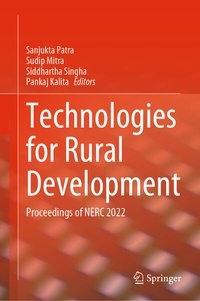
Technologies for Rural Development
Description

The book spans across the research domains of mechanisation and automation, agrobusiness, food processing and value addition, climate smart agriculture, rural sanitation, agro biotechnology, and rural energy.
More details
Other editions
Additional editions
Persons
Dr. Sanjukta Patra
Dr. Sanjukta Patra is currently Professor in Department of Biosciences and Bioengineering, IIT Guwahati and Head, School of Agro and Rural Technology, IIT Guwahati. Before joining IIT Guwahati in 2007, she obtained her doctoral degree in Biotechnology from the prestigious Central Food Technological Research Institute, Mysore. Prof. Patra leads the "Enzyme and Microbial Technology Research Group" at IIT Guwahati which studies application of microbes and enzymes in different spectrums. She works in the domains of applications of microbes and enzymes for Industrial, Environmental, Therapeutics and diagnosis. Further her work extends to utilisation of agro wastes for value added products, usage of macro fungi for edible and medicinal purposes. Till date, she has to her credit 14 sponsored International/National Projects, supervised 7 doctoral thesis and 14 M. Tech. dissertations. Prof. Patra has to her credit 3 granted Patents, 51 ResearchPapers, 18 Book Chapters, 02 Databases and 61 conference presentations. She is the editorial board member of the Nature Publishing Group's Journal "Scientific Report" and also reviewer of leading journals as PLoS One, Enzyme and Microbial Technology, Food Chemistry, Medicinal Chemistry, Biosensor and Bioelectronics, Amino acid etc.
Dr. Sudip Mitra
A faculty of the School of Agro & Rural Technology (SART) and the founding Head of the Centre for Disaster Management & Research (CDMR) at IIT Guwahati. In his 22 years of professional career, he has been actively involved in climate change, adaptation and disaster risk reduction (DRR) research, policy and outreach. His present research looks at the climate smart agriculture and application of indigenous resources and technologies for the enhancement of rural livelihood. He is a Fulbright fellow & visiting Faculty at the University of California, Davis, USA. He served as a Task Force Member of MNREGA convergence of schemes under the Ministry of Rural Development, Government of India (2008); and as a member of the Global Technology Watch Group, TIFAC, Department of Science & Technology (DST), Govt. of India. He is an elected member of the National Academy of Science, India (NASI).
Dr. Siddhartha Singha
Dr. Siddhartha Singha is a Food & Bioprocess Engineer by training and working in the area of food and bio processing for the last thirteen years. Currently he is working as Assistant Professor at School of Agro & Rural Technology at IIT Guwahati. He has work experience in NIFTEM-Ministry of Food Processing Industries, GoI and in Industries like Pepsico Holdings, Bridge2Tech. Dr. Singha's core area of research is process optimization & scale up of traditional food products. He is active to bring the culture of innovation in Policy making, Institution building, human resource development and research especially in the area of food & nutritional security. He is part of various Government programs like RuTAG, DoNER, DBTSEED, DRDO futuristic technology program, NetProFan- FSSAI etc. and various stakeholder groups. As an advisor to different NGOs and Industries he contributes to the ecology of food entrepreneurship for sustainable usage of the natural resources and circular economy.
Dr. Pankaj Kalita
Dr. Pankaj Kalita is Associate Professor, in the School of Energy Science and Engineering, Indian Institute of Technology Guwahati. He has more than 8 years of teaching and 16 years of research experience in the field of renewable energy. He has published more than 60 peer reviewed research papers in various reputed journals, 15 book chapters and more than 25 conference papers. He is a recipient of India Distinguished Visiting Fellow awarded by the University of Nottingham, United Kingdom in the year 2010. He has been awarded early career research awardby Science Engineering Research Board (SERB), DST, Govt. of India. He has successfully implemented seven research projects and twelve consultancy projects funded by different government and private agencies in various fields of renewable energy. At present two research projects funded by SERB Govt. of India and ASTEC, Govt. of Assam are in progress in the areas of renewable energy integration for remote electrification, and solar drying. His current areas of research include solar energy conversion, thermochemical and biochemical conversion, energy management, energy storage (li-ion and thermal energy) and integration of renewable energy for remote electrification. He has also offered one NPTEL moocs on solar energy engineering and technology which is available in YouTube.
