

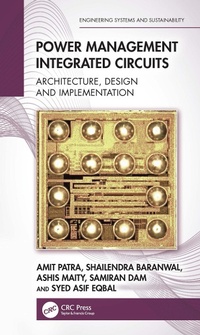
Power Management Integrated Circuits
Architecture, Design and Implementation
1st Edition
Published on 9. September 2024
400 pages
978-1-040-11742-2 (ISBN)
Description

This book intends to be a comprehensive text on the topic of integrated circuits for power management, putting together both theoretical foundations and practical details, leading to successful design practices in research and industry. It covers all the three main categories of power management circuits, viz., linear regulators, inductor-based switchers and switched-capacitor circuits, and presents detailed discussion of their common topologies, operation and modeling.
Features
Includes underlying theory and design/implementation practical ingredients for power management integrated circuits (PMICs).
Provides in-depth analysis of topologies and circuits related to linear regulators, switched-capacitor converters and inductor-based converters.
Covers all the relevant topics at the intersection between power electronics and integrated circuit design areas.
Provides guidelines for design of circuits and solutions for all the pertinent topologies.
Indicates all important issues and the related trade-offs in the design of PMICs.
The book will be a valuable resource for senior- and graduate-level students as well as industry professionals who have done university-level courses on analog circuit design, control systems and power electronics.
Features
Includes underlying theory and design/implementation practical ingredients for power management integrated circuits (PMICs).
Provides in-depth analysis of topologies and circuits related to linear regulators, switched-capacitor converters and inductor-based converters.
Covers all the relevant topics at the intersection between power electronics and integrated circuit design areas.
Provides guidelines for design of circuits and solutions for all the pertinent topologies.
Indicates all important issues and the related trade-offs in the design of PMICs.
The book will be a valuable resource for senior- and graduate-level students as well as industry professionals who have done university-level courses on analog circuit design, control systems and power electronics.
More details
Series
Edition
1. Auflage
Language
English
Place of publication
London
United Kingdom
Publishing group
Taylor & Francis Ltd
Target group
College/higher education
Professional and scholarly
Illustrations
27 Tables, black and white; 363 Line drawings, black and white; 8 Halftones, black and white; 371 Illustrations, black and white
ISBN-13
978-1-040-11742-2 (9781040117422)
Copyright in bibliographic data and cover images is held by Nielsen Book Services Limited or by the publishers or by their respective licensors: all rights reserved.
Schweitzer Classification
Other editions
Additional editions
Amit Patra | Shailendra Baranwal | Ashis Maity
Power Management Integrated Circuits
Architecture, Design and Implementation
Book
approx. 07/2026
1st Edition
CRC Press
€74.50
Not yet published
Amit Patra | Shailendra Baranwal | Ashis Maity
Power Management Integrated Circuits
Architecture, Design and Implementation
Book
09/2024
1st Edition
CRC Press
€240.60
Shipment within 15-20 days

Amit Patra | Shailendra Baranwal | Ashis Maity
Power Management Integrated Circuits
Architecture, Design and Implementation
Book
09/2024
CRC Press
Unfortunately, price unknown
Article exhausted; check different version
Persons
Amit Patra received BTech, MTech and PhD degrees from the Indian Institute of Technology, Kharagpur, in 1984, 1986 and 1990, respectively. During 1992-1993 and in 2000, he visited the Ruhr-University, Bochum, Germany, as a postdoctoral fellow of the Alexander von Humboldt Foundation. He joined the Department of Electrical Engineering, Indian Institute of Technology, Kharagpur, in 1987 as a faculty member and is currently a Professor. He visited the Georgia Institute of Technology, Atlanta, in 2003. He was the Professor In-Charge, Advanced VLSI Design Lab at IIT Kharagpur during 2004-2007. Between 2007 and 2013, he served as Dean (Alumni Affairs and International Relations) at IIT Kharagpur. His current research interests include power management circuits, mixed-signal VLSI design and automotive diagnostics and battery management systems. He has guided 25 doctoral students and has published more than 250 research papers in various journals and conferences. He is the coauthor of two research monographs entitled General Hybrid Orthogonal Functions and Their Applications in Systems and Control (Springer Verlag, 1996) and Nano-Scale CMOS Analog Circuits-Models and CAD Tools for High-Level Design (CRC Press, 2014). He has carried out more than 50 sponsored projects mostly in the areas of VLSI and power management circuits and industrial diagnostics. He has collaborated with Texas Instruments (National Semiconductor Corporation), Infineon Technologies, NXP Corporation (Freescale Semiconductor) and Maxim Corporation in the Power Management area. As Professor In-Charge of the Advanced VLSI Design Laboratory, he also took the lead role in the formation of the AVLSI Consortium at IIT Kharagpur to increase the collaboration between the industry and the academic community in the area of VLSI. Dr. Patra received the Young Engineer Award of the Indian National Academy of Engineering in 1996 and the Young Teachers' Career Award from the All India Council for Technical Education in 1995. He was a Young Associate of the Indian Academy of Sciences during 1992-1997. He is a senior member of IEEE (USA), Institution of Engineers (India), and a life member of the Systems Society of India.
Shailendra Baranwal obtained his BTech and MS degrees from the Indian Institute of Technology, Kharagpur, in 2002 and 2005, respectively. He started his career as an analog design engineer at Texas Instruments India in 2005 and later moved to Texas Instruments Dallas in 2012, where he currently holds the position of a senior member of technical staff. During his tenure at TI, he has spearheaded multiple integrated circuits (IC) projects in the areas of power management, high-voltage isolated gate drivers, class-D audio amplifiers and motor drivers. Shailendra's work in power management includes motor drivers, high-frequency resonant full bridge converters, buck converters, transformer drivers and switched-capacitor supplies. He is also the holder of approximately 15 US patents.
Ashis Maity received his PhD degree from the Indian Institute of Technology Kharagpur in 2016. He is presently serving as Assistant Professor in the Department of Electrical Engineering at the Indian Institute of Technology Kharagpur since 2017. His research interests include energy harvesting for powering microsystems, power management ICs for portable applications and low-power, high-performance analog ICs. During 2002-2005, he was working with Alliance Semiconductor, Bangalore, India, as a Design Team Member. During 2008-2009, he was with National Semiconductor, Tokyo, Japan, as Senior Design Engineer. He was a Postdoctoral Research Associate with the Integrated Power System Design Laboratory in the University of Texas at Dallas, Richardson, USA, from 2016 to 2017. Dr. Maity was the recipient of the IESA Techno Inventor Award 2016 by India Electronics & Semiconductor Association. He was also the winner in the PhD Forum at the 29th International Conference on VLSI Design and 15th International Conference on Embedded Systems 2016.
Samiran Dam presently serves as Principal Engineer at Infineon Technologies in Bangalore, India. His expertise lies in a diverse range of Power Management IC design, involving low-power, integrated switched-capacitor-based DC-DC converters, constant-on-time (COT) buck converters, buck-boost converters, boost PFC, flyback converters, integrated gate driver and current sense for high-voltage GaN power switches. With an extensive experience in analog and mixed-signal design, Samiran has played multiple roles in different phases of IC development cycle in the Semiconductor industry. Samiran earned his PhD and MS degrees from the Indian Institute of Technology (IIT), Kharagpur, India, in 2017 and 2012, respectively, and has completed his BE at the Indian Institute of Engineering, Science & Technology (IIEST), Shibpur, in 2007. During his academic tenure at IIT, he contributed to several technical papers published in renowned IEEE journals and conferences, and he holds a number of patents as well.
Syed Asif Eqbal received his BTech degree from the Indian Institute of Technology (IIT), Kharagpur, India, in 2001, an MS degree from the University of Colorado at Boulder, USA, in 2004, and a PhD from the Advanced Technology Development Center, IIT Kharagpur, in 2017, all in electrical engineering. He worked as a research consultant at AVLSI Lab, IIT Kharagpur, for several years and was with National Semiconductor in Longmont, Colorado, from 2004 to 2006, where he worked as a circuit design engineer. During 2013-2019, he worked for SiWays Microelectronics, India, as a senior circuit design engineer. Currently he works for Tagore Technology, Kolkata, India. His interests include dynamics and control of DC-DC converters, digital pulse width modulator design, single inductor multi-input and -output converters, and IC implementation of power management circuits. Mr. Syed received the Systems Society Award, IIT Kharagpur, for his Bachelor's thesis in 2001.
Shailendra Baranwal obtained his BTech and MS degrees from the Indian Institute of Technology, Kharagpur, in 2002 and 2005, respectively. He started his career as an analog design engineer at Texas Instruments India in 2005 and later moved to Texas Instruments Dallas in 2012, where he currently holds the position of a senior member of technical staff. During his tenure at TI, he has spearheaded multiple integrated circuits (IC) projects in the areas of power management, high-voltage isolated gate drivers, class-D audio amplifiers and motor drivers. Shailendra's work in power management includes motor drivers, high-frequency resonant full bridge converters, buck converters, transformer drivers and switched-capacitor supplies. He is also the holder of approximately 15 US patents.
Ashis Maity received his PhD degree from the Indian Institute of Technology Kharagpur in 2016. He is presently serving as Assistant Professor in the Department of Electrical Engineering at the Indian Institute of Technology Kharagpur since 2017. His research interests include energy harvesting for powering microsystems, power management ICs for portable applications and low-power, high-performance analog ICs. During 2002-2005, he was working with Alliance Semiconductor, Bangalore, India, as a Design Team Member. During 2008-2009, he was with National Semiconductor, Tokyo, Japan, as Senior Design Engineer. He was a Postdoctoral Research Associate with the Integrated Power System Design Laboratory in the University of Texas at Dallas, Richardson, USA, from 2016 to 2017. Dr. Maity was the recipient of the IESA Techno Inventor Award 2016 by India Electronics & Semiconductor Association. He was also the winner in the PhD Forum at the 29th International Conference on VLSI Design and 15th International Conference on Embedded Systems 2016.
Samiran Dam presently serves as Principal Engineer at Infineon Technologies in Bangalore, India. His expertise lies in a diverse range of Power Management IC design, involving low-power, integrated switched-capacitor-based DC-DC converters, constant-on-time (COT) buck converters, buck-boost converters, boost PFC, flyback converters, integrated gate driver and current sense for high-voltage GaN power switches. With an extensive experience in analog and mixed-signal design, Samiran has played multiple roles in different phases of IC development cycle in the Semiconductor industry. Samiran earned his PhD and MS degrees from the Indian Institute of Technology (IIT), Kharagpur, India, in 2017 and 2012, respectively, and has completed his BE at the Indian Institute of Engineering, Science & Technology (IIEST), Shibpur, in 2007. During his academic tenure at IIT, he contributed to several technical papers published in renowned IEEE journals and conferences, and he holds a number of patents as well.
Syed Asif Eqbal received his BTech degree from the Indian Institute of Technology (IIT), Kharagpur, India, in 2001, an MS degree from the University of Colorado at Boulder, USA, in 2004, and a PhD from the Advanced Technology Development Center, IIT Kharagpur, in 2017, all in electrical engineering. He worked as a research consultant at AVLSI Lab, IIT Kharagpur, for several years and was with National Semiconductor in Longmont, Colorado, from 2004 to 2006, where he worked as a circuit design engineer. During 2013-2019, he worked for SiWays Microelectronics, India, as a senior circuit design engineer. Currently he works for Tagore Technology, Kolkata, India. His interests include dynamics and control of DC-DC converters, digital pulse width modulator design, single inductor multi-input and -output converters, and IC implementation of power management circuits. Mr. Syed received the Systems Society Award, IIT Kharagpur, for his Bachelor's thesis in 2001.
Content
1. Introduction to Power Management Integrated Circuits. 2. Linear Regulators. 3. Inductor-based Switching Converters. 4. Control Techniques for Inductor-based Switching Converters. 5. Switched-Capacitor DC-DC Converters. 6. Integrated Circuit Realization. 7. Implementation of a Low Dropout Regulator. 8. Implementation of a Buck Converter.
