

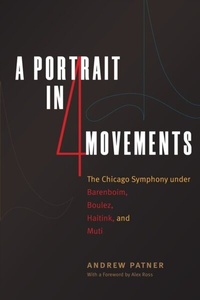
A Portrait in 4 Movements
The Chicago Symphony under Barenboim, Boulez, Haitink, and Muti
1st Edition
Published on 22. December 2022
271 pages
978-0-226-61008-5 (ISBN)
Description

"Playing in an orchestra in an intelligent way is the best school for democracy."-Daniel Barenboim
The Chicago Symphony Orchestra has been led by a storied group of conductors. And from 1994 to 2015, through the best work of Daniel Barenboim, Pierre Boulez, Bernard Haitink, and Riccardo Muti, Andrew Patner was right there. As a classical music critic for the Chicago Sun-Times and WFMT radio, Patner was able to trace the arc of the CSO's changing repertories, all while cultivating a deep rapport with its four principal conductors.
This book assembles Patner's reviews of the concerts given by the CSO during this time, as well as transcripts of his remarkable radio interviews with these colossal figures. These pages hold tidbits for the curious, such as Patner's "driving survey" that playfully ranks the Maestri he knew on a scale of "total comfort" to "fright level five," and the observation that Muti appears to be a southpaw on the baseball field. Moving easily between registers, they also open revealing windows onto the sometimes difficult pasts that brought these conductors to music in the first place, including Boulez's and Haitink's heartbreaking experiences of Nazi occupation in their native countries as children. Throughout, these reviews and interviews are threaded together with insights about the power of music and the techniques behind it-from the conductors' varied approaches to research, preparing scores, and interacting with other musicians, to how the sound and personality of the orchestra evolved over time, to the ways that we can all learn to listen better and hear more in the music we love. Featuring a foreword by fellow critic Alex Ross on the ethos and humor that informed Patner's writing, as well as an introductionand extensive historical commentary by musicologist Douglas W. Shadle, this book offers a rich portrait of the musical life of Chicago through the eyes and ears of one of its most beloved critics.
The Chicago Symphony Orchestra has been led by a storied group of conductors. And from 1994 to 2015, through the best work of Daniel Barenboim, Pierre Boulez, Bernard Haitink, and Riccardo Muti, Andrew Patner was right there. As a classical music critic for the Chicago Sun-Times and WFMT radio, Patner was able to trace the arc of the CSO's changing repertories, all while cultivating a deep rapport with its four principal conductors.
This book assembles Patner's reviews of the concerts given by the CSO during this time, as well as transcripts of his remarkable radio interviews with these colossal figures. These pages hold tidbits for the curious, such as Patner's "driving survey" that playfully ranks the Maestri he knew on a scale of "total comfort" to "fright level five," and the observation that Muti appears to be a southpaw on the baseball field. Moving easily between registers, they also open revealing windows onto the sometimes difficult pasts that brought these conductors to music in the first place, including Boulez's and Haitink's heartbreaking experiences of Nazi occupation in their native countries as children. Throughout, these reviews and interviews are threaded together with insights about the power of music and the techniques behind it-from the conductors' varied approaches to research, preparing scores, and interacting with other musicians, to how the sound and personality of the orchestra evolved over time, to the ways that we can all learn to listen better and hear more in the music we love. Featuring a foreword by fellow critic Alex Ross on the ethos and humor that informed Patner's writing, as well as an introductionand extensive historical commentary by musicologist Douglas W. Shadle, this book offers a rich portrait of the musical life of Chicago through the eyes and ears of one of its most beloved critics.
All prices
More details
Other editions
Additional editions
Andrew Patner | John R. Schmidt | Douglas W. Shadle
A Portrait in Four Movements
The Chicago Symphony Under Barenboim, Boulez, Haitink, and Muti
Book
04/2019
University of Chicago Press
€29.76
Shipment within 10-20 days
Person
Andrew Patner was a Chicago-based journalist, broadcaster, critic, and interviewer.
Content
- Intro
- Contents
- Foreword / Alex Ross
- Preface / John R. Schmidt
- Introduction. The First Century: A Sketch / Douglas W. Shadle
- I. Daniel Barenboim (1991-2006)
- Early Weaknesses and Emerging Strengths
- Celebrating a Great Trumpeter
- Taking on Signature Pieces
- Lightning Strikes with Radu Lupu in Berlin
- Returning Home to Argentina
- Reaching New Heights at Home and Abroad
- A Conversation among Geniuses
- Going Out on Top
- Looking Back at His Chicago Years
- II. Pierre Boulez (1991-2010)
- A Visitor Enchants the City
- Revelatory Analyses from the Podium
- Ligeti, Ravel, Berio, and Berlioz
- Tackling New Music
- A Musician's Evolution
- Modernism from Mahler to Janácek
- III. Bernard Haitink (2006-2010)
- Taking the Stage in a New Role
- Impressing with a Wide Repertoire
- Chicago's Greatest Ambassador
- Bruckner Beyond Words
- A Profound Beethoven Cycle
- Mahler by a Master Interpreter
- A New "Creation
- Beethoven's Greatest Mass
- IV. Riccardo Muti (2010-)
- A Musical Romance
- Triumph in the Verdi Requiem
- Austria v. Germany
- Celebrating His Arrival
- Verdi's Otello
- Open Hands, Open Heart
- New Music in Chicago and California
- A Forgotten Classical Master
- An Emotional Return to Italy with "His Orchestra
- Embracing Eclecticism
- The Challenge of a "Universal" Mass Setting
- Finding the Sacred in Verdi, Vivaldi, and Mozart
- Verdi's Macbeth
- What Makes a Composer Italian?
- A Musician's Retirement and a Conductor's Teacher
- Three Russians
- Afterword: Riccardo Muti Remembers Andrew Patner
- Acknowledgments
- Notes
- Select Bibliography
- Index of Composers and Works

