

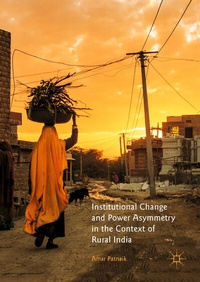
Institutional Change and Power Asymmetry in the Context of Rural India
Description

This book explains how to bring about institutional change and foster new institutional structures (institution building) by resolving power inequities in a rural ecosystem in India, and advocates the identification of an appropriate institutional champion to make this happen.
The book develops a power-asymmetry-based framework and argues that a champion with the right attributes and the 'ability' to 'convene' people over a social issue can only succeed if he/she can resolve or reduce the deep-rooted societal power asymmetries within that community. It also presents four case studies that indicate how such social change is typically spread over a long period of time.
More details
Other editions
Additional editions
Person
Amar Patnaik is currently the Principal Accountant General, West Bengal under the Comptroller and Auditor General of India. He has been in the Indian civil service (Indian Audit and Accounts Service) for the past 25 years. In addition to detailed financial audits and value-for-money evaluations of government programmes in sectors like health service delivery, water supply, consumer protection, poverty reduction and more recently on public-private partnership models for development of hydropower and minor ports and environmental protection, he has also conducted international audits of the Food and Agriculture Organization of the United Nations in Rome and in Kabul, Afghanistan and of the United Nations Peacekeeping Operations in Darfur, Sudan. He also completed a performance audit of the UN's spending on information and communication technology services across peacekeeping operations around the globe in October - November 2014.
He was the Director of the Agricultural Marketing and Co-operatives Department of Odisha, India, where he designed sustainable livelihood models for farmers through efficient and effective marketing of their produce.
Dr Patnaik has a PhD from the Xavier University, Xavier Institute of Management, Bhubaneswar, Odisha, India and a Master's programme in Public Management from Lee Kuan Yew School of Public Policy, Singapore and Kennedy School of Government, Harvard.
Content
Chapter 1 Introduction.- Chapter 2 Literature Review and Experiential Observations.- Chapter 3 Ex-ante Framework & Research Questions.- Chapter 4 Research Methodology, Design and Methods.- Chapter 5 Emerging Framework & Model.- Chapter 6 Description and Analyses of the Cases.- Case I: The Thaku Ma of Tambakhuri - Bharati Kabi.- Case II: Total sanitation success of Bahalpur - Kumari Sahoo.- Case III : Aparajita, the architect of child rights at Bolaniposi.- Case IV: Bastina banishes alcoholism from Dasingbadi.- Chapter 7 Summary and Conclusions and significance of study.- Chapter 8 Limitations of the study and Future research.
