

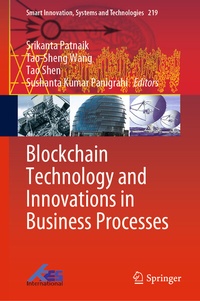
Blockchain Technology and Innovations in Business Processes
Description

This edited book provides a platform to bring together researchers, academia and industry collaborators to exchange their knowledge and work to develop better understanding about the scope of blockchain technology in business management applications of different sectors such as retail sector, supply chain and logistics, healthcare sector, manufacturing sector, judiciary, finance and government sector in terms of data quality and timeliness. The book presents original unpublished research papers on blockchain technology and business management on novel architectures, prototypes and case studies.
More details
Other editions
Additional editions
Persons
Prof. (Dr.) Srikanta Patnaik is Professor in the Department of Computer Science and Engineering, Faculty of Engineering and Technology, SOA University, Bhubaneswar, India. He has received his Ph.D. (Engineering) on Computational Intelligence from Jadavpur University, India, in 1999 and supervised 25 Ph.D. theses and more than 50 Master theses in the area of Computational Intelligence, Soft Computing Applications and Re-Engineering. Dr. Patnaik has published around 100 research papers in international journals and conference proceedings. He is the author of 2 textbooks and 35 edited volumes and few invited book chapters, published by leading international publisher like Springer-Verlag and Kluwer Academic. Dr. Patnaik was Principal Investigator of AICTE sponsored TAPTEC project "Building Cognition for Intelligent Robot" and UGC sponsored Major Research Project "Machine Learning and Perception using Cognition Methods." He is Editor-in-Chief of International Journal of Informationand Communication Technology and International Journal of Computational Vision and Robotics and also Associate Editor of International Journal of Granular Computing, Rough Sets and Intelligent Systems (IJGCRSIS) and International Journal of Telemedicine and Clinical Practices (IJTMCP), published from Inderscience Publishing House, England. Dr. Patnaik is also Editor of Journal of Information and Communication Convergence Engineering, published from Korean Institute of Information and Communication Engineering. He is also Editor-in-Chief of Book Series on "Modeling and Optimization in Science and Technology" published from Springer, Germany.
Prof. Tao-Sheng Wang is Doctor, Professor of Applied Economics (International Trade Direction), Specialist of General Office of the State Council, Director of Chinese Society of World Economy, Vice Chairman of the Expert Committee of China Association of Trade in Service and Master Tutor. He is Dean of the School of Business of HunanInternational Economics University and Chief Expert of the provincial-level social science key research base. He is also a foregoer of provincial-level key construction course "International Trade," provincial-level teaching team "International Trade" and provincial-level characteristic specialty "International Economics and Trade ." His main research areas are international economic and trade theory and policy; institutional innovation and international trade; international competitive advantage and competitive strategy.
Prof. Tao Shen is the Deputy Dean of the College of Information Engineering and Automation, Kunming University of Science and Technology. He received his Master and Ph.D. degree from Illinois Institute of Technology in USA and Bachelor's degree from the University of Electronic Science and Technology of China. He has conducted and participated in over 20 research projects, including projects supported by the National Natural Science Foundation of China, Key Project of Applied Basic Research Programs of Yunnan Province. He has published more than 60 papers indexed by SCI/EI, 1 book and received 11 national patents. His main research fields including intelligent detection and sensing, artificial intelligent, blockchain and energy internet.
Prof. (Dr.) Sushanta Kumar Panigrahi has received his Ph.D. (Engineering & Information Technology) on Artificial Intelligence & Soft Computing from Fakir Mohan University, Balasore, Odisha, India, in 2016, and supervised more than 25 Master theses in the area of Computational Intelligence, Soft Computing Applications and Re-Engineering. Dr. Panigrahi is well acclaimed for his stints in teaching at various institutions. His academic career spans over more than one decade in which he has earned the reputation of an admirable teacher in areas of Optimization, Database Management, Soft Computing and Data Science. Dr. Panigrahi has published more than 38 research papers in international journals and conference proceedings. He has attended and presented papers in a number of IEEE, Elsevier and Springer conferences. Dr. Panigrahi is also an active reviewer of a number of journals of IEEE, Elsevier, Inderscience and Springer in the discipline of Computer Science and Engineering.
