

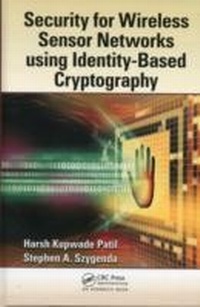
Security for Wireless Sensor Networks using Identity-Based Cryptography
1st Edition
Published on 18. October 2012
232 pages
978-1-4665-8126-5 (ISBN)
Description

Security for Wireless Sensor Networks using Identity-Based Cryptography introduces identity-based cryptographic schemes for wireless sensor networks. It starts with an exhaustive survey of the existing layered approach to WSN security-detailing its pros and cons. Next, it examines new attack vectors that exploit the layered approach to security.Aft
Reviews / Votes
" ... an excellent starting point for practitioners in the industry and students in academia faced with security issues in WSNs. It provides a comprehensive and systematic introduction to the fundamental concepts, major issues, and effective security solutions in wireless sensor networking."-IEEE Communications Magazine, October 2013"Getting the right balance of systems security is a hard enough task in traditional networking, let alone securing a wireless network composed of sensors with high resource limitations that, nonetheless, can collaborate to perform complex tasks. This book serves as an excellent starting point for practitioners in the industry and students in academia to come up to speed with security issues in wireless sensor networks."
-Vijay K. Gurbani, Ph.D., Distinguished Member of Technical Staff, Bell Laboratories, Alcatel-Lucent; Adjunct Professor, Department of Computer Science, Illinois Institute of Technology
"Strong identity mechanisms are a hard sell for today's Net because people feel that they know who they're talking to. In the Internet of Things with its focus on unfeeling machine-to-machine communications, we must replace 'feeling secure' with actually being secure. Wireless sensors are the eyes, ears, noses and cat-whiskers of the Internet of Things. Yet these sensors are connected by a network that can be subverted by hostile parties, risking that their output could be diverted or false information inserted. Given the vast number of sensors to be deployed, cryptographic identity systems may be the only manageable approach to trusting our senses."-Dean Willis, Chair, IETF SIP Working Group, 1999-2009
"... a valuable reference on IBC theory and practice that researchers and practitioners will want on their bookshelves for many years. In addition, it will certainly stimulate new directions in research in wireless network security." -Thomas M. Chen, Editor-in-Chief, IEEE Network, 2009-2011
More details
Edition
1. Auflage
Language
English
Place of publication
Philadelphia, PA
United States
Publishing group
Taylor & Francis Inc
Target group
Professional and scholarly
Engineers working on wireless sensor networks; computer scientists and cryptologists; electrical engineering students.
Product notice
Reflowable
Illustrations
57 s/w Abbildungen, 12 s/w Tabellen
57 b/w images and 12 tables
File size
1,42 MB
ISBN-13
978-1-4665-8126-5 (9781466581265)
Copyright in bibliographic data and cover images is held by Nielsen Book Services Limited or by the publishers or by their respective licensors: all rights reserved.
Schweitzer Classification
Other editions
Additional editions
Harsh Kupwade Patil | Stephen A. Szygenda
Security for Wireless Sensor Networks using Identity-Based Cryptography
Book
12/2016
1st Edition
CRC Press
€72.30
Shipment within 10-20 days
Harsh Kupwade Patil | Stephen A. Szygenda
Security for Wireless Sensor Networks using Identity-Based Cryptography
Book
10/2012
1st Edition
Taylor & Francis
€206.30
Shipment within 15-20 days
Persons
Harsh Kupwade Patil:
Dr. Harsh Kupwade Patil is a Technical Advisor in the Dallas office of Fish & Richardson P.C. His practice supports patent prosecution in a broad range of technologies, particularly in network and system security and applied cryptography. Prior to joining the firm, Dr. Kupwade Patil was involved in collaborative research work with Cisco Systems Inc., Bell Laboratories-Alcatel-Lucent, and Sipera Systems Inc. (acquired by Avaya Inc.). He holds a Master's Degree in Electrical Engineering and a Ph.D. in Applied Science from Southern Methodist University.
Stephen A. Szygenda:
Professor Szygenda is the former Dean of the School of Engineering at Southern Methodist University and The University of Alabama-Birmingham. He has held the position of Chairman of the Electrical and Computer Engineering Department at The University of Texas-Austin, where he also held the Clint Murchison Jr. Chair of Free Enterprise and was the founding Director of the Texas Center for Technology Development and Transfer. During his academic endeavors, Dr. Szygenda acquired extensive government and industry research funding, received numerous awards, consulted for more than 50 international companies and universities, served on the board of directors of a number of companies, and published more than 200 papers. He received his Ph.D. from Northwestern University.
In industry, Dr. Szygenda has served as President of SBI Inc., COMSAT General Integrated Systems, the Rubicon Group, and Comprehensive Computing Systems and Services Inc. He was also a member of the technical staff at Bell Telephone Laboratories. Dr. Szygenda is a pioneer in the areas of Simulation, CAD, Fault Tolerant Computing, Telecommunications, Software Engineering, Entrepreneurship, Strategic Planning, Technology Transfer, Business Management, and Economic Development.
Dr. Harsh Kupwade Patil is a Technical Advisor in the Dallas office of Fish & Richardson P.C. His practice supports patent prosecution in a broad range of technologies, particularly in network and system security and applied cryptography. Prior to joining the firm, Dr. Kupwade Patil was involved in collaborative research work with Cisco Systems Inc., Bell Laboratories-Alcatel-Lucent, and Sipera Systems Inc. (acquired by Avaya Inc.). He holds a Master's Degree in Electrical Engineering and a Ph.D. in Applied Science from Southern Methodist University.
Stephen A. Szygenda:
Professor Szygenda is the former Dean of the School of Engineering at Southern Methodist University and The University of Alabama-Birmingham. He has held the position of Chairman of the Electrical and Computer Engineering Department at The University of Texas-Austin, where he also held the Clint Murchison Jr. Chair of Free Enterprise and was the founding Director of the Texas Center for Technology Development and Transfer. During his academic endeavors, Dr. Szygenda acquired extensive government and industry research funding, received numerous awards, consulted for more than 50 international companies and universities, served on the board of directors of a number of companies, and published more than 200 papers. He received his Ph.D. from Northwestern University.
In industry, Dr. Szygenda has served as President of SBI Inc., COMSAT General Integrated Systems, the Rubicon Group, and Comprehensive Computing Systems and Services Inc. He was also a member of the technical staff at Bell Telephone Laboratories. Dr. Szygenda is a pioneer in the areas of Simulation, CAD, Fault Tolerant Computing, Telecommunications, Software Engineering, Entrepreneurship, Strategic Planning, Technology Transfer, Business Management, and Economic Development.
Content
Introduction to Wireless Sensor Networks. Security in Wireless Sensor Networks. Elliptic Curve Cryptography. Identity-Based Cryptography. Identity-Based Authentication and Encryption in Wireless Sensor Networks. Identity-Based Key Distribution in Wireless Sensor Networks. Routing in Wireless Sensor Networks Using Identity-Based Cryptography. Cross-Layer Security in Wireless Sensor Networks. Implementation of Elliptic Curve Cryptography in Wireless Sensor Networks. Each chapter includes a Summary and References. Appendix-For Further Reading.
