

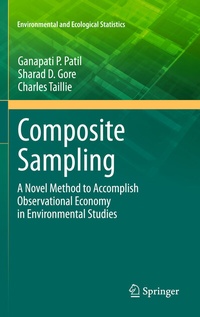
Composite Sampling
Description

Sampling consists of selection, acquisition, and quantification of a part of the population. While selection and acquisition apply to physical sampling units of the population, quantification pertains only to the variable of interest, which is a particular characteristic of the sampling units. A sampling procedure is expected to provide a sample that is representative with respect to some specified criteria. Composite sampling, under idealized conditions, incurs no loss of information for estimating the population means. But an important limitation to the method has been the loss of information on individual sample values, such as, the extremely large value. In many of the situations where individual sample values are of interest or concern, composite sampling methods can be suitably modified to retrieve the information on individual sample values that may be lost due to compositing. This book presents statistical solutions to issues that arise in the context of applications of composite sampling.
Reviews / Votes
From the reviews:
"In this monograph, the authors present the work of a 4-year initiative undertaken in the United States and discuss several previously unpublished results and applications of composite sampling in environmental studies. . the theory presented is sufficient to understand the formal analytical approaches and the solutions presented. The text . is well worth reading. . will appeal to those practitioners needing to balance the desire for statistical rigour in sampling design with the constraints of ever decreasing financial budgets with which to undertake such sampling." (Carl M. O'Brien, International Statistical Review, Vol. 80 (1), 2012)
"The book by Patil, Gore, and Taillie provides a detailed yet accessible overview of composite sampling and elaborates on the issues and tradeoffs that arise in the context of various practical applications. . will appeal to the student or the general scientific reader looking for a comprehensive overview . . The authors of this book have provided an excellent entry and addition to the literature on composite sampling." (Ramesh Natarajan, Technometrics, Vol. 54 (1), February, 2012)
More details
Other editions
Additional editions
Content
Introduction.- Classification.- Extreme Values.- Estimating Prevalence.- Bayesian Approach.- Inference on Mean and Variance.- Random Weights.- A Linear Model.- Site Characterization and Cleanup.- Spatial Structures.- Sampling of Soils and Sediments.- Sampling of Liquids and Fluids.- Indoor Air Pollution.- Bioaccumulation.- References.
