

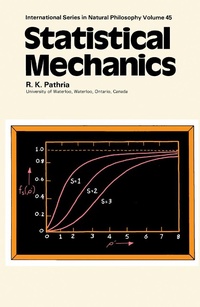
Statistical Mechanics
1st Edition
Published on 30. June 2016
544 pages
978-1-4831-0497-3 (ISBN)
Description

International Series in Natural Philosophy, Volume 45: Statistical Mechanics discusses topics relevant to explaining the physical properties of matter in bulk. The book is comprised of 13 chapters that primarily focus on the equilibrium states of physical systems. Chapter 1 discusses the statistical basis of thermodynamics, and Chapter 2 covers the elements of ensemble theory. Chapters 3 and 4 tackle the canonical and grand canonical ensemble. Chapter 5 deals with the formulation of quantum statistics, while Chapter 6 reviews the theory of simple gases. Chapters 7 and 8 discuss the ideal Bose and Fermi systems. The book also covers the cluster expansion, pseudopotential, and quantized field methods. The theory of phase transitions and fluctuations are then discussed. The text will be of great use to researchers who wants to utilize statistical mechanics in their work.
More details
Other editions
New editions
E-Book
11/2001
2nd Edition
Woodhead Publishing
€38.95
Available for download
Paul D. Beale
Statistical Mechanics
E-Book
09/1996
2nd Edition
Butterworth-Heinemann
€79.95
Available for download
Additional editions

R. K. Pathria
Statistical Mechanics
Book
09/1995
Butterworth-Heinemann
€43.33
Article exhausted; check different version
Content
PrefaceAcknowledgmentsHistorical IntroductionChapter 1. The Statistical Basis of Thermodynamics 1.1 The Macroscopic and the Microscopic Dtates 1.2 Contact between Statistics and Thermodynamics: Physical Significance of O{N, V, E) 1.3 Further Contact between Statistics and Thermodynamics 1.4 The Classical Ideal Gas 1.5 The Entropy of Mixing and the Gibbs Paradox 1.6 The "Correct" Enumeration of the Microstates ProblemsChapter 2. Elements of Ensemble Theory 2.1 Phase Space of a Classical System 2.2 Liouville's Theorem and its Consequences 2.3 The Microcanonical Ensemble 2.4 Examples 2.5 Quantum States and the Phase Space 2.6 Two Important Theorems - The "Equipartition" and the "Virial" ProblemsChapter 3. The Canonical Ensemble 3.1 Equilibrium between a System and a Heat Reservoir 3.2 A System in the Canonical Ensemble 3.3 Physical Significance of the Various Statistical Quantities 3.4 Alternative Expressions for the Partition Function 3.5 The Classical Systems 3.6 Energy Fluctuations in the Canonical Ensemble: Correspondence with the Microcanonical Ensemble 3.7 A System of Harmonic Oscillators 3.8 The Statistics of Paramagnetism 3.9 Thermodynamics of Magnetic Systems: Negative Temperatures ProblemsChapter 4. The Grand Canonical Ensemble 4.1 Equilibrium between a System and a Particle-Energy Reservoir 4.2 A system in the Grand Canonical Ensemble 4.3 Physical Significance of the Statistical Quantities 4.4 Examples 4.5 Density and Energy Fluctuations in the Grand Canonical Ensemble: Correspondence with Other Ensembles ProblemsChapter 5. Formulation of Quantum Statistics 5.1 Quantum-Mechanical Ensemble Theory: The Density Matrix 5.2 Statistics of the Various Ensembles 5.3 Examples 5.4 Systems Composed of Indistinguishable Particles 5.5 The Density Matrix and the Partition Function of a System of Free Particles ProblemsChapter 6. The Theory of Simple Gases 6.1 An Ideal Gas in a Quantum-Mechanical Microcanonical Ensemble 6.2 An Ideal Gas in Other Quantum-Mechanical Ensembles 6.3 Statistics of the Occupation Numbers 6.4 Kinetic Considerations 6.5 A Gaseous System in Mass Motion 6.6 Gaseous Systems Composed of Molecules with Internal Motion A. Monatomic Molecules B. Diatomic Molecules C. Polyatomic Molecules ProblemsChapter 7. Ideal Bose Systems 7.1 Thermodynamic Behavior of an Ideal Bose Gas 7.2 Thermodynamics of the Black-Body Radiation 7.3 The Field of Sound Waves 7.4 Inertial Density of the Sound Field 7.5 Elementary Excitations in Liquid Helium II ProblemsChapter 8. Ideal Fermi Systems 8.1 Thermodynamic Behavior of an Ideal Fermi Gas 8.2 Magnetic Behavior of an Ideal Fermi Gas A. Pauli Paramagnetism B. Landau Diamagnetism and de Haas-van Alphen Effect 8.3 The Electron Gas in Metals A. Thermionic Emission B. Photoelectric Emission 8.4 Statistical Equilibrium of White Dwarf Stars 8.5 Statistical Model of the Atom ProblemsChapter 9. Statistical Mechanics of Interacting Systems: The Method of Cluster Expansions 9.1 Cluster Expansion for a Classical Gas 9.2 Virial Expansion of the Equation of State 9.3 Evaluation of the Virial Coefficients 9.4 General Remarks on Cluster Expansions 9.5 Exact Treatment of the Second Virial Coefficient 9.6 Cluster Expansion for a Quantum-Mechanical System 9.7 The Binary Collision Method of Lee and Yang 9.8 Applications of the Binary Collision Method A. A Gas of Noninteracting Particles B. A Gas of Hard Spheres ProblemsChapter 10. Statistical Mechanics of Interacting Systems: The Method of Pseudopotentials 10.1 The Two-Body Pseudopotential 10.2 The N-body Pseudopotential and its Eigenvalues 10.3 Low-Temperature Behavior of an Imperfect Fermi Gas 10.
