

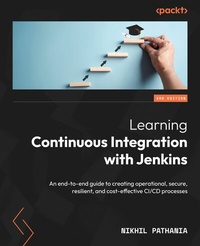
Learning Continuous Integration with Jenkins
An end-to-end guide to creating operational, secure, resilient, and cost-effective CI/CD processes
3rd Edition
Published on 21. May 2024
396 pages
978-1-83508-112-9 (ISBN)
Description

Integrate Jenkins, Kubernetes, and more on cloud into a robust, GitOps-driven CI/CD system, leveraging JCasC, IaC, and AI for a streamlined software delivery processKey Features - Follow the construction of a Jenkins CI/CD pipeline start to finish through a real-world example
- Construct a continuous deployment (CD) pipeline in Jenkins using GitOps principles and integration with Argo CD
- Craft and optimize your CI pipeline code with ChatGPT and GitHub Copilot
- Purchase of the print or Kindle book includes a free PDF eBook
Book DescriptionThis updated edition of Learning Continuous Integration with Jenkins is your one-stop guide to implementing CI/CD with Jenkins, addressing crucial technologies such as cloud computing, containerization, Infrastructure as Code, and GitOps. Tailored to both beginners and seasoned developers, the book provides a practical path to mastering a production-grade, secure, resilient, and cost-effective CI/CD setup. Starting with a detailed introduction to the fundamental principles of CI, this book systematically takes you through setting up a CI environment using Jenkins and other pivotal DevOps tools within the CI/CD ecosystem. You'll learn to write pipeline code with AI assistance and craft your own CI pipeline. With the help of hands-on tutorials, you'll gain a profound understanding of the CI process and Jenkins' robust capabilities. Additionally, the book teaches you how to expand your CI pipeline with automated testing and deployment, setting the stage for continuous deployment. To help you through the complete software delivery process, this book also covers methods to ensure that your CI/CD setup is maintainable across teams, secure, and performs optimally. By the end of the book, you'll have become an expert in implementing and optimizing CI/CD setups across diverse teams.What you will learn - Understand CI with the Golden Circle theory
- Deploy Jenkins on the cloud using Helm charts and Jenkins Configuration as Code (JCasC)
- Implement optimal security practices to ensure Jenkins operates securely
- Extend Jenkins for CI by integrating with SonarQube, GitHub, and Artifactory
- Scale Jenkins using containers and the cloud for optimal performance
- Master Jenkins declarative syntax to enrich your pipeline coding vocabulary
- Enhance security and improve pipeline code within your CI/CD process using best practices
Who this book is forThis book is for a diverse audience, from university students studying Agile software development to seasoned developers, testers, release engineers, and project managers. If you're already using Jenkins for CI, this book will assist you in elevating your projects to CD. Whether you're new to the concepts of Agile, CI, and CD, or a DevOps engineer seeking advanced insights into JCasC, IaC, and Azure, this book will equip you with the tools to harness Jenkins for improved productivity and streamlined deliveries in the cloud.
- Construct a continuous deployment (CD) pipeline in Jenkins using GitOps principles and integration with Argo CD
- Craft and optimize your CI pipeline code with ChatGPT and GitHub Copilot
- Purchase of the print or Kindle book includes a free PDF eBook
Book DescriptionThis updated edition of Learning Continuous Integration with Jenkins is your one-stop guide to implementing CI/CD with Jenkins, addressing crucial technologies such as cloud computing, containerization, Infrastructure as Code, and GitOps. Tailored to both beginners and seasoned developers, the book provides a practical path to mastering a production-grade, secure, resilient, and cost-effective CI/CD setup. Starting with a detailed introduction to the fundamental principles of CI, this book systematically takes you through setting up a CI environment using Jenkins and other pivotal DevOps tools within the CI/CD ecosystem. You'll learn to write pipeline code with AI assistance and craft your own CI pipeline. With the help of hands-on tutorials, you'll gain a profound understanding of the CI process and Jenkins' robust capabilities. Additionally, the book teaches you how to expand your CI pipeline with automated testing and deployment, setting the stage for continuous deployment. To help you through the complete software delivery process, this book also covers methods to ensure that your CI/CD setup is maintainable across teams, secure, and performs optimally. By the end of the book, you'll have become an expert in implementing and optimizing CI/CD setups across diverse teams.What you will learn - Understand CI with the Golden Circle theory
- Deploy Jenkins on the cloud using Helm charts and Jenkins Configuration as Code (JCasC)
- Implement optimal security practices to ensure Jenkins operates securely
- Extend Jenkins for CI by integrating with SonarQube, GitHub, and Artifactory
- Scale Jenkins using containers and the cloud for optimal performance
- Master Jenkins declarative syntax to enrich your pipeline coding vocabulary
- Enhance security and improve pipeline code within your CI/CD process using best practices
Who this book is forThis book is for a diverse audience, from university students studying Agile software development to seasoned developers, testers, release engineers, and project managers. If you're already using Jenkins for CI, this book will assist you in elevating your projects to CD. Whether you're new to the concepts of Agile, CI, and CD, or a DevOps engineer seeking advanced insights into JCasC, IaC, and Azure, this book will equip you with the tools to harness Jenkins for improved productivity and streamlined deliveries in the cloud.
More details
Other editions
Additional editions
Nikhil Pathania
Learning Continuous Integration with Jenkins
An end-to-end guide to creating operational, secure, resilient, and cost-effective CI/CD processes
Book
01/2024
3rd Edition
Packt Publishing
€89.10
Shipment within 3-4 weeks
Previous edition
Nikhil Pathania
Learning Continuous Integration with Jenkins.
A beginner's guide to implementing Continuous Integration and Continuous Delivery using Jenkins 2
E-Book
06/2024
2nd Edition
Packt Publishing Limited
€32.49
Available for download
Person
Pathania Nikhil :
Nikhil Pathania is a tech expert with deep knowledge in the Software Development Lifecycle (SDLC) domain. His professional identity is shaped by his specialization in Agile methodologies, DevOps practices, cloud technologies, and container solutions. His significant contributions, particularly in implementing CI/CD frameworks at multinational corporations, underline his expertise in optimizing complex software development processes. In his current role as a solutions architect at Arla Foods, Nikhil spearheads innovative projects in software development and data analytics, reflecting his keen insight into technological advancements and their practical applications.
Nikhil Pathania is a tech expert with deep knowledge in the Software Development Lifecycle (SDLC) domain. His professional identity is shaped by his specialization in Agile methodologies, DevOps practices, cloud technologies, and container solutions. His significant contributions, particularly in implementing CI/CD frameworks at multinational corporations, underline his expertise in optimizing complex software development processes. In his current role as a solutions architect at Arla Foods, Nikhil spearheads innovative projects in software development and data analytics, reflecting his keen insight into technological advancements and their practical applications.
Content
Table of Contents - The What, How, and Why of Continuous Integration
- Planning, Deploying, and Maintaining Jenkins
- Securing Jenkins
- Extending Jenkins
- Scaling Jenkins
- Enhancing Jenkins Pipeline Vocabulary
- Crafting AI-Powered Pipeline Code
- Setting the Stage for Writing Your First CI Pipeline
- Writing Your First CI pipeline
- Planning for Continuous Deployment
- Writing Your First CD Pipeline
- Enhancing Your CI/CD Pipelines
- Planning, Deploying, and Maintaining Jenkins
- Securing Jenkins
- Extending Jenkins
- Scaling Jenkins
- Enhancing Jenkins Pipeline Vocabulary
- Crafting AI-Powered Pipeline Code
- Setting the Stage for Writing Your First CI Pipeline
- Writing Your First CI pipeline
- Planning for Continuous Deployment
- Writing Your First CD Pipeline
- Enhancing Your CI/CD Pipelines
