

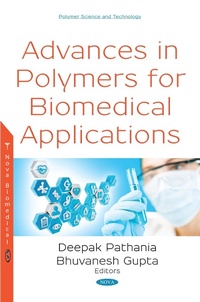
Advances in Polymers for Biomedical Applications
Published on 1. August 2018
435 pages
978-1-5361-3613-5 (ISBN)
Description

Polymers have generated considerable interest in a large number of technologically important fields such as human healthcare systems. Polymers represent a very important domain of materials and have become an integral part of day to day human life. Polymers exist in nature; they have been and continue to be an integral part of the universe. This book is intended for scientists and researchers to use in their research or in their professional practice in polymer chemistry and its biomedical applications. Multiple biological, synthetic and hybrid polymers are used for multiple medical applications. A wide range of different polymers are available, and they have the advantage to be tunable in physical, chemical and biological properties and in a wide range to match the requirements of specific applications. This book gives a brief overview about the introduction and developments of polymers for different applications. The biomedical polymers comprise not only bulk materials, but also coatings and pharmaceutical nano-carriers for drugs. The surface modification of the inorganic nanoparticles with a physically or chemically end-tethered polymer chain has been employed to overcome the problems associated with the polymers. Chemically attached polymer chains not only stabilize the inorganic nanoparticles, but also lead to photosensitivity, bioactivity, biocompatibility and pharmacological properties in the composites. Polymer encapsulated silica nanocomposites (mesoporous) have potential applications in different fields, such as optics, bio-catalysis, microelectronics bone tissue engineering, coatings cosmetics, inks, agriculture, drug release systems, diagnoses, enzyme imaging, temperature-responsive materials, and thermosensitive vehicles for cellular imaging. Polymer grafted nanosized particles are known to have excellent properties such as good dispersion ability in solvents and polymer matrices. Polymer-based controlled drug delivery systems have some specific advantages, such as improved efficiency and reduced toxicity. The incorporation of a thermoresponsive polymer layer often enhances protein absorption and specific biomolecular tagging through hydrogen bonding. As a result, the nanocomposite gets cleared from the body at a faster rate (blood residence becomes low). This book is composed of fourteen edited chapters; it is intended for scientists and researchers to use in their research or in their professional practice in polymer chemistry and its biomedical applications.
More details
Other editions
Additional editions
Deepak Pathania | Bhuvanesh Gupta
Advances in Polymers for Biomedical Applications
Book
09/2018
Nova Science Publishers Inc
€362.47
Shipment within 15-20 days
Content
- Intro
- Contents
- Preface
- Acknowledgments
- Chapter 1
- Innovative Biopolymer Nano-Multilayered Films for Biomedical Applications: Fabrication and Physical Properties
- Abstract
- 1. Introduction
- 2. Results
- 2.1. Effect of the Substrate Properties on the PEMs Deposition
- 2.1.1. Degree of Crystallinity
- 2.1.2. Corona Polarity
- 2.1.3. Substrate Porosity
- 2.2. Methods of Deposition
- 2.3. Effect of pH and Ionic Strength on the PEMs Structure
- 2.4. Physical Properties of PEMs, Swelling, Mechanical Properties
- 2.4.1. Adhesion and Surface Free Energy of PEMs
- 2.4.2. Swelling
- 2.4.3. Mechanical Properties
- 2.5. Stability of PEMs at Different Environment Conditions
- 2.5.1. Stability of PEMs at Different Ionic Strength
- 2.5.2. Stability of PEMs at Different pH
- 2.5.3. Stability of PEMs at Different Temperature
- Conclusion
- Acknowledgment
- References
- Chapter 2
- Polymer Grafted Smart Mesoporous Silica Nanoparticles: Challenges and Advances in Controlled Drug Delivery Applications
- Abstract
- 1. Introduction
- 2. Synthesis of Mesoporous Silica Nanoparticles
- 3. Surface Functionalization of Mesoporous Silica Nanoparticles
- 4. Mechanism of Cellular Uptake of MSNs
- 5. Targeting Cancer Cells
- 5.1. Passive Targeting
- 5.2. Active Targeting
- 6. Biocompatibility and Biodegradation of Mesoporous Silica Nanoparticles
- 7. Surface Functionalization of MSNs with Polymers for Drug Delivery Applications
- 7.1. Surface Functionalization of MSNs with Synthetic Polymers for Targeted Drug Delivery
- 7.2. Surface Functionalization of MSNs with Natural Polymers for Targeted Drug Delivery
- 8. Carboxymethyl Cellulose Grafted Mesoporous Silica Nanoparticles (MSN-CMC)
- 8.1. Synthesis of Mesoporous Silica Nanoparticles
- 8.2. Synthesis of Carboxymethyl (CMC) Grafted Mesoporous Silica Nanoparticles (MSNs)
- 8.3. Synthesis of Curcumin Loaded MSN-CMC
- 8.4. In Vitro Cytotoxicity Assay
- 8.5. Intracellular Uptake of MSN Particles
- 8.6. Apoptosis by Annexin V-FITC PI Staining
- Conclusion
- Acknowledgments
- References
- Chapter 3
- Biodegradable Shape Memory Polyurethane and Its Nanocomposites for Biomedical Applications
- Abstract
- 1. Introduction
- 2. Shape Memory Polyurethanes (SMPUs)
- 3. Mechanism of Generation of Thermoresponsive Shape Memory Effects in Segmented Polyurethanes
- 4. Behavior and Performance of Shape Memory POLYURETHANES (SMPUs)
- 5. Shape Memory Polyurethanes Nanocomposites
- 6. Shape Memory Polyurethanes Nanocomposites for Biomedical Applications
- Conclusion
- Acknowledgments
- Références
- Chapter 4
- Advances in Polymers for Drug Delivery and Wound Healing Applications
- Abstract
- 1. Introduction
- 2. Chitosan (CS) Drug Delivery Systems
- 3. Polylactic Acid (PLA) Drug Delivery Systems
- 4. Polyethyleneglycol (PEG) Drug Delivery Systems
- 5. Polylactic-Co-Glycolic Acid (PLGA) Drug Delivery Systems
- 6. Molecularly Imprinted Polymer (MIP) Drug Delivery Systems
- 7. Smart Polymeric Drug Delivery Systems
- 8. DFT Computations on Drug Delivery Systems
- 8.1. Delivery of Anti-Hypertensive Hydrochlorothiazide Drug Using Ethyleneglycol
- 8.1.1. Computational Methods
- 8.1.2. Results and Discussion
- 8.1.2.1. Optimization and Energies of the Structures
- 8.1.2.2. NBO Analysis
- 8.1.2.3. QTAIM Analysis
- 8.1.2.4. NQR Analysis
- 8.1.3. Summary
- 8.2. MIP Drug Delivery Systems
- 9. CS Wound Healing Materials
- 10. PLA Wound Healing Materials
- 11. PEG Wound Healing Materials
- 12. PLGA Healing Materials
- Conclusion
- Acknowledgments
- References
- Chapter 5
- Modified Biopolymers and Its Potential Significance in Targeted Drug Delivery and Disease Diagnosis
- Abstract
- Introduction
- 1.1. Polysaccharide Based Biopolymers
- 1.1.1. Functional Modification: Cross Linking
- 1.1.2. Polyion-Complex
- 2. Chitosan
- 2.1. Modified Chitosan
- 2.2. Chitosan-Based Nano Medicines for Cancer Treatment
- 3. Alginate
- 3.1. Modified Alginates
- 3.2. Hybrid Microparticles
- 3.3. Hybrid Aerogels
- 3.4. Microcapsules
- 3.5. Alginate Hydrogel: Drug Delivery Applications
- 4. Dextran
- 4.1. Dextran Conjugates for Drug Delivery
- 4.2. Dextran as Drug Carrier
- 4.3. Modified Dextran
- 4.4. Dextran as Stimuli-Responsive Drug Carriers
- 4.5. Bioresponsive Drug Delivery System
- 4.6. Dextran Based Nanoparticles
- 4.7. Modified Biopolymers in Disease Diagnosis
- 5. Hyaluronic Acid
- 5.1. Modified Hyaluronic Acid
- 5.2. Functionalized HA Derivatives /Modifications in Hyaluronic Acid
- 5.3. Functional Modifications in Hyaluronic Acid
- 5.4. Smart Nanocarrier Based on PEGylated Hyaluronic Acid for Cancer Therapy
- 6. Heparin
- 6.1. Modified Heparin
- 6.2. Heparin Based Binary Drug Delivery Systems
- 6.3. Modified Heparin in Combination Therapy
- 6.4. Heparin Conjugated Nanoparticles for Drug Delivery
- Conclusion
- Acknowledgments
- References
- Chapter 6
- Validation of Nano Bis-Demethoxy Curcumin Analog (NBDMCA) as Adjuvants for Multidrug Resistant Infections
- Abstract
- 1. Introduction
- 1.1. Multidrug Resistance
- 1.2. Phytochemicals
- 1.3. Turmeric
- 1.3.1. Curcuminoids
- 1.3.2. Bisdemethoxy Curcumin Analog
- 2. Experimental Section
- 2.1. Materials
- 2.2. Measurements
- 2.3. Methods
- 2.3.1. Preparation of NBDMCA
- 2.3.2. Characterization of NBDMCA
- 2.3.2.1. Particle Size and Zeta Potential Measurement
- 2.3.2.2. Microscopic Imaging
- 2.3.2.3. Spectral Studies
- 2.4. Antimicrobial Screening
- 2.4.1. Agar Disc Diffusion Method
- 2.4.1.1. Medium
- 2.4.1.2. Inoculum
- 2.4.1.3. Method
- 2.4.2. Resazurin Based Antibacterial Activity
- 2.4.2.1. Minimal Inhibitory Concentration
- 2.4.2.2. Inoculum Preparation
- 2.4.2.3. Preparation of Resazurin Solution
- 2.4.2.4. Method
- 2.5. Visualization of Bacteria NBDMCA Interaction
- 2.5.1. Medium
- 2.5.2. Inoculum
- 2.5.3. Method
- 3. Results and Discussion
- 3.1. Characterisation of BDMCA
- 3.2. Anti-Bacterial Activity
- 3.3. Resazurin Assay
- 3.4. Visualization of Bacteria NBDMCA Interaction
- Conclusion
- References
- Chapter 7
- Plasma Functionalisation of Polycaprolactone Surface for Biomedical Applications
- Abstract
- 1. Introduction
- 2. Applications of PCL Based Scaffolds
- 2.1. Tissue Engineering
- 2.2. Bioimmobilization
- Conclusion
- References
- Chapter 8
- Advances in Directional Delivery of DNA and siRNA
- Abstract
- Introduction
- Advances in Directional Delivery of DNA and siRNA
- DNA Directional Delivery through Polymers
- Asymmetric Polyplex-Nanocapsules Loaded with Photosensitizer for Light Assisted Gene Transfer [11]
- Chitosan Nanoparticle Based Delivery of Fused NKG2D-IL-21 Gene Suppresses Growth of Colon Cancer in Mice
- PAMAM/DNA Dendriplex Coated with Hyaluronic Acid for Efficient Targeted Gene Delivery to Tumor Cells [25]
- Phenylboronic Acid-Sugar Grafted Polymer Construct as a Dual Stimuli-Responsive Gene Carrier for Targeted Anti-Angiogenic Tumor Therapy [39]
- siRNA Directional Delivery through Polymers
- Arginine Engrafted Biodegradable Polymer for the Systemic Delivery of siRNA for Gene Therapy Purposes
- Methods for Hepatocyte Specific Delivery of siRNA
- Targeted siRNA Delivery to Prevent Nitric Oxide Mediated Cell Death after Spinal Cord Injury
- Targeted siPLK1 Delivery Using Polymerosomes to Treat Lung Cancer
- References
- Chapter 9
- Chitosan Containing Biomaterials for Tissue Engineering Applications
- Abstract
- Abbreviations
- 1. Introduction
- 2. Chitosan Activities and Properties Useful for Applications in Tissue Engineering
- 3. Chitosan-Based Products Used in Tissue Engineering
- 3.1. 3D Chitosan-Based Scaffolds
- 3.1.1. Chitosan Hydrogels
- 3.1.1.1. Chitosan Hydrogels Formed by Physical Association
- 3.1.1.2. Chitosan Coordination Complexes
- 3.1.1.3. Polyelectrolyte Complexes (PEC)
- 3.1.1.4. Chemically Crosslinked Chitosan Hydrogels
- 3.1.1.5. Applications of the Chitosan Hydrogels
- 3.1.2. Chitosan Sponges
- 3.2. 2D Chitosan Scaffolds, Used for Wound Healing
- 3.2.1. Chitosan Films
- 3.2.2. Porous Membranes from Chitosan Nanofibers
- 3.2.3. Chitosan Membranes Used for Coating of the Titanium Surfaces
- 4. Chitosan Applications in Tissue Regeneration
- 4.1. Wound Healing
- 4.1.1. Chitosan Based Systems Used for Wound Healing
- 4.1.2. Chitosan-Based Adhesives for Tissues
- 4.1.3. Effects of the Chitosan Based Products, Evidenced by In Vitro and Preclinic Studies
- 4.1.4. Effects of the Chitosan Based Products Evidenced by Clinical Studies
- 4.1.5. Chitosan Based Dressings as Devices for Drug Release for Improving the Antimicrobial Effect and the Wound Healing Rate
- 4.1.5.1. Chitosan Used For Antimicrobial Drug Carriers
- 4.1.5.2. Chitosan Systems as Carriers of Growth Factors
- 4.1.5.3. Chitosan Systems Used as Carriers of Other Drugs
- 4.1.6. Other Systems Obtained from Chitosan and Hyaluronic Acid
- 4.2. Bone Tissue Engineering
- 4.2.1. Chitosan Scaffolds in Bone Tissue Engineering
- 4.2.2. Scaffolds for Bone Tissue Based on Chitosan Hydrogels
- 4.2.3. Chitosan/CNT Composites
- 4.2.4. Chitosan Blends and Composite Scaffolds
- 4.2.4.1. Physical Blends
- 4.2.4.2. Polyelectrolyte Complexes
- 4.2.4.3. Scaffolds Based on Chitosan-Calcium Phosphate Composites
- 4.2.4.3.1. Chitosan/Hydroxyapatite Composites (CS/HAp)
- 4.2.4.3.2. Chitosan/Calcium Phosphate Composites
- 4.2.4.3.3. Coating of the Chitosan Scaffolds with Calcium Phosphate
- 4.2.4.3.4. Multicomponent Chitosan-Based Scaffolds
- Conclusion
- References
- Chapter 10
- Dressing Materials Using Herbal Drugs for Better Wound Management
- Abstract
- 1. Introduction
- 2. Classification of Wounds
- 3. Phases of Wound Healing
- 3.1. The Inflammatory Phase
- 3.2. Proliferative Phase
- 3.3. Remodeling Phase
- 4. Wound Management
- 4.1. Advancement in Wound Dressing
- 5. Herbal Drugs with Wound Healing Activities
- 5.1. Herbal Drug Loaded Wound Dressings
- Conclusion
- References
- Chapter 11
- Stimuli-Responsive Hydrogels through Gamma Radiation Induced Graft Copolymerization of Hydrophilic Monomers onto Polymeric Films: For Biomedical Applications
- Abstract
- 1. Introduction
- 1.1. Hydrogels
- 2. Classifications of Hydrogels
- 2.1. Based on Physical and Chemical Composition
- 2.1.1. Homopolymeric Hydrogels
- 2.1.2. Copolymeric Hydrogels
- 2.1.3. Interpenetrating Polymer Network (IPN) Hydrogels
- 2.2. Based on the Presence of Ionic Charges on the Monomer
- 2.2.1. Non-Ionic Hydrogels
- 2.2.2. Ionic Hydrogels
- 2.2.2.1. Anionic Hydrogels
- 2.2.2.2. Cationic Hydrogels
- 3. Polyampholytic Hydrogels
- 3.1. Based on Their Physical Nature
- 3.1.1. Hydrogels Network Structures
- 3.1.2. Amorphous Hydrogels Structures
- 3.1.3. Semicrystalline Hydrogels Structures
- 3.1.4. Hydrogen Bonded Hydrogels Structures
- 3.2. Based on Response to the Environmental Factors
- 3.2.1. pH-Sensitive Polymer
- 3.2.2. Temperature-Sensitive Polymer
- 4. Applications of Hydrogels
- 4.1. Biomedical Applications of Hydrogels
- 4.1.1. Hydrogels Useful in Drug Delivery
- 4.1.2. Transdermal Delivery
- 4.1.3. Diffusion-Controlled Delivery Systems
- 4.2. Agricultural Applications
- 4.3. Environmental Applications
- 4.4. Dye Uptake
- 4.5. Other Applications
- 5. Challenges in the Field of Hydrogels
- 5.1. Hydrogels on Polymeric Surfaces
- 5.2. Graft-Copolymerization
- 5.3. Advantages of Grafting Method
- 5.4. Radiation Induced Graft Copolymerization
- 5.4.1. Controlling Factors of Graft Copolymerization
- 6. Methods of Radiation Grafting
- 6.1. Simultaneous Radiation Grafting Method (Direct or Mutual)
- 6.2. Pre-Irradiation Method
- 6.3. Per-Oxidation Grafting Method
- 6.4. Formation of Hydroperoxides
- 7. Applications
- 8. Future Directions
- Conclusion
- References
- Chapter 12
- Therapeutic Applications of Polymeric Hydrogels
- Abstract
- 1. Hydrogels
- 1.1. History of Hydrogels
- 1.2. Classification of Polymeric Hydrogels
- 1.3. Natural Polymer Based Hydrogels
- 1.3.1. Cellulose Based Hydrogels
- 1.3.2. Chitosan Based Hydrogels
- 1.3.3. Hyaluronic Acid Hydrogels
- 1.3.4. Dextran Hydrogels
- 1.3.5. Alginate Hydrogels
- 1.4. Synthetic Polymer Based Hydrogels
- 1.4.1. Poly(ethylene glycol) (PEG) and Poly (ethylene oxide) (PEO) Hydrogels
- 1.4.2. Poloxamer Hydrogels
- 1.4.3. Poly(hydroxyethyl methacrylate) pHEMA Hydrogels
- 1.4.4. Polyacrylamide (PAAm) Hydrogels and Its Derivatives
- 1.4.5. Polyvinyl Alcohol (PVA) Hydrogels
- 2. Polymeric Hydrogels and Therapeutics
- 2.1. Hydrogels in Drug Delivery
- 2.1.1. Polymeric Hydrogels Used for Colon-Targeted Drug Delivery
- 2.1.2. Mucoadhesive Polymeric Hydrogels for Buccal, Nasal and Ocular Drug Delivery
- 2.1.3. Polymeric Hydrogels as Floating Drug Delivery System for Gastric Delivery
- 2.2. Hydrogels for Sustained Delivery
- 2.3. Polymeric Hydrogels for Tissue Engineering
- 2.4. Polymeric Hydrogels Used for the Gene Therapy
- 3. General Mechanism of Drug Release from Polymeric Hydrogel
- Conclusion
- References
- Chapter 13
- Bioinspired Materials for Diagnostic Imaging Applications
- Abstract
- Introduction
- Polymer Nanoparticles
- Block Copolymers
- Liposomes
- References
- Chapter 14
- Recent Advances in Polymeric Drug Delivery Carrier Systems
- Abstract
- 1. Introduction
- 2. Polymers Used in Drug Delivery Carrier Systems
- 3. Poymeric Drug Delivery Carrier Systems
- Polymeric Microspheres
- Polymeric Nanoparticles
- Polymeric Vesicles
- Polymeric Micelles
- Polymer Drug Conjugates
- Dendrimers
- Polymeric Gels and Hydrogels
- Capsosomes
- 4. Responsive Polymeric Drug Delivery Carrier Systems
- 4.1. Responsive Systems Based on Temperature
- 4.2. Responsive Systems Based on pH
- 4.3. Responsive Systems Based on Redox Potential
- 5. General Mechanism of Drug Release from PDDCS
- Conclusion
- References
- Chapter 15
- Value Added Wound Healing Material of Cross Linked PVA-Alginate Network
- Abstract
- 1. Introduction
- 1.1. Wound-Type and Healing
- Hemostasis
- Inflammation
- Migration
- Proliferation
- Maturation or Remodelling
- 1.2. Wound Dressing
- 1.2.1. Traditional Wound Dressing
- 1.2.2. Advanced Wound Dressings
- Hydrogels
- Hydrocolloid Dressings
- Chitosan Dressings
- 1.3. Alginate-The Signature of Seaweed's Cell Wall
- 1.4. Electrospinning Creates Nano-Platform for Wound Healing Applications
- 1.5. Electrospinning of Alginate Is a Challenging Task
- 1.6. A Renowned co-Polymer Candidate - The Poly Vinyl Alcohol (PVA)
- 1.7. Citric Acid Is a Promising Choice of Cross Linker for Alginate
- 1.8. Calcium Alginate Is Advantageous Over Sodium Alginate
- 2. Materials and Methods
- 2.1. Chemicals and Equipments
- 2.2. Preparation of Alginate-PVA Blend
- 2.3. Electrospinning
- 2.4. Physiochemical Characterization of the Fibre Web
- 2.5. Moisture Vapour Transmission Rate
- 2.6. Thermogravimetric Analysis
- 2.7. Antibacterial Activity
- 3. Results and Discussion
- 3.1. The Web Morphology
- 3.2. The FTIR Spectral Peaks
- 3.3. Thermal Degradation Behaviour of Nanofibrous Web
- 3.4. Moisture Vapour Transmission Rate
- 3.5. Antibacterial Attribute of the Cross Linked PVA-Alginate Nanoweb
- 4. Summary
- Conclusion
- References
- About the Editors
- Index
- Blank Page
