

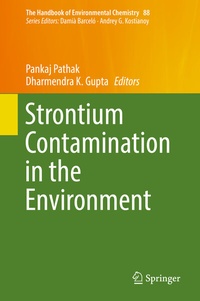
Strontium Contamination in the Environment
Description

This book provides an authoritative review of the origin and extraction of strontium and its impact on the environment. It also presents the latest strontium decontamination and remediation strategies. Around the globe, nuclear power is being recognized as a major source of energy and is expected to play a crucial role in meeting the energy requirements of present day society. However, the pros and cons have to be considered, and the safe disposal of large amounts of radionuclide wastes is becoming a matter of great concern. These wastes encompass contaminants such as heavy metals and toxic substances, which may exist in solid, liquid or gaseous forms or a combination of these, and as such, their disposal requires particular attention.
The book focuses on 90 Sr, which is a predominant isotope of strontium and considered an intermediate level radioactive waste with a half-life of 28.8 years, average biological half-life of 18 years and 546 KeV decay energy. Written by expert contributors, it addresses occurrence, detection and extraction of strontium, the chemical and nuclear properties of strontium isotopes, the fate and migration of strontium in soil, its bioaccumulation, and its associated health impact, mechanistic toxicity response as well as related regulation and remediation. It appeals to scholars, scientists and environmental managers working with strontium contamination in the environment and its consequences.
More details
Other editions
Additional editions
Persons
Dr. Pankaj Pathak is an Assistant Professor at Marwadi University Rajkot, India with a keen interest in the area of waste management and geochemistry, including sustainable handling of nuclear waste and associated environmental impacts. She has been involved in several research projects at Indian Institute of Technology (IIT) Bombay related with nuclear waste management, where she gained experience in characterizing buffer materials for nuclear waste repositories. In addition, she is also working on projects related with hazardous waste characterization, disposal and remediation techniques.
Dr. Dharmendra K. Gupta is working as a Sr. Scientist at Leibniz Universität Hannover, Germany, and his main field of research is pollution remediation of contaminated environments (radioactive materials, metal/metalloids stresses in water, soil and in plants). Within this field, he also has an interest in molecular biology, metal speciation, water, air, soil testing and treatment, plant molecular physiology, phytoremediation of radioactive materials/toxic metal ions, antioxidant enzymes in plants and in algae, protein analysis, low molecular binding peptides (phytochelatin) and related biochemical parameters and also screening, isolation of Rhizobium strains useful for revegetation of fly-ash (coal-ash) dumping sites, as well as using of saprophytic and symbiotic fungi together to revegetate radioactively contaminated sites. He also works in the field of environmental impact and assessment (EIA) of industrially polluted sites and hazardous waste material disposal. He has published more than 90 peer-reviewed research papers in respected high impact journals and 13 books with renowned international publishers, including Springer.
Content
Strontium: Source, occurrence, properties and detection.- Isotopes of strontium: Properties and applications.- Strontium extraction from the geo-environment.- Biosorption of strontium from aqueous solutions.- Plant response under strontium and phytoremediation.- Uptake, transport, and remediation of strontium.- Spatial distribution of 90 Sr in the ecosystems of Polesie State Radiation-Ecological Reserve.- Spatial distribution of 90 Sr from different sources in soils of the Urals region, Russia.- 90 Sr in the components of pine forests of Belarusian part of Chernobyl NPP exclusion zone.- Removal of strontium by physio-chemical adsorption and ion exchange methods.- Use of the sorption method for strontium removal.- Assessment of the alkaline earth metals (Ca, Sr, Ba) and their associated health impacts.
